Stringaris Argyris, Burman Charlotte, Delpech Raphaelle, Uher Rudolph, Bhudia Dayna, Miliou Despoina, Rokas Ioannis-Marios, Kyriakopoulos Marinos, Foulkes Lucy, Moreno Carmen, Cortese Samuele, Lewis Glyn, Krebs Georgina
University College London, London, UK
National and Kapodistrian University of Athens, Athens, Attica, Greece.
BMJ Ment Health. 2025 Jan 19;28(1):e301162. doi: 10.1136/bmjment-2024-301162.
Should a young person receive psychotherapy or medication for their depression and on what evidence do we base this decision? In this paper, we test the factors across modalities that may influence comparability between medication and psychotherapy trials.
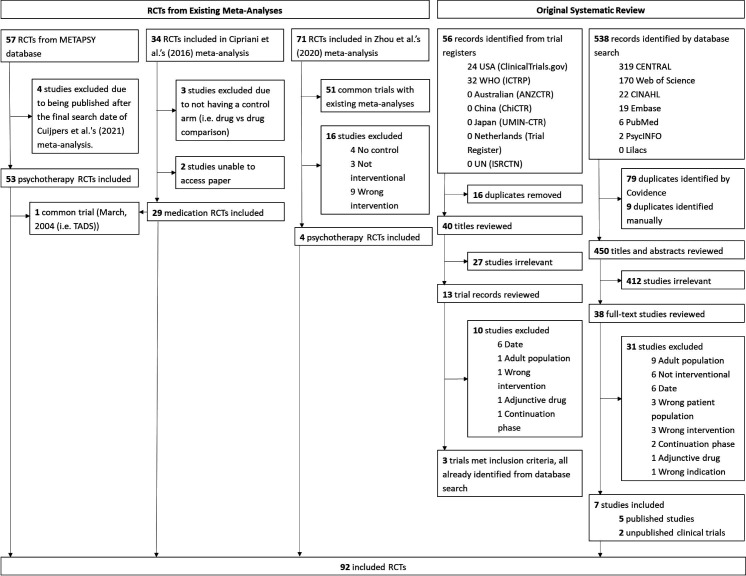
We included 92 randomised controlled trials (RCTs) of psychotherapy and medication for child and adolescent depression (mean age 4-18 years). Using meta-analyses, we compared (a) participant characteristics and (b) trial characteristics in medication and psychotherapy trials. Lastly, we examined whether psychotherapy controls are well-matched to active conditions.
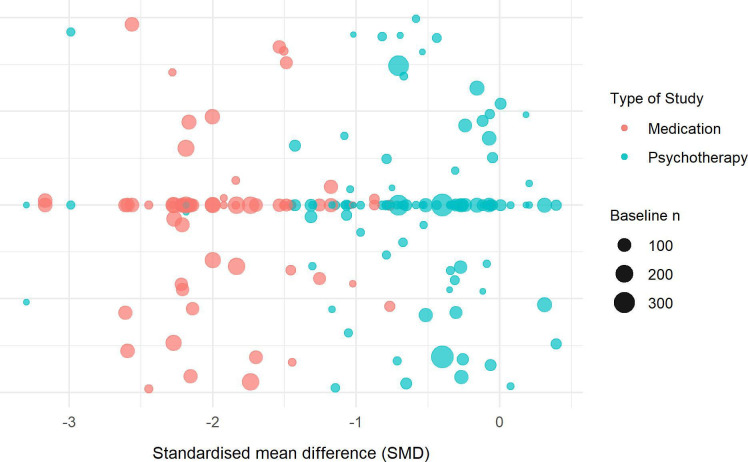
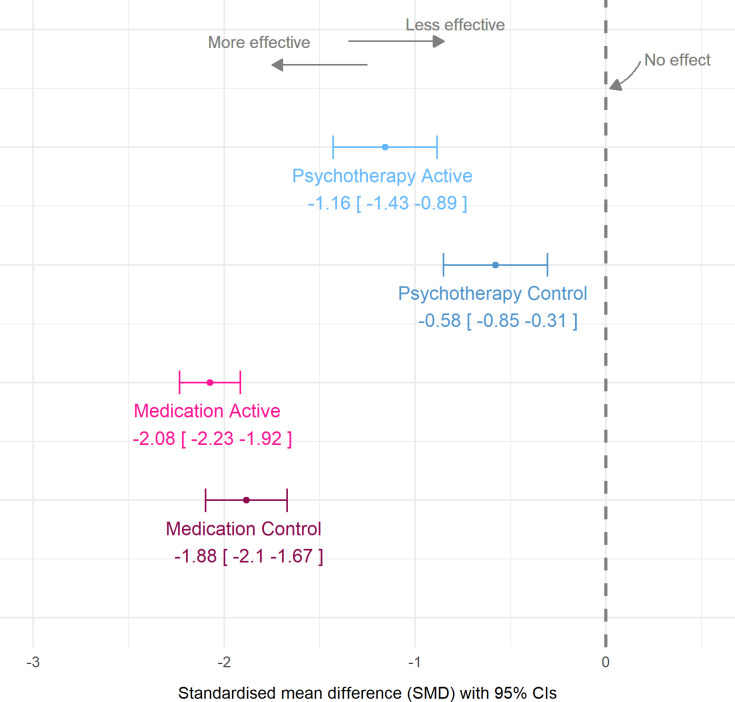
Participants in medication RCTs had higher depression severity and were more frequently male compared with psychotherapy RCTs. There was a dramatic difference in the within-subject improvement due to placebo (SMD=-1.9 (95% CI: -2.1 to -1.7)) vs. psychotherapy controls (SMD=-0.6 (95% CI: -0.9 to -0.3)). Within psychotherapy RCTs, control conditions were less intensive on average than active conditions.
Medication and psychotherapy RCTs differ on fundamental participant and methodological characteristics, thereby raising questions about their comparability. Psychotherapy controls often involve little therapist contact and are easy-to-beat comparators. These findings cast doubt on the confidence with which psychotherapy is recommended for youth depression and highlight the pressing need to improve the evidence base.
年轻人的抑郁症应该接受心理治疗还是药物治疗,我们基于什么证据做出这个决定?在本文中,我们测试了不同治疗方式下可能影响药物治疗和心理治疗试验可比性的因素。
我们纳入了92项针对儿童和青少年抑郁症(平均年龄4 - 18岁)的心理治疗和药物治疗的随机对照试验(RCT)。通过荟萃分析,我们比较了(a)药物治疗试验和心理治疗试验中的参与者特征,以及(b)试验特征。最后,我们检查了心理治疗对照组是否与积极治疗组匹配良好。
与心理治疗RCT相比,药物治疗RCT中的参与者抑郁严重程度更高,且男性更为常见。安慰剂组(标准化均数差=-1.9(95%可信区间:-2.1至-1.7))与心理治疗对照组(标准化均数差=-0.6(95%可信区间:-0.9至-0.3))在受试者内改善方面存在显著差异。在心理治疗RCT中,对照组的平均治疗强度低于积极治疗组。
药物治疗和心理治疗RCT在基本参与者和方法学特征上存在差异,从而引发了关于它们可比性的问题。心理治疗对照组通常涉及较少的治疗师接触,是易于超越的对照。这些发现对推荐心理治疗用于青少年抑郁症的信心提出了质疑,并突出了改善证据基础的迫切需求。