MacArthur Christine, Bick Debra, Salmon Victoria, Jones Ellie, Hay-Smith Jean, Bishop Jonathan, Gkini Eleni, Hemming Karla, Webb Sara, Pearson Mark, Coleman Tim, Terry Rohini, Edwards Elizabeth, Frawley Helena, Oborn Eivor, Dean Sarah
School of Health Sciences, University of Birmingham, Birmingham, UK.
Warwick Clinical Trials Unit, Warwick Medical School, University of Warwick, Coventry, UK.
BMJ Open. 2025 Jan 20;15(1):e091248. doi: 10.1136/bmjopen-2024-091248.
To assess the feasibility of an intervention of midwifery support for antenatal pelvic floor muscle exercises (PFME) to prevent postnatal urinary incontinence (UI).
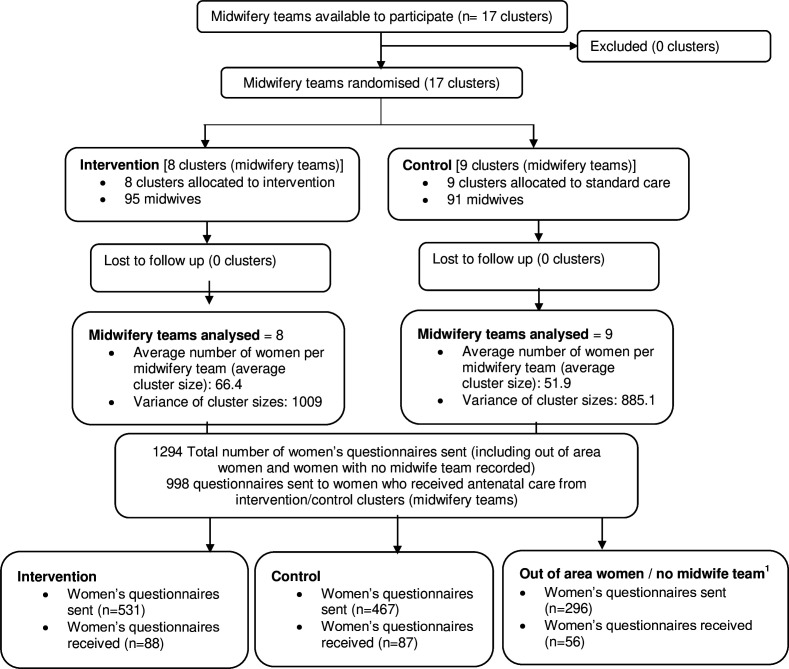
Feasibility and pilot cluster randomised controlled trial. Clusters were community midwifery teams.
Community maternity antenatal care.
One hundred seventy-five women; 186 midwives.
Midwifery training and resources for midwives and women to support antenatal PFME. Control clusters continued standard care.
Women reporting: that their midwife explained how to do PFME, PFME adherence and postpartum UI. Midwives reporting: pre-post-training PFME confidence, intervention acceptability. Fidelity of training delivery and implementation.
Ninety-five midwives in intervention clusters; 91 midwives in control clusters. Of 998 women sent questionnaires, 175 responded: 15.8% in intervention, 16.4% in control clusters. Women's characteristics in both trial arms were similar and characteristics of respondents and non-respondents were similar. Sixty-five percent (95% CI 56.9% to 72.4%) of women in intervention clusters reported their midwife explained how to do PFME vs 38% (95% CI 24.6% to 51.2%) in control clusters. Fifty percent (95% CI 24.1% to 77.1%) of women in intervention clusters vs 38% (95% CI 12.4% to 67.1%) in control clusters reported doing enough PFME to potentially prevent UI. Fourty-four percent (95% CI 32.0% to 56.1%) of women in intervention clusters reported UI vs 54% (95% CI 42.2% to 65.8%) in control clusters.Intervention training was delivered with fidelity and received positively. Midwives reported improvements in PFME confidence/knowledge (median increase of at least 1 point on a 0-4 scale for each of eight questions). Midwives (26%) most frequently reported insufficient time as an implementation barrier.
This pilot trial produced consistent new findings that training and resourcing midwives to teach and support pregnant women to undertake PFME is acceptable and feasible for women and midwives. It increased the number of women who are informed about PFME, with potential to improve PFME adherence and reduce postpartum UI. Recent changes to the National Health Service perinatal pelvic healthcare means a full trial is not possible.
ISRCTN10833250.
评估助产士支持产前盆底肌肉锻炼(PFME)以预防产后尿失禁(UI)干预措施的可行性。
可行性和试点整群随机对照试验。群组为社区助产士团队。
社区产妇产前护理。
175名女性;186名助产士。
为助产士和女性提供助产士培训及资源以支持产前PFME。对照群组继续接受标准护理。
干预群组中有95名助产士;对照群组中有91名助产士。在998名收到问卷的女性中,175人做出回应:干预组为15.8%,对照组为16.4%。两个试验组中女性的特征相似,回应者和未回应者的特征也相似。干预组中65%(95%置信区间56.9%至72.4%)的女性报告其助产士解释了如何进行PFME,而对照组中这一比例为38%(95%置信区间24.6%至51.2%)。干预组中50%(95%置信区间24.1%至77.1%)的女性与对照组中38%(95%置信区间12.4%至67.1%)的女性报告进行了足够的PFME以潜在预防UI。干预组中44%(95%置信区间32.0%至56.1%)的女性报告有UI,而对照组中这一比例为54%(95%置信区间42.2%至65.8%)。干预培训得到了忠实执行且获得了积极评价。助产士报告PFME信心/知识有所提高(八个问题中每个问题在0 - 4分制上的中位数至少增加1分)。助产士(26%)最常报告时间不足是实施障碍。
这项试点试验得出了一致的新发现,即培训助产士并为其提供资源以教导和支持孕妇进行PFME对女性和助产士来说是可接受且可行的。它增加了了解PFME的女性数量,有可能提高PFME的依从性并减少产后UI。英国国家医疗服务体系围产期盆腔保健的近期变化意味着无法进行全面试验。
ISRCTN10833250