Zhang Chen, Yu Yang, Yue Ling, Chen Yi, Chen Yixin, Liu Yang, Guo Cheng, Su Qianqian, Xiang Zuofu
College of Forestry, Central South University of Forestry and Technology, Changsha, Hunan, China.
College of Life Sciences and Technology, Central South University of Forestry and Technology, Changsha, Hunan, China.
Commun Biol. 2025 Jan 20;8(1):95. doi: 10.1038/s42003-025-07538-6.
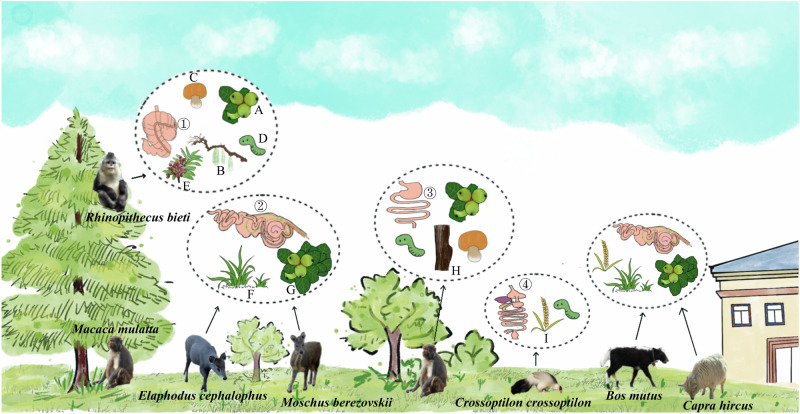
The unique environment of the Qinghai-Tibetan Plateau provides a great opportunity to study how primate intestinal microorganisms adapt to ecosystems. The 16S rRNA gene amplicon and metagenome analysis were conducted to investigate the correlation between gut microbiota in primates and other sympatric animal species living between 3600 and 4500 m asl. Results showed that within the same geographical environment, Macaca mulatta and Rhinopithecus bieti exhibited a gut microbiome composition similar to that of Tibetan people, influenced by genetic evolution of host, while significantly differing from other distantly related animals. The gut microbiota of plateau species has developed similar strategies to facilitate their hosts' adaptation to specific environments, including broadening its dietary niche and enhancing energy absorption. These findings will enhance our comprehension of the significance of primate gut microbiota in adapting to specific habitats.
青藏高原独特的环境为研究灵长类动物肠道微生物如何适应生态系统提供了绝佳机会。通过16S rRNA基因扩增子和宏基因组分析,研究了海拔3600至4500米之间生活的灵长类动物肠道微生物群与其他同域动物物种之间的相关性。结果表明,在相同的地理环境中,猕猴和滇金丝猴的肠道微生物群组成与藏族人相似,受宿主基因进化影响,而与其他亲缘关系较远的动物有显著差异。高原物种的肠道微生物群已形成类似策略,以促进其宿主适应特定环境,包括拓宽饮食生态位和增强能量吸收。这些发现将加深我们对灵长类动物肠道微生物群在适应特定栖息地方面重要性的理解。