
乐伐替尼治疗失败后,乐伐替尼联合免疫疗法与瑞戈非尼联合免疫疗法治疗晚期肝细胞癌的疗效比较:一项回顾性研究
Comparative Efficacy of Lenvatinib Plus Immunotherapy and Regorafenib Plus Immunotherapy After Lenvatinib Failure for Advanced Hepatocellular Carcinoma: A Retrospective Study.
作者信息
Yu Zeyu, Leng Bin, You Ran, Diao Lingfeng, Xu Qingyu, Yin Guowen
机构信息
Interventional Radiology Department, Jiangsu Cancer Hospital and Jiangsu Institute of Cancer Research and The Affiliated Cancer Hospital of Nanjing Medical University, Nanjing, Jiangsu, China.
出版信息
Drugs Real World Outcomes. 2025 Mar;12(1):135-143. doi: 10.1007/s40801-024-00480-9. Epub 2025 Jan 20.
BACKGROUND
The combination of regorafenib and immune checkpoint inhibitor (ICI) has been the most popular second-line systemic therapy for advanced hepatocellular carcinoma (HCC). However, considering the good anti-tumor performance of lenvatinib, combined immunotherapy on the basis of lenvatinib after first-line lenvatinib failure is also popular in clinical practice. This study aimed to compare the efficacy and safety of regorafenib plus ICI (TACE-R-I) versus lenvatinib plus ICI (TACE-L-I) in patients with advanced HCC after lenvatinib failure.
METHODS
In this single-center retrospective study, 164 patients with advanced HCC were enrolled from January 2019 to March 2024 in China. All patients were aged ≥ 18 years, clinically or pathologically diagnosed with HCC. All patients received trans-arterial chemoembolization (TACE) as local treatment. Overall survival (OS), progression-free survival (PFS), and treatment-related adverse events (TRAEs) were compared between groups. The Cox regression model was used to analyze the factors associated with OS and PFS.
RESULTS
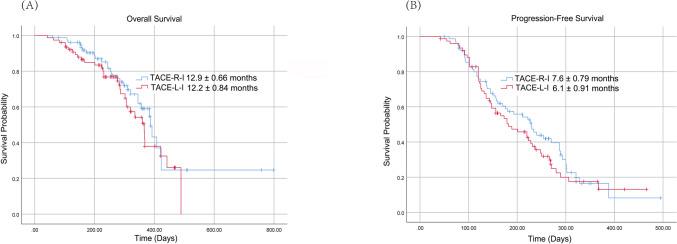
We compared 77 patients from each group after propensity score matching (PSM). There was no significant difference in the OS (p = 0.255) or PFS (p = 0.387) between groups. However, in the subgroup (distant metastases, Barcelona Clinic Liver Cancer (BCLC) stage C or tumor thrombus), the TACE-R-I group showed better survival benefit than the TACE-L-I group. The multivariable Cox regression model suggested that BCLC stage and alpha-fetoprotein (AFP) were independently associated with OS. Distant metastases, tumor thrombus and Child-Pugh were independent associated factors for PFS (p < 0.05). The frequency of grade ≥ 3 TRAEs was not significantly different between groups (p ≥ 0.05).
CONCLUSION
Our study demonstrated that in patients with greater tumor burden, the TACE-R-I group showed better OS and PFS benefits than the TACE-L-I group. However, in the overall population of HCC patients, there was no significant difference in efficacy and safety between the groups.
背景
瑞戈非尼与免疫检查点抑制剂(ICI)联合使用一直是晚期肝细胞癌(HCC)最常用的二线全身治疗方案。然而,鉴于乐伐替尼良好的抗肿瘤性能,一线乐伐替尼治疗失败后在乐伐替尼基础上联合免疫治疗在临床实践中也很常见。本研究旨在比较乐伐替尼治疗失败后的晚期HCC患者中,瑞戈非尼联合ICI(TACE-R-I)与乐伐替尼联合ICI(TACE-L-I)的疗效和安全性。
方法
在这项单中心回顾性研究中,2019年1月至2024年3月在中国纳入了164例晚期HCC患者。所有患者年龄≥18岁,经临床或病理诊断为HCC。所有患者均接受经动脉化疗栓塞术(TACE)作为局部治疗。比较两组的总生存期(OS)、无进展生存期(PFS)和治疗相关不良事件(TRAEs)。采用Cox回归模型分析与OS和PFS相关的因素。
结果
倾向评分匹配(PSM)后,我们比较了每组77例患者。两组之间的OS(p = 0.255)或PFS(p = 0.387)无显著差异。然而,在亚组(远处转移、巴塞罗那临床肝癌(BCLC)分期C期或肿瘤血栓)中,TACE-R-I组比TACE-L-I组显示出更好的生存获益。多变量Cox回归模型表明,BCLC分期和甲胎蛋白(AFP)与OS独立相关。远处转移、肿瘤血栓和Child-Pugh分级是PFS的独立相关因素(p < 0.05)。两组之间≥3级TRAEs的发生率无显著差异(p≥0.05)。
结论
我们的研究表明,在肿瘤负荷较大的患者中,TACE-R-I组比TACE-L-I组显示出更好的OS和PFS获益。然而,在HCC患者的总体人群中,两组之间的疗效和安全性无显著差异。



 Zotero 插件