Xu Yongkang, Fu Shumin, Shang Kai, Zeng Jiayu, Mao Ye
Department of Oncology, The Second Affiliated Hospital of Nanchang University, Nanchang, China.
Department of Oncology, The First Affiliated Hospital of Nanchang University, Nanchang, China.
Front Oncol. 2022 Sep 13;12:958869. doi: 10.3389/fonc.2022.958869. eCollection 2022.
Lenvatinib, regorafenib and anti-programmed cell death protein-1 (PD-1) immunotherapy have shown promising clinical outcomes in patients with advanced hepatocellular carcinoma (HCC) after sorafenib failure, respectively. However, the combination of the two treatments has not been reported. We compared the efficacy of PD-1 inhibitors with lenvatinib (PL) and PD-1 inhibitors plus regorafenib (PR) in patients with advanced HCC in this study.
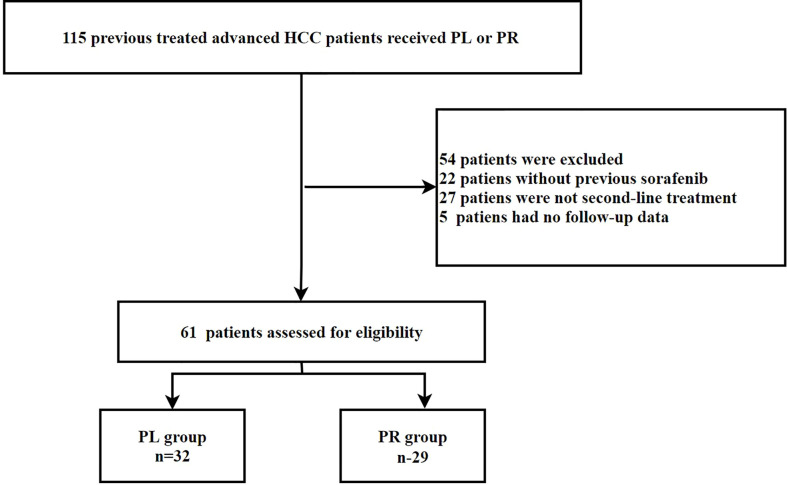
We conducted a retrospective study of advanced HCC patients who undergone PD-1 inhibitors combined with lenvatinib or regorafenib after failure of sorafenib at Second Affiliated Hospital of Nanchang University from July 2018 and December 2020. The overall survival (OS), progression-free survival (PFS), effective rates and treatment-related adverse events (TRAEs) were investigated.
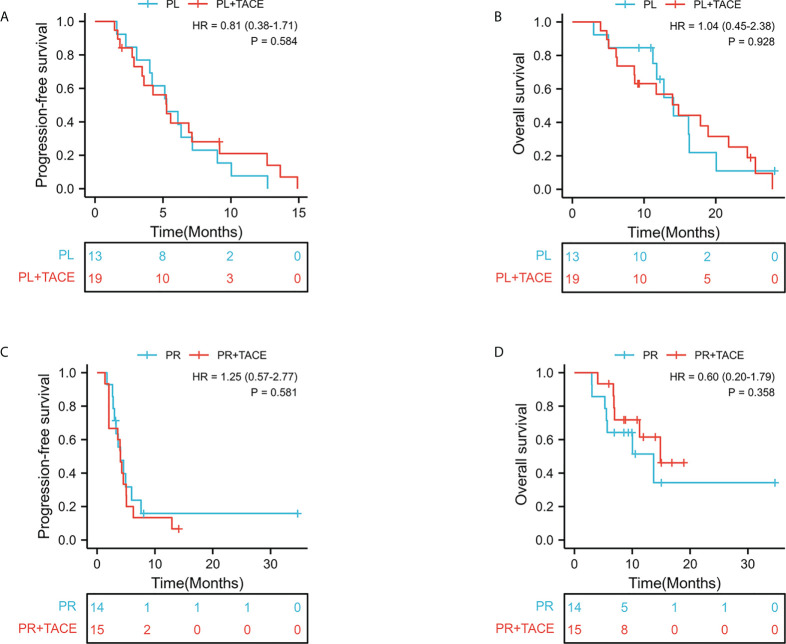
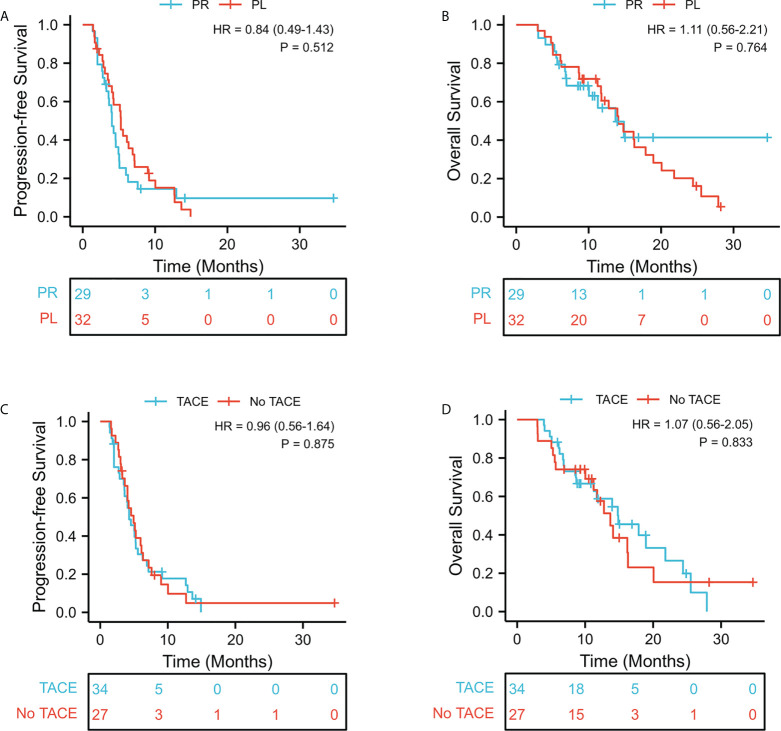
In total, 61 patients met the criteria and were included in the present study, and they were divided into the PL group (n = 32) and PR group (n = 29). The overall response rate (ORR) (12.5%vs. 10.3%, respectively; p = 0.557) and disease control rate (DCR) (71.9%vs. 58.6%, respectively; p < 0.207) were higher in the PL group than in the PR group, but there was no statistical difference.Furthermore, median PFS and OS were not significantly different between the two groups in Kaplan-Meier survival analysis (PFS: 5.3 months vs 4.0 months, p = 0.512; OS: 14.1 months vs 13.7 months, p = 0.764 for the PL group vs PR group). The most common treatment-related adverse events (TRAEs) were hand -foot skin reaction (24/61,39.3%), hypertension (20/61,32.8%) and hypothyroidism (13/61,21.3%). The frequent TRAEs (≥Grade 3) during PD-1 inhibitors plus lenvatinib or regorafenib treatment were hand-foot skin reaction (5/29,12.4%), thrombocytopenia (2/29 6.90%) and proteinuria (n =2/32,6.25%).
Combination of lenvatinib/regorafenib and PD-1 inhibitors is a promising therapy for HCC patients after sorafenib failure.
乐伐替尼、瑞戈非尼和抗程序性细胞死亡蛋白-1(PD-1)免疫疗法分别在索拉非尼治疗失败后的晚期肝细胞癌(HCC)患者中显示出了良好的临床疗效。然而,这两种治疗方法的联合应用尚未见报道。在本研究中,我们比较了PD-1抑制剂联合乐伐替尼(PL)和PD-1抑制剂联合瑞戈非尼(PR)治疗晚期HCC患者的疗效。
我们对2018年7月至2020年12月在南昌大学第二附属医院接受索拉非尼治疗失败后接受PD-1抑制剂联合乐伐替尼或瑞戈非尼治疗的晚期HCC患者进行了一项回顾性研究。研究了总生存期(OS)、无进展生存期(PFS)、有效率和治疗相关不良事件(TRAEs)。
共有61例患者符合标准并纳入本研究,他们被分为PL组(n = 32)和PR组(n = 29)。PL组的总缓解率(ORR)(分别为12.5%对10.3%;p = 0.557)和疾病控制率(DCR)(分别为71.9%对58.6%;p < 0.207)高于PR组,但无统计学差异。此外,在Kaplan-Meier生存分析中,两组的中位PFS和OS无显著差异(PFS:5.3个月对4.0个月,p = 0.512;OS:14.1个月对13.7个月,PL组对PR组,p = 0.764)。最常见的治疗相关不良事件(TRAEs)为手足皮肤反应(24/61,39.3%)、高血压(20/61,32.8%)和甲状腺功能减退(13/61,21.3%)。在PD-1抑制剂联合乐伐替尼或瑞戈非尼治疗期间频繁出现的TRAEs(≥3级)为手足皮肤反应(5/29,12.4%)、血小板减少(2/29,6.90%)和蛋白尿(n = 2/32,6.25%)。
乐伐替尼/瑞戈非尼与PD-1抑制剂联合应用是索拉非尼治疗失败后HCC患者的一种有前景的治疗方法。