Bandiera Carole, Mistry Sabuj Kanti, Harris Elizabeth, Harris Mark F, Aslani Parisa
School of Pharmacy, The University of Sydney, Sydney, Australia.
School of Population Health, University of New South Wales, Sydney, Australia.
Int J Equity Health. 2025 Jan 21;24(1):23. doi: 10.1186/s12939-025-02377-7.
Community health workers (CHWs) help bridge the cultural gap between health services and the communities they serve. CHWs work with physicians, nurses and social workers, but little is known about their collaboration with pharmacists. This scoping review aims to describe the interprofessional collaboration between CHWs and pharmacists, the types of interventions they deliver and CHWs' and pharmacists' specific roles within these interventions.
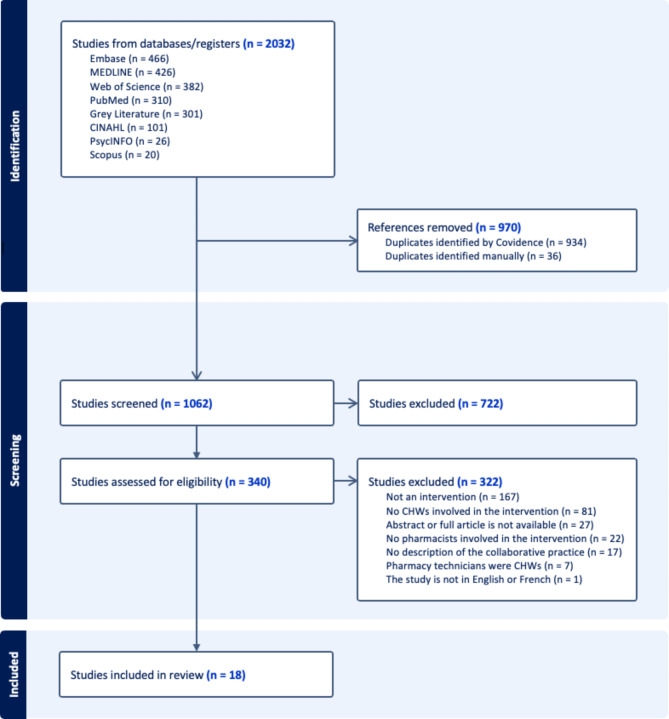
The scientific literature published in PubMed, Embase, MEDLINE, Scopus, Web of Science, PsycInfo, CINAHL and the grey literature were searched. Inclusion criteria were that the research (i) involved pharmacists and CHWs working collaboratively and (ii) included an intervention, service or program. One researcher screened all articles, and two reviewers screened 6% of articles (20/340) assessed for eligibility, using the software Covidence. After the discrepancies were resolved, data from the included articles were extracted using a customized template for data extraction and synthesized narratively.
Eighteen studies met the inclusion criteria. Most were conducted in the USA (14/18) and were published since 2020 (12/18). Most interventions involved medication reviews, support for medication adherence, disease prevention or addressing the social determinants of health. Pharmacists had primarily clinical roles (i.e., medication reconciliation and patient education), while the CHWs' roles consisted of collecting patient information, supporting patient self-management, bridging the cultural gap by translating information in the patient's language and ensuring patient follow-up. The collaborative practice occurred via interprofessional referral, ranging from the CHW facilitating the link between the patient and the pharmacist, and information sharing between the CHW and the pharmacist, to an interprofessional collaborative practice where CHWs and pharmacists delivered the intervention together.
While CHWs and pharmacists had independent roles as part of the interventions, they also collaborated at various levels to deliver services to patients. CHWs have an important role to play in bridging the cultural gap between the patient and the pharmacist, in improving patient referral so that more patients can benefit from pharmaceutical services, and in identifying patients' social determinants of health. CHWs and pharmacists can work synergistically and collaboratively to tailor an intervention to the patient's needs, which can improve and optimize pharmaceutical services, and may ultimately positively impact health outcomes.
社区卫生工作者(CHWs)有助于弥合卫生服务与其所服务社区之间的文化差距。社区卫生工作者与医生、护士和社会工作者合作,但对于他们与药剂师的合作却知之甚少。本范围综述旨在描述社区卫生工作者与药剂师之间的跨专业合作、他们提供的干预类型以及社区卫生工作者和药剂师在这些干预中的具体角色。
检索了发表在PubMed、Embase、MEDLINE、Scopus、Web of Science、PsycInfo、CINAHL上的科学文献以及灰色文献。纳入标准为研究(i)涉及药剂师和社区卫生工作者的合作,且(ii)包括一项干预、服务或项目。一名研究人员筛选了所有文章,两名评审员使用Covidence软件对6%(20/340)的文章进行了资格评估筛选。在解决差异后,使用定制的数据提取模板从纳入文章中提取数据并进行叙述性综合分析。
18项研究符合纳入标准。大多数研究在美国进行(14/18),且自2020年以来发表(12/18)。大多数干预措施包括药物审查、支持药物依从性、疾病预防或解决健康的社会决定因素。药剂师主要承担临床角色(即药物调和与患者教育),而社区卫生工作者的角色包括收集患者信息、支持患者自我管理、通过用患者的语言翻译信息来弥合文化差距以及确保患者随访。协作实践通过跨专业转诊进行,范围从社区卫生工作者促进患者与药剂师之间的联系、社区卫生工作者与药剂师之间的信息共享,到社区卫生工作者和药剂师共同提供干预的跨专业协作实践。
虽然社区卫生工作者和药剂师在干预中各自发挥独立作用,但他们也在各个层面进行合作以向患者提供服务。社区卫生工作者在弥合患者与药剂师之间的文化差距、改善患者转诊以便更多患者能够受益于药学服务以及识别患者健康的社会决定因素方面发挥着重要作用。社区卫生工作者和药剂师可以协同合作,根据患者需求定制干预措施,这可以改善和优化药学服务,并最终可能对健康结果产生积极影响。