Lapin Dmitriy, Sharma Archna, Wang Ping
Center for Immunology and Inflammation, The Feinstein Institutes for Medical Research, Manhasset, NY, 11030, USA.
Zucker School of Medicine at Hofstra/Northwell, Manhasset, NY, 11030, USA.
J Neuroinflammation. 2025 Jan 21;22(1):12. doi: 10.1186/s12974-025-03340-7.
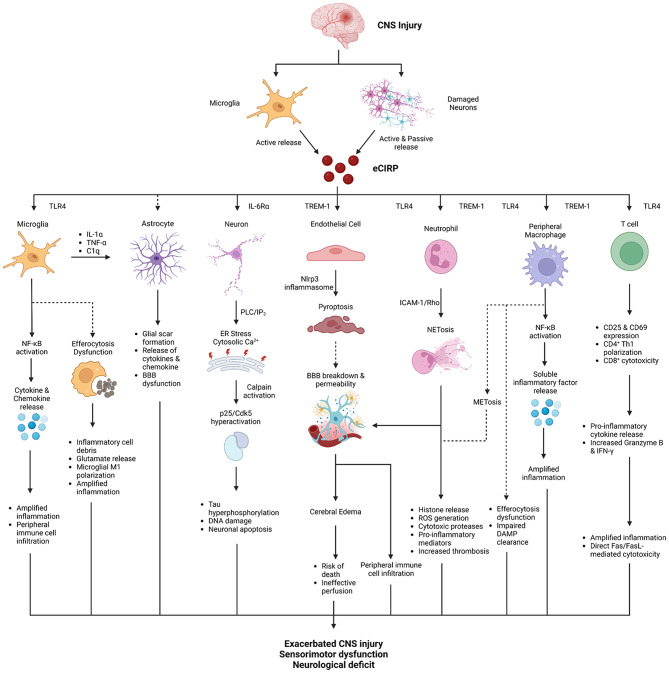
Central nervous system (CNS) injuries, such as ischemic stroke (IS), intracerebral hemorrhage (ICH) and traumatic brain injury (TBI), are a significant global burden. The complex pathophysiology of CNS injury is comprised of primary and secondary injury. Inflammatory secondary injury is incited by damage-associated molecular patterns (DAMPs) which signal a variety of resident CNS cells and infiltrating immune cells. Extracellular cold-inducible RNA-binding protein (eCIRP) is a DAMP which acts through multiple immune and non-immune cells to promote inflammation. Despite the well-established role of eCIRP in systemic and sterile inflammation, its role in CNS injury is less elucidated. Recent literature suggests that eCIRP is a pleiotropic inflammatory mediator in CNS injury. eCIRP is also being evaluated as a clinical biomarker to indicate prognosis in CNS injuries. This review provides a broad overview of CNS injury, with a focus on immune-mediated secondary injury and neuroinflammation. We then review what is known about eCIRP in CNS injury, and its known mechanisms in both CNS and non-CNS cells, identifying opportunities for further study. We also explore eCIRP's potential as a prognostic marker of CNS injury severity and outcome. Next, we provide an overview of eCIRP-targeting therapeutics and suggest strategies to develop these agents to ameliorate CNS injury. Finally, we emphasize exploring novel molecular mechanisms, aside from neuroinflammation, by which eCIRP acts as a critical mediator with significant potential as a therapeutic target and prognostic biomarker in CNS injury.
中枢神经系统(CNS)损伤,如缺血性中风(IS)、脑出血(ICH)和创伤性脑损伤(TBI),是一项重大的全球负担。CNS损伤复杂的病理生理学包括原发性损伤和继发性损伤。炎症性继发性损伤由损伤相关分子模式(DAMPs)引发,这些模式向多种中枢神经系统驻留细胞和浸润免疫细胞发出信号。细胞外冷诱导RNA结合蛋白(eCIRP)是一种DAMP,它通过多种免疫细胞和非免疫细胞发挥作用,促进炎症反应。尽管eCIRP在全身炎症和无菌性炎症中的作用已得到充分确立,但其在CNS损伤中的作用尚不清楚。最近的文献表明,eCIRP是CNS损伤中的一种多效性炎症介质。eCIRP也正在作为一种临床生物标志物进行评估,以指示CNS损伤的预后。本综述对CNS损伤进行了广泛概述,重点关注免疫介导的继发性损伤和神经炎症。然后,我们回顾了关于eCIRP在CNS损伤中的已知情况,以及其在中枢神经系统和非中枢神经系统细胞中的已知机制,确定了进一步研究的机会。我们还探讨了eCIRP作为CNS损伤严重程度和预后的预后标志物的潜力。接下来,我们概述了靶向eCIRP的治疗方法,并提出开发这些药物以改善CNS损伤的策略。最后,我们强调除了神经炎症之外,探索eCIRP作为CNS损伤中关键介质的新分子机制,其具有作为治疗靶点和预后生物标志物的巨大潜力。