Zhong Qi-Hong, Huang Jiang-Shan, Guo Fei-Long, Wu Jing-Yu, Yuan Mao-Xiu, Zhu Jia-Fu, Lin Wen-Wei, Chen Sui, Zhang Zhen-Yang, Lin Jiang-Bo
Department of Thoracic Surgery, Fujian Medical University Union Hospital, Fuzhou 350001, Fujian Province, China.
The Graduate School, Fujian Medical University, Fuzhou 350001, Fujian Province, China.
World J Gastroenterol. 2025 Jan 21;31(3):101041. doi: 10.3748/wjg.v31.i3.101041.
Minimally invasive esophagectomy (MIE) is a widely accepted treatment for esophageal cancer, yet it is associated with a significant risk of surgical adverse events (SAEs), which can compromise patient recovery and long-term survival. Accurate preoperative identification of high-risk patients is critical for improving outcomes.
To establish and validate a risk prediction and stratification model for the risk of SAEs in patients with MIE.
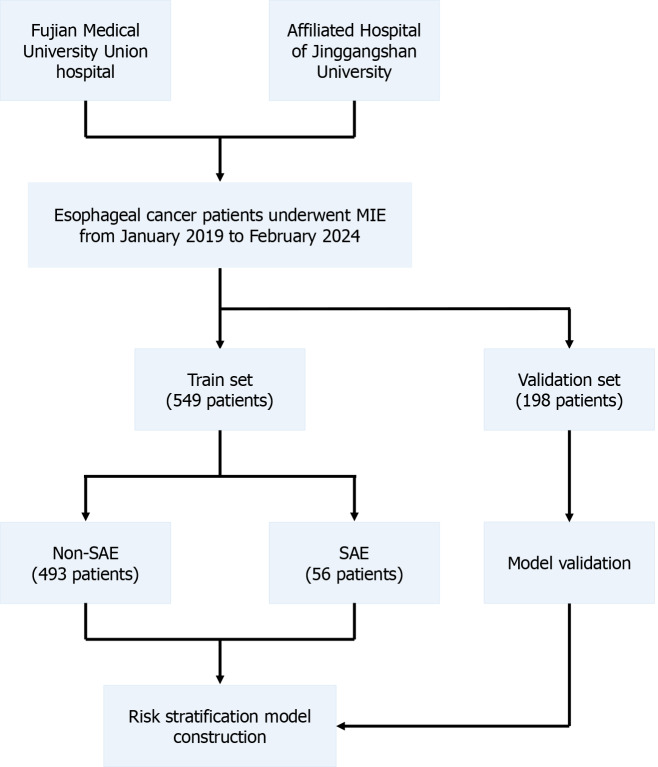
This retrospective study included 747 patients who underwent MIE at two centers from January 2019 to February 2024. Patients were separated into a train set ( = 549) and a validation set ( = 198). After screening by least absolute shrinkage and selection operator regression, multivariate logistic regression analyzed clinical and intraoperative variables to identify independent risk factors for SAEs. A risk stratification model was constructed and validated to predict the probability of SAEs.
SAEs occurred in 10.2% of patients in train set and 13.6% in the validation set. Patients with SAE had significantly higher complication rate and a longer hospital stay after surgery. The key independent risk factors identified included chronic obstructive pulmonary disease, a history of alcohol consumption, low forced expiratory volume in the first second, and low albumin levels. The stratification model has excellent prediction accuracy, with an area under the curve of 0.889 for the training set and an area under the curve of 0.793 for the validation set.
The developed risk stratification model effectively predicts the risk of SAEs in patients undergoing MIE, facilitating targeted preoperative interventions and improving perioperative management.
微创食管切除术(MIE)是一种被广泛接受的食管癌治疗方法,但它与手术不良事件(SAEs)的显著风险相关,这可能会影响患者的恢复和长期生存。准确术前识别高危患者对于改善治疗结果至关重要。
建立并验证MIE患者SAEs风险的预测和分层模型。
这项回顾性研究纳入了2019年1月至2024年2月在两个中心接受MIE的747例患者。患者被分为训练集(n = 549)和验证集(n = 198)。经过最小绝对收缩和选择算子回归筛选后,多因素逻辑回归分析临床和术中变量以确定SAEs的独立危险因素。构建并验证了一个风险分层模型以预测SAEs的概率。
训练集中10.2%的患者发生了SAEs,验证集中为13.6%。发生SAEs的患者术后并发症发生率显著更高,住院时间更长。确定的关键独立危险因素包括慢性阻塞性肺疾病、饮酒史、第一秒用力呼气量低和白蛋白水平低。分层模型具有出色的预测准确性,训练集的曲线下面积为0.889,验证集的曲线下面积为0.793。
所建立的风险分层模型能有效预测接受MIE患者的SAEs风险,有助于进行有针对性的术前干预并改善围手术期管理。