Takane-Cabrera Isamu Daniel, Ortega-Vargas Fanny Yasmin, Díaz-Torres Ilen Adriana, Herrera-González Aldo Agustin, Villa Antonio R, García-León Miguel Leonardo, Bautista-Carbajal Patricia, Pérez-Sastre Miguel A, Cortazar-Maldonado Luis Alberto, Díaz-Ramírez Jorge Baruch, Wong-Chew Rosa Maria
Infectious Diseases Research Laboratory, Research Division, Facultad de Medicina, Universidad Nacional Autónoma de México, Ciudad de México, Mexico.
Traveler's Preventive Clinic, Research Division, Facultad de Medicina, Universidad Nacional Autónoma de México, Ciudad de México, Mexico.
Front Pediatr. 2025 Jan 7;12:1440107. doi: 10.3389/fped.2024.1440107. eCollection 2024.
The study aimed to describe the characteristics and risk factors associated with disease severity across six waves of COVID-19 in the pediatric population in Mexico.
A cohort study was conducted using data from the Mexican Ministry of Health, covering the period from March 2020 to March 2023. The dataset included patients under 18 years of age with confirmed SARS-CoV-2 infection. Univariate, bivariate, and logistic regression analyses were performed to determine demographic and clinical characteristics, mortality across waves, and age group distributions.
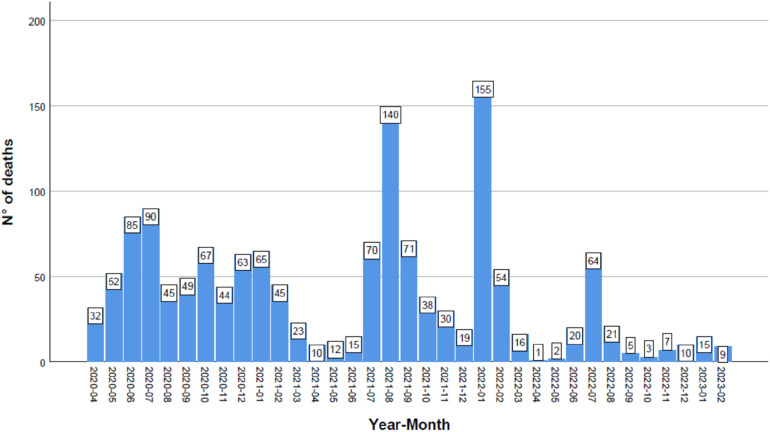
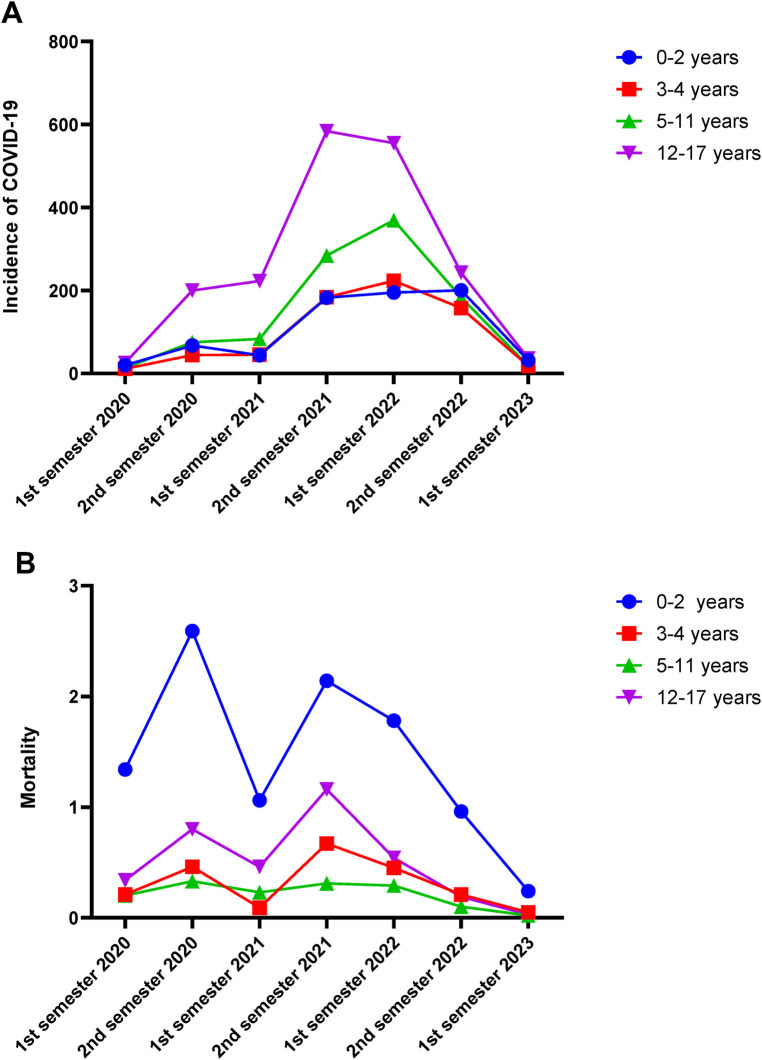
Of the total cohort, 9.5% were children, with 497,428 confirmed cases. Among these, 50% were male, 4.4% required hospitalization, and there were 1,447 (0.03%) deaths. The highest prevalence was observed in the 12-17-year age group (52%), followed by the 5-11-year age group (32%), with incidence rates peaking towards the end of 2021 and the early 2022. Although the 0-2-year age group represented 9.6% of cases, it had higher hospitalization (40%), ICU admission (58%), and case fatality rate (CFR) (44%). Cardiovascular disease, hypertension, diabetes and immunosuppression were identified as risk factors for severe outcomes. The initial wave displayed the highest CFR (OR 5.28) especially in children aged 0-2 years.
Children were less affected during the pandemic compared to adults; however, children under two years-old experienced more severe outcomes. Currently, with 95% of the population estimated to be immune due to vaccination and/or prior infection, children under 2 years of age are now at higher risk of severe disease and should be evaluated for vaccination as a public health policy.
本研究旨在描述墨西哥儿科人群中六波新冠疫情期间疾病严重程度的特征及相关风险因素。
采用墨西哥卫生部的数据进行队列研究,涵盖2020年3月至2023年3月期间。数据集包括确诊感染SARS-CoV-2的18岁以下患者。进行单因素、双因素和逻辑回归分析,以确定人口统计学和临床特征、各波疫情期间的死亡率以及年龄组分布。
在整个队列中,9.5%为儿童,确诊病例达497,428例。其中,50%为男性,4.4%需要住院治疗,有1447例(0.03%)死亡。12 - 17岁年龄组患病率最高(52%),其次是5 - 11岁年龄组(32%),发病率在2021年底和2022年初达到峰值。尽管0 - 2岁年龄组病例占9.6%,但其住院率(40%)、重症监护病房(ICU)入住率(58%)和病死率(CFR)(44%)更高。心血管疾病、高血压、糖尿病和免疫抑制被确定为严重后果的风险因素。第一波疫情显示出最高的病死率(OR 5.28),尤其是在0 - 2岁的儿童中。
与成年人相比,儿童在疫情期间受影响较小;然而,两岁以下儿童的病情更为严重。目前,估计95%的人口因接种疫苗和/或既往感染而具有免疫力,两岁以下儿童现在患重病的风险更高,应作为一项公共卫生政策对其进行疫苗接种评估。