Mou Hong, Zhang Jun, Guo Yichuan, Xu Liangzhi, Luo Xiaoyan
Department of Medical Genetics/Prenatal Diagnostic Center, West China Second University Hospital, Sichuan University, Chengdu, China.
Key Laboratory of Birth Defects and Related Diseases of Women and Children, Sichuan University, Ministry of Education, Chengdu, P.R. China.
Sci Rep. 2025 Jan 22;15(1):2814. doi: 10.1038/s41598-025-86613-8.
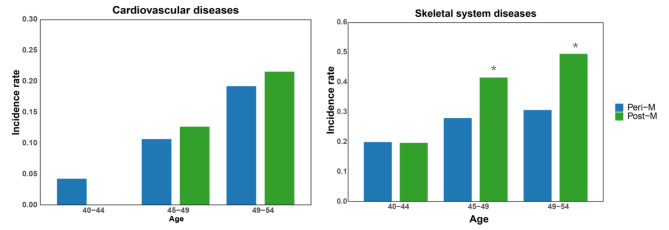
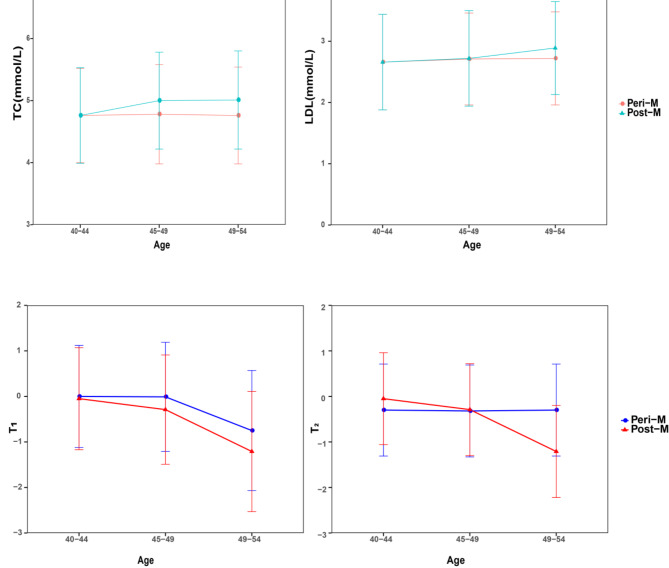
The essential cause of menopause is ovarian failure, which can cause decline in sex hormones (especially estrogen) that can increase the risk of metabolic diseases, such as cardiovascular disease and osteoporosis. This study screened 1511 eligible patients from 2148 perimenopausal and postmenopausal women, measuring various physiological and biochemical indicators to analyze differences among age groups (40-44, 45-49, and 50-54 years) with laboratory techniques. The study found no significant difference in the incidence of cardiovascular disease betweenperimenopausal and postmenopausal women. But the incidence of osteoporosis was higher in postmenopausal women and was associated with age (p < 0.05). Additionally, follicle-stimulating hormone (FSH), luteinizing hormone (LH), estradiol (E), total cholesterol (TC), lumbar spine bone mineral density (BMD) (T1), right femoral BMD (T2) and femoral neck BMD were significantly correlated in both groups. Significant differences were observed in FSH, LH, E, TC, low-density lipoprotein (LDL), L2-L4, T, femoral neck reduction and T among women in different age groups. Correlation analysis indicated that age increased the risk of cardiovascular disease and osteoporosis in bothperimenopausal and postmenopausal women. This study contributes to a deeper understanding of the pathogenesis of cardiovascular disease and osteoporosis in perimenopausal and menopausal women.
更年期的根本原因是卵巢功能衰竭,这会导致性激素(尤其是雌激素)水平下降,进而增加患代谢性疾病的风险,如心血管疾病和骨质疏松症。本研究从2148名围绝经期和绝经后女性中筛选出1511名符合条件的患者,采用实验室技术测量各种生理和生化指标,以分析不同年龄组(40 - 44岁、45 - 49岁和50 - 54岁)之间的差异。研究发现,围绝经期和绝经后女性心血管疾病的发病率没有显著差异。但绝经后女性骨质疏松症的发病率较高,且与年龄相关(p < 0.05)。此外,两组患者的促卵泡生成素(FSH)、促黄体生成素(LH)、雌二醇(E)、总胆固醇(TC)、腰椎骨密度(BMD)(T1)、右股骨BMD(T2)和股骨颈BMD均显著相关。不同年龄组女性在FSH、LH、E、TC、低密度脂蛋白(LDL)、L2 - L4、T、股骨颈缩小和T方面存在显著差异。相关性分析表明,年龄增加了围绝经期和绝经后女性患心血管疾病和骨质疏松症的风险。本研究有助于更深入地了解围绝经期和绝经后女性心血管疾病和骨质疏松症的发病机制。