Kpirikai Abraham Y, Ofosu Belinda A, Okai Josie N A, Kornu Victor, Kassim Abdul Rashid, Donkor Esther, Malm Frederica, Ahmed Osumanu, Sakyi Mona-Liza E, Saiid Samirah, Kudakpo Albert Yao, Mensah Charles, Dzabeng Francis, Morang'a Collins, Awandare Gordon A, Aniweh Yaw, Amenga-Etego Lucas N
West African Centre for Cell Biology of Infectious Pathogens, Accra University of Ghana, Volta Rd, Accra, Ghana.
Department of Biochemistry, Cell and Molecular Biology, University of Ghana, P. O. Box LG 54, Accra, Ghana.
Malar J. 2025 Jan 22;24(1):23. doi: 10.1186/s12936-025-05263-3.
Malaria remains a leading cause of death worldwide, claiming over 600,000 lives each year. Over 90% of these deaths, mostly among children under 5 years, occur in sub-Saharan Africa and are caused by Plasmodium falciparum. The merozoites stage of the parasite, crucial for asexual development invade erythrocytes through ligand-receptor interactions. Erythrocyte binding antigen (EBA)-175 is one of the key ligands facilitating invasion via interaction with glycoprotein A (GpA) receptors on the erythrocytes. EBA-175 is known to exist in two dimorphic allelic (F and C) forms with each found to infer different virulence. There is paucity of data on the prevalence of these alleles and their epidemiology in the Ghanaian malaria landscape and hence this study.
Parasite gDNA was extracted from archived Dried Blood Spots (DBS) prepared from 700 confirmed malaria-infected individuals and analysed for P. falciparum EBA-175 dimorphism. Selective eba-175 gene amplification via nested PCR and allele scoring using agarose gel electrophoresis for F, C and F/C alleles.
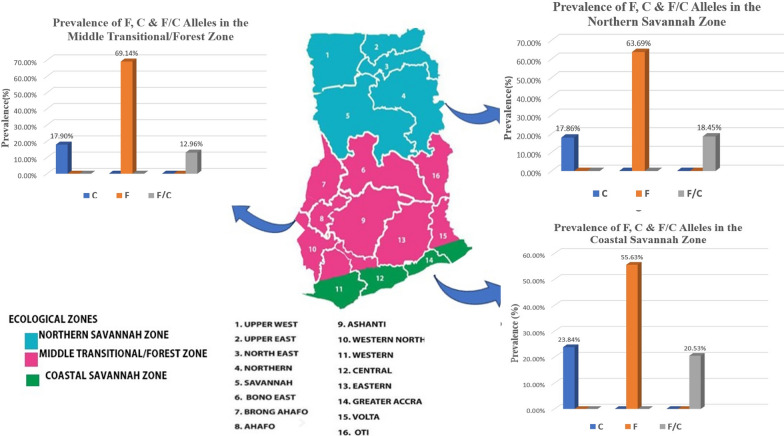
Of the total 632 successfully genotyped samples, prevalence of F, C, and F/C allelic forms were 61.2% (n = 387), 20.7% (n = 131), and 18.0% (n = 114), respectively. Seasonality analysis did not reveal a statistically significant difference in the prevalence of dimorphic forms between the wet (n = 475) and dry (n = 157) seasons (p = 0.051). The prevalence ratio (wet/dry) for C, F and F/C were determined to be 1.0, 1.1 and 1.4, respectively. Between 2019 and 2022, the prevalence of the alleles changed significantly (χ = 6.5427, p = 0.03). Geometric mean parasite density for the C, F, and F/C alleles were 21,477.1 [95%CI 15,749.2 - 29,288.1], 18,308.0 [95%CI 15,149.9-22,124.5] and 22,690.4[95% CI 16,891.9-30,479.2], respectively.
The F-allele was the most prevalent form across all age groups, followed by the C allele and mixed F/C alleles. No significant difference in allele prevalence was observed between the high malaria season (wet) and low malaria season (dry). However, a statistically significant difference in the temporal prevalence of pure alleles (F & C) between two time points was observed. The current study adds to the existing body of knowledge on eba-175 allelic dimorphism and highlights the co-circulation of alleles in high malaria endemic areas in Ghana.
疟疾仍然是全球主要的死亡原因,每年导致超过60万人死亡。其中超过90%的死亡病例,主要是5岁以下儿童,发生在撒哈拉以南非洲,由恶性疟原虫引起。疟原虫的裂殖子阶段对于无性发育至关重要,它通过配体-受体相互作用侵入红细胞。红细胞结合抗原(EBA)-175是通过与红细胞上的糖蛋白A(GpA)受体相互作用促进侵入的关键配体之一。已知EBA-175以两种二态等位基因(F和C)形式存在,每种形式都具有不同的毒力。关于这些等位基因在加纳疟疾环境中的流行情况及其流行病学的数据很少,因此开展了本研究。
从700名确诊的疟疾感染个体制备的存档干血斑(DBS)中提取寄生虫基因组DNA,并分析恶性疟原虫EBA-175的二态性。通过巢式PCR进行选择性eba-175基因扩增,并使用琼脂糖凝胶电泳对F、C和F/C等位基因进行等位基因评分。
在总共632个成功进行基因分型的样本中,F、C和F/C等位基因形式的流行率分别为61.2%(n = 387)、20.7%(n = 131)和18.0%(n = 114)。季节性分析未发现雨季(n = 475)和旱季(n = 157)之间二态形式流行率的统计学显著差异(p = 0.051)。C、F和F/C的流行率比值(雨季/旱季)分别确定为1.0、1.1和1.4。在2019年至2022年期间,等位基因的流行率发生了显著变化(χ = 6.5427,p = 0.03)。C、F和F/C等位基因的几何平均寄生虫密度分别为21,477.1 [95%置信区间15,749.2 - 29,288.1]、18,308.0 [95%置信区间15,149.9 - 22,124.5]和22,690.4[95%置信区间16,891.9 - 30,479.2]。
F等位基因是所有年龄组中最普遍的形式,其次是C等位基因和混合的F/C等位基因。在高疟疾季节(雨季)和低疟疾季节(旱季)之间未观察到等位基因流行率的显著差异。然而,在两个时间点之间观察到纯合等位基因(F和C)的时间流行率存在统计学显著差异。本研究增加了关于eba-175等位基因二态性的现有知识,并突出了加纳高疟疾流行地区等位基因的共同传播。