Prigent Arnaud, Texereau Joëlle, Bailly Sébastien, Gervais Renaud, Serandour Anne-Laure, Luraine Régis, Pépin Jean Louis
Groupe Medical de Pneumologie, Polyclinique Saint-Laurent, Rennes, France.
Centre du sommeil, Polyclinique Saint-Laurent, Rennes, France.
Respir Res. 2025 Jan 22;26(1):31. doi: 10.1186/s12931-025-03109-9.
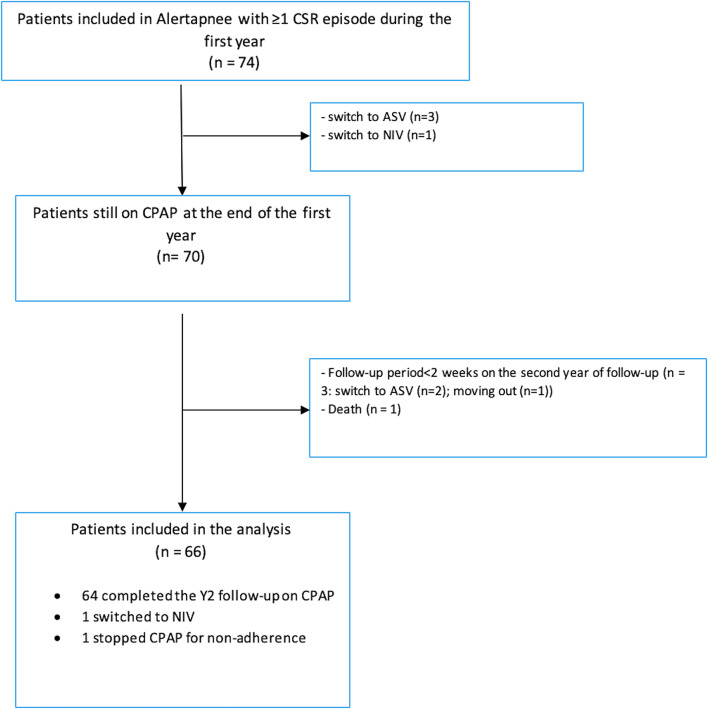
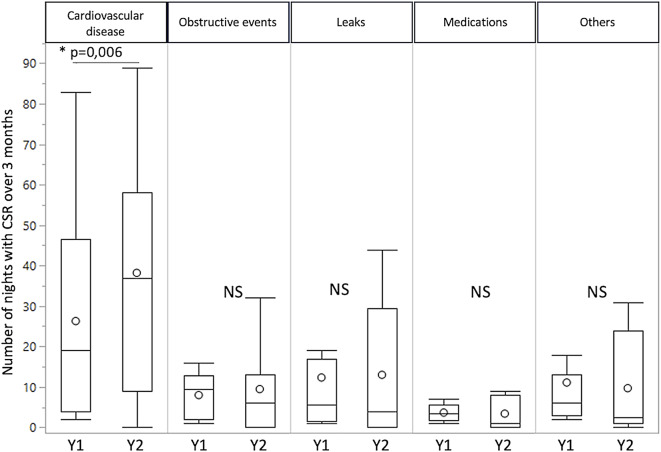
The Alertapnée study followed 555 adults with obstructive sleep apnea treated with CPAP and found that the occurrence of Cheyne-Stokes respiration (CSR) was linked to a 14-fold increase in the risk of significant cardiac events (SCE) after one year. However, the progression and clinical significance of CSR episodes over time remain unclear. This ancillary study aimed to assess CSR progression and clinical outcomes during a second year of follow-up in 66 patients who had experienced at least one CSR episode in the first year. The study focused on the number of nights with CSR, percentage of CSR, SCEs. Results showed that 62 of 66 patients with CSR in the first year also experienced CSR in the second year, with a significant increase in the median number of CSR nights, particularly when CSR was related to cardiovascular conditions (37 vs. 19 nights, p = 0.006). Patients who experienced a SCE in year 2 had significantly more nights with CSR (median 48/90nights; IQR = 35) and a significantly greater mean percentage of CSR (median 13.8%; interquartile range (IQR) = 13.7) as compared with patients free of SCE (median 9.5/90 nights IQR = 27.8 (p = 0.012); 6.1% IQR = 4.5 (p = 0.008), respectively). In conclusion, CSR occurrence and severity depend on the underlying condition. CSR related to cardiovascular aetiology increases over time and is associated with SCEs, whereas CSR linked to non-cardiovascular conditions does not indicate a poor prognosis. Identifying CSR patterns related to cardiovascular aetiologies could enable early detection of SCEs through telemonitoring in CPAP-treated patients.
“警觉性呼吸暂停”研究跟踪了555名接受持续气道正压通气(CPAP)治疗的阻塞性睡眠呼吸暂停成年患者,发现一年后,潮式呼吸(CSR)的发生与严重心脏事件(SCE)风险增加14倍有关。然而,随着时间推移,CSR发作的进展和临床意义仍不明确。这项辅助研究旨在评估66名在第一年至少经历过一次CSR发作的患者在第二年随访期间的CSR进展和临床结果。该研究重点关注出现CSR的夜晚数量、CSR百分比以及SCE情况。结果显示,第一年有CSR的66名患者中,62名在第二年也出现了CSR,CSR夜晚的中位数显著增加,尤其是当CSR与心血管疾病相关时(37晚对19晚,p = 0.006)。与未发生SCE的患者相比,第二年发生SCE的患者有CSR的夜晚显著更多(中位数48/90晚;四分位间距(IQR)= 35),且CSR的平均百分比显著更高(中位数13.8%;四分位间距(IQR)= 13.7)(分别为中位数9.5/90晚,IQR = 27.8(p = 0.012);6.1%,IQR = 4.5(p = 0.008))。总之,CSR的发生和严重程度取决于潜在病情。与心血管病因相关的CSR会随时间增加,并与SCE相关,而与非心血管疾病相关的CSR并不预示预后不良。识别与心血管病因相关的CSR模式可通过对接受CPAP治疗的患者进行远程监测来实现SCE的早期检测。