Emergency & Critical Care Center, Beijing Anzhen Hospital, Capital Medical University, 2 Anzhen Road, Chaoyang District, Beijing, 100029, China.
Cardiovascular Center, Beijing Tongren Hospital, Capital Medical University, Beijing, China.
Respir Res. 2018 Apr 10;19(1):61. doi: 10.1186/s12931-018-0761-8.
Obstructive sleep apnea (OSA) is highly prevalent in patients with coronary artery disease (CAD) and is associated with recurrent cardiovascular risk. However, whether treatment with continuous positive airway pressure (CPAP) reduces this risk remains unclear. We performed a systematic review and meta-analysis to assess the effect of CPAP on long-term cardiovascular outcomes in patients with concomitant CAD and OSA.
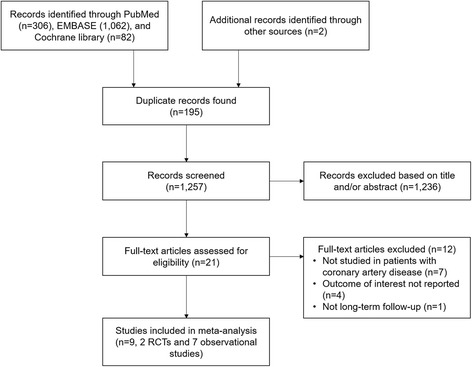
We searched the PubMed, EMBASE, and Cochrane library from their inceptions to October 7, 2017. We included observational studies and randomized controlled trials (RCTs) that described the association of CPAP treatment with cardiovascular events in patients with CAD and OSA. The primary outcome of interest was major adverse cardiovascular event (MACE), including all-cause or cardiovascular death, myocardial infarction, stroke, repeat revascularization, or hospitalization for heart failure. Outcomes data were pooled using random effects models and heterogeneity assessed with the I statistic.
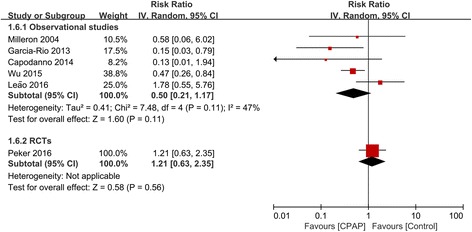
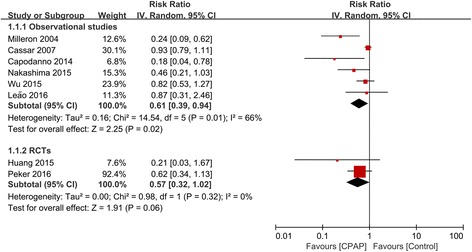
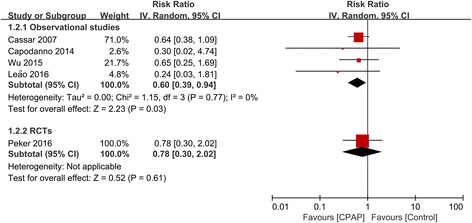
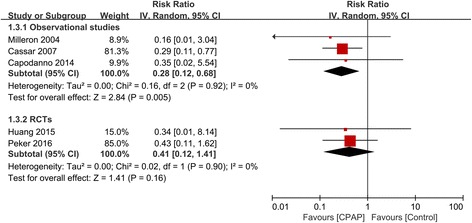
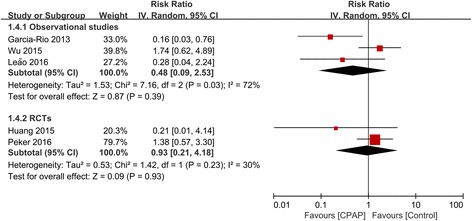
We identified 9 studies (2 RCTs and 7 observational studies) with 1430 participants. The median follow-up duration was from 36 to 86.5 months. Treatment with CPAP was associated with a significantly lower risk of MACE in 6 observational studies (RR 0.61, 95% CI: 0.39-0.94, P = 0.02), but this was not reproduced in 2 RCTs (RR 0.57, 95% CI: 0.32-1.02, P = 0.06). Similarly, CPAP significantly reduced the risk of all-cause death (4 observational studies) and cardiovascular death (3 observational studies), which were also not confirmed in RCTs.
The use of CPAP in patients with CAD and OSA might prevent subsequent cardiovascular events, which was only demonstrated in observational studies, but not in RCTs. The value of CPAP therapy as second prevention for CAD needs further investigation.
阻塞性睡眠呼吸暂停(OSA)在患有冠状动脉疾病(CAD)的患者中非常普遍,并且与复发性心血管风险相关。然而,持续气道正压通气(CPAP)治疗是否降低这种风险尚不清楚。我们进行了一项系统评价和荟萃分析,以评估 CPAP 对伴有 CAD 和 OSA 的患者的长期心血管结局的影响。
我们从建立到 2017 年 10 月 7 日在 PubMed、EMBASE 和 Cochrane 图书馆中进行了搜索。我们纳入了描述 CPAP 治疗与 CAD 和 OSA 患者心血管事件之间关联的观察性研究和随机对照试验(RCT)。主要观察终点是主要不良心血管事件(MACE),包括全因或心血管死亡、心肌梗死、卒中和再次血运重建或心力衰竭住院。使用随机效应模型汇总结局数据,并使用 I ²统计评估异质性。
我们确定了 9 项研究(2 项 RCT 和 7 项观察性研究),共 1430 名参与者。中位随访时间为 36 至 86.5 个月。6 项观察性研究显示 CPAP 治疗与 MACE 风险显著降低相关(RR 0.61,95%CI:0.39-0.94,P=0.02),但 2 项 RCT 未重现这一结果(RR 0.57,95%CI:0.32-1.02,P=0.06)。同样,CPAP 显著降低全因死亡(4 项观察性研究)和心血管死亡(3 项观察性研究)的风险,这在 RCT 中也没有得到证实。
在伴有 CAD 和 OSA 的患者中使用 CPAP 可能预防随后的心血管事件,这仅在观察性研究中得到证实,但在 RCT 中未得到证实。CPAP 治疗作为 CAD 二级预防的价值需要进一步研究。