Shimayama Chihiro, Fujihara Kazuya, Khin Laymon, Takizawa Hiroki, Horikawa Chika, Sato Takaaki, Kitazawa Masaru, Matsubayashi Yasuhiro, Yamada Takaho, Sone Hirohito
Department of Hematology, Endocrinology and Metabolism, Niigata University Faculty of Medicine, 1-757 Asahimachi-dori, Chuo Ward, Niigata, 951-8510, Japan.
Kowa Company, Ltd., Tokyo, Japan.
Cardiovasc Diabetol. 2025 Jan 22;24(1):37. doi: 10.1186/s12933-025-02578-y.
Previous studies demonstrated that diabetes remission can occur during intensive intervention and in real-world settings. However, the impact of diabetes remission in real-world settings on the incidence of cardiovascular disease (CVD) remains unclear.
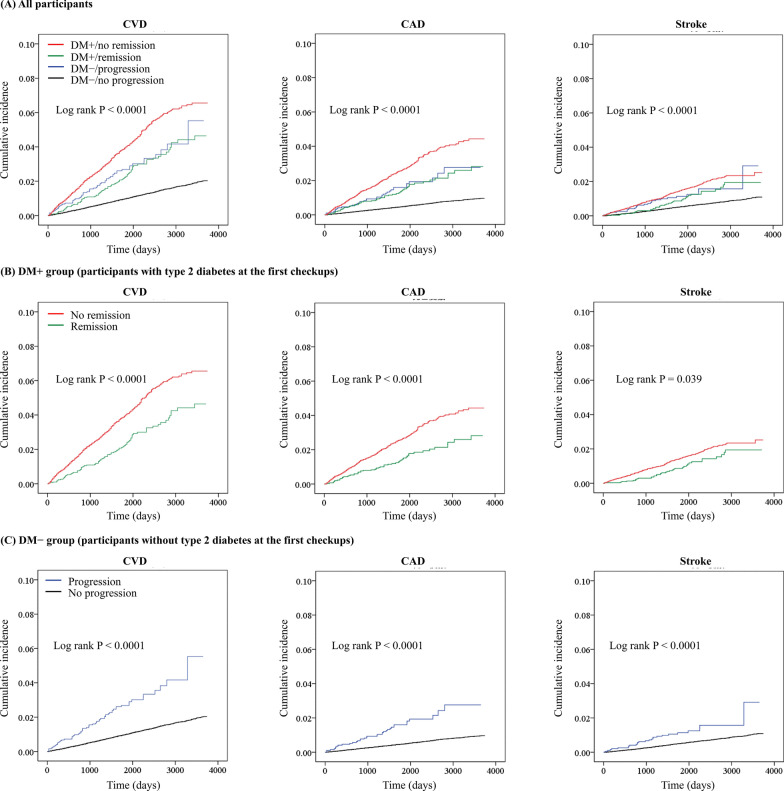
This retrospective cohort study included 299,967 individuals aged 20-72 years who underwent multiple checkups between 2008 and 2020 and completed ≥ 3 years of follow-up. Patients were divided into four groups according to changes in glycated hemoglobin levels and the use of diabetes medications during the 1-year baseline period: diabetes mellitus (DM)+/no remission, DM+/remission, DM-/no progression, and DM-/progression. The risk of CVD was evaluated using multivariable Cox regression analysis.
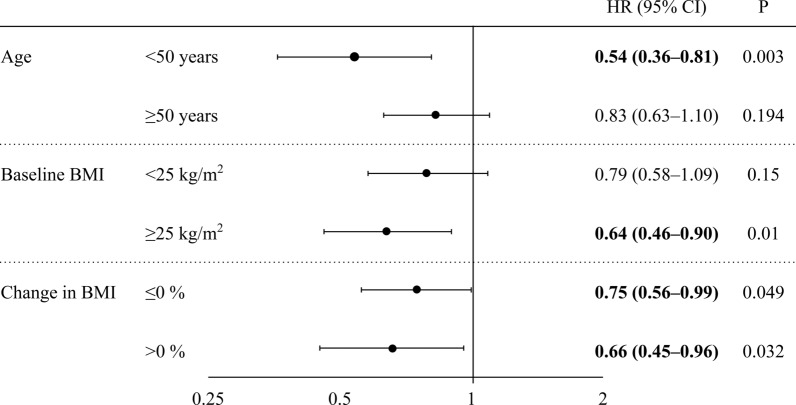
The median follow-up period was 5.0 years. The rates of CVD in the DM+/no remission, DM+/remission, DM-/no progression, and DM-/progression groups were 7.96, 4.76, 1.99, and 5.47 per 1000 person-years, respectively. Compared with DM+/no remission, DM+/remission reduced the risk of CVD [hazard ratio (HR) = 0.71, 95% confidence interval (CI) = 0.57-0.89]. Meanwhile, the HR for CVD in the DM+/remission group was 0.75 (95% CI = 0.56-0.99) for change in BMI ≤ 0%, versus 0.66 (95% CI = 0.45-0.96) for change in BMI > 0%.
In a real-world setting without intensive intervention, diabetes remission decreased the risk of CVD by approximately 30% regardless of changes in BMI, suggesting that diabetes remission can prevent CVD without weight loss in routine care and emphasizing the importance of achieving remission.
先前的研究表明,强化干预期间及现实环境中均可出现糖尿病缓解。然而,现实环境中糖尿病缓解对心血管疾病(CVD)发病率的影响仍不明确。
这项回顾性队列研究纳入了299967名年龄在20至72岁之间的个体,这些个体在2008年至2020年间接受了多次检查,并完成了≥3年的随访。根据糖化血红蛋白水平的变化以及1年基线期内糖尿病药物的使用情况,将患者分为四组:糖尿病(DM)+/未缓解、DM+/缓解、DM-/无进展和DM-/进展。使用多变量Cox回归分析评估CVD风险。
中位随访期为5.0年。DM+/未缓解、DM+/缓解、DM-/无进展和DM-/进展组的CVD发生率分别为每1000人年7.96、4.76、1.99和5.47。与DM+/未缓解相比,DM+/缓解降低了CVD风险[风险比(HR)=0.71,95%置信区间(CI)=0.57-0.89]。同时,DM+/缓解组中,体重指数(BMI)变化≤0%时CVD的HR为0.75(95%CI=0.56-0.99),而BMI变化>0%时为0.66(95%CI=0.45-0.96)。
在没有强化干预的现实环境中,无论BMI如何变化,糖尿病缓解均可使CVD风险降低约30%,这表明在常规护理中,糖尿病缓解无需减重即可预防CVD,并强调了实现缓解的重要性。