Hu Qianrong, Xuan Jiangying, Wang Lu, Shen Kangjie, Gao Zixu, Zhou Yuhong, Wei Chuanyuan, Gu Jianying
Department of Plastic and Reconstructive Surgery, Zhongshan Hospital, Fudan University, 180 Fenglin Road, Shanghai, 200032, People's Republic of China.
Department of Medical Oncology, Zhongshan Hospital, Fudan University, Shanghai, 200032, People's Republic of China.
J Transl Med. 2025 Jan 22;23(1):102. doi: 10.1186/s12967-025-06093-2.
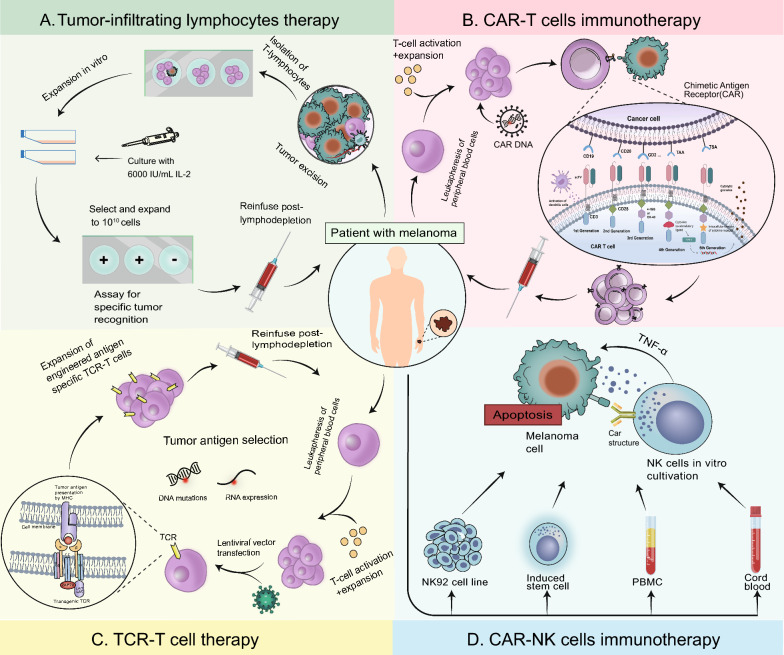
Cutaneous melanoma is one of the most aggressive skin cancers originating from skin pigment cells. Patients with advanced melanoma suffer a poor prognosis and generally cannot benefit well from surgical resection and chemo/target therapy due to metastasis and drug resistance. Thus, adoptive cell therapy (ACT), employing immune cells with specific tumor-recognizing receptors, has emerged as a promising therapeutic approach to display on-tumor toxicity. This review discusses the application, efficacy, limitations, as well as future prospects of four commonly utilized approaches -including tumor-infiltrating lymphocytes, chimeric antigen receptor (CAR) T cell, engineered T-cell receptor T cells, and chimeric antigen receptor NK cells- in the context of malignant melanoma.
皮肤黑色素瘤是起源于皮肤色素细胞的最具侵袭性的皮肤癌之一。晚期黑色素瘤患者预后较差,由于转移和耐药性,通常无法从手术切除和化疗/靶向治疗中获得良好疗效。因此,采用具有特异性肿瘤识别受体的免疫细胞的过继性细胞疗法(ACT)已成为一种有前景的显示肿瘤毒性的治疗方法。本综述讨论了四种常用方法——包括肿瘤浸润淋巴细胞、嵌合抗原受体(CAR)T细胞、工程化T细胞受体T细胞和嵌合抗原受体NK细胞——在恶性黑色素瘤背景下的应用、疗效、局限性以及未来前景。