Wang Liqun, Qiao Tianqi, Wang Xinxin, Wang Chen, Ye Pingzhi
College of Education, Guangzhou University, Guangzhou, Guangdong, China.
Front Public Health. 2025 Jan 8;12:1513514. doi: 10.3389/fpubh.2024.1513514. eCollection 2024.
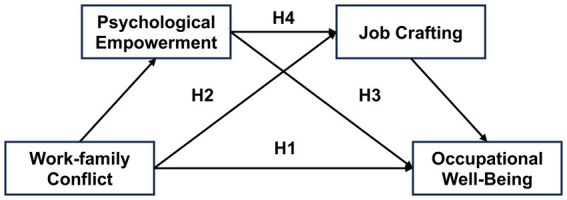
The occupational well-being of early childhood teachers, as a crucial measure of the stability of the early childhood workforce, is increasingly becoming a core topic of interest within the education system. Work-related stressors, particularly work-family conflict, have drawn significant attention for their impact on the occupational well-being of early childhood teachers, becoming a prominent issue in the education field. However, current research rarely explores the relationship between these factors and the underlying mechanisms involved. Therefore, this study aims to investigate the relationship between work-family conflict and the occupational well-being of early childhood teachers and the mediating role of psychological empowerment and job crafting.
This study conducted a survey involving 1,200 early childhood teachers from Guangdong Province, China, using personal information forms and four scales. The collected data were processed and analyzed using SPSS 27.0.
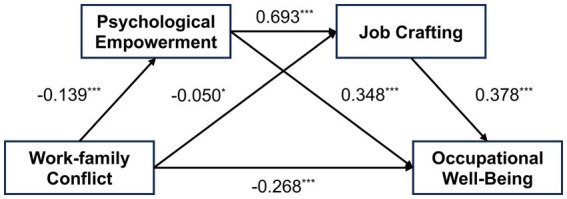
Work-family conflict showed a significant negative correlation with early childhood teacher's occupational well-being ( = -0.268, < 0.001). Psychological empowerment (indirect effect size = -0.049) and job crafting (indirect effect size = -0.019) partially mediated the relationship between work-family conflict and occupational well-being. Furthermore, psychological empowerment and job crafting played a chain mediating role between work-family conflict and occupational well-being (indirect effect size = -0.036).
This study reveals the underlying mechanisms by which work-family conflict affects early childhood teachers' occupational well-being. The findings demonstrate that work-family conflict has a direct and negative impact on the occupational well-being of early childhood teachers. Psychological empowerment and job crafting both partially mediate the relationship between work-family conflict and occupational well-being among early childhood teachers, and they also function in a serial mediating role within this association. The study provides crucial evidence supporting the significant impact of work-related stressors on early childhood teachers' occupational well-being, serving as a reference for policymakers and educators in developing interventions targeting occupational well-being.
幼儿教师的职业幸福感作为幼儿教育师资队伍稳定性的一项关键指标,日益成为教育系统中备受关注的核心话题。与工作相关的压力源,尤其是工作-家庭冲突,因其对幼儿教师职业幸福感的影响而受到了广泛关注,成为教育领域的一个突出问题。然而,目前的研究很少探讨这些因素之间的关系以及其中潜在的机制。因此,本研究旨在探究工作-家庭冲突与幼儿教师职业幸福感之间的关系,以及心理授权和工作重塑的中介作用。
本研究对来自中国广东省的1200名幼儿教师进行了调查,使用了个人信息表和四个量表。收集到的数据使用SPSS 27.0进行处理和分析。
工作-家庭冲突与幼儿教师的职业幸福感呈显著负相关(r = -0.268,p < 0.001)。心理授权(间接效应量 = -0.049)和工作重塑(间接效应量 = -0.019)部分中介了工作-家庭冲突与职业幸福感之间的关系。此外,心理授权和工作重塑在工作-家庭冲突与职业幸福感之间起到了链式中介作用(间接效应量 = -0.036)。
本研究揭示了工作-家庭冲突影响幼儿教师职业幸福感的潜在机制。研究结果表明,工作-家庭冲突对幼儿教师的职业幸福感有直接的负面影响。心理授权和工作重塑都部分中介了幼儿教师工作-家庭冲突与职业幸福感之间的关系,并且它们在这种关联中还起到了连续中介的作用。该研究提供了关键证据,支持了与工作相关的压力源对幼儿教师职业幸福感的重大影响,为政策制定者和教育工作者制定针对职业幸福感的干预措施提供了参考。