Yang Yixuan, Varrelmann Mark, Liebe Sebastian
Department of Phytopathology or Coordination, Institute of Sugar Beet Research, Göttingen, Germany.
Pest Manag Sci. 2025 Jun;81(6):2970-2980. doi: 10.1002/ps.8666. Epub 2025 Jan 23.
Cercospora leaf spot (CLS), caused by Cercospora beticola, is the most destructive foliar disease in sugar beet. CLS is conventionally controlled with fungicide, but the emergence of fungicide-resistant populations reinforces the importance of developing and cultivating resistant varieties. Understanding the dynamics of CLS in different varieties is hence essential for sustainable CLS management.
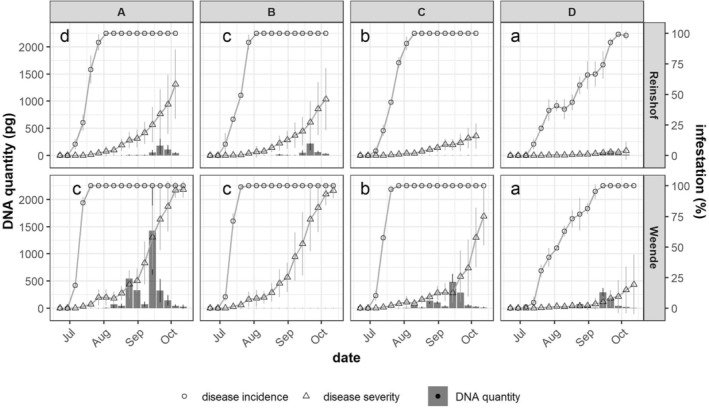
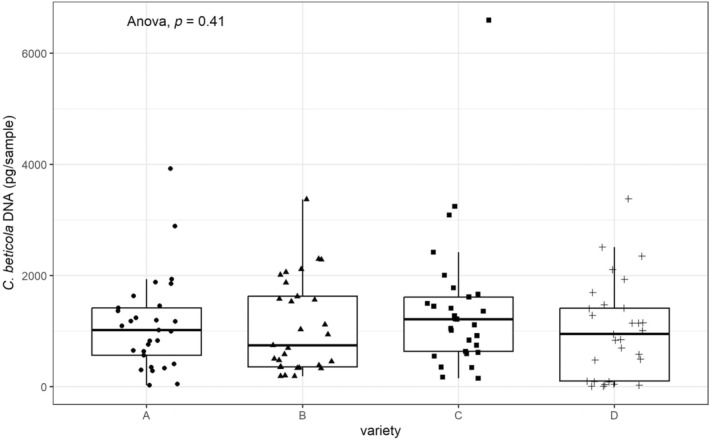
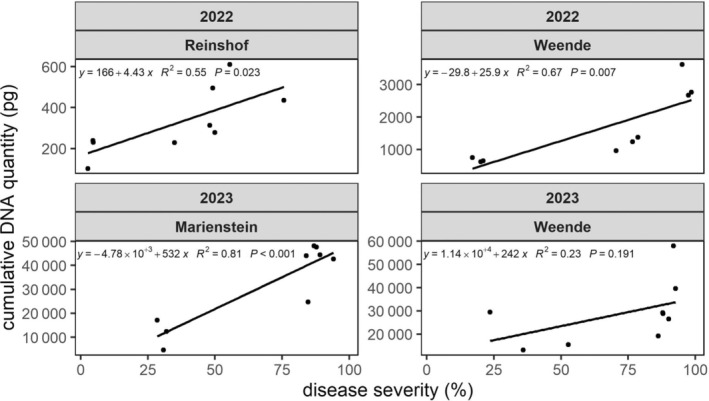
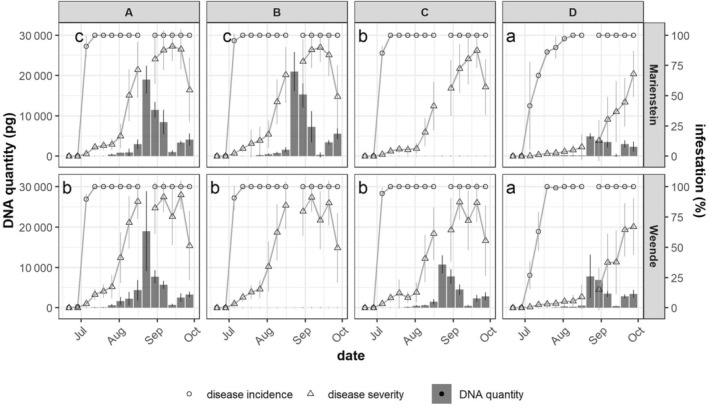
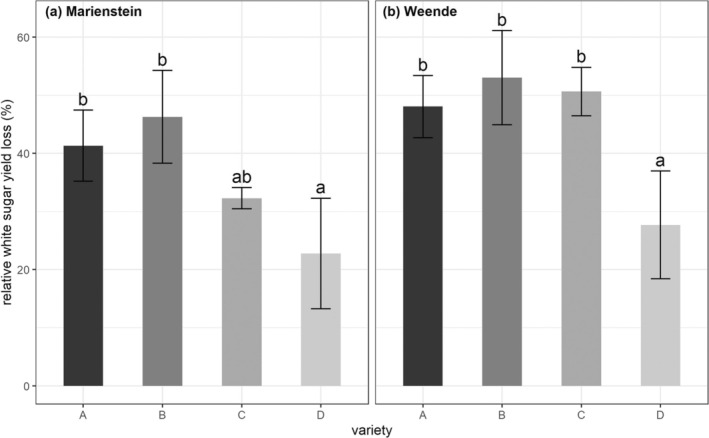
Field experiments (2022 and 2023) with four sugar beet varieties possessing different resistant properties were conducted to describe the relationship between the variety resistance and the disease epidemiology of C. beticola. For this purpose, spore flight and disease progression were assessed on a weekly basis. Disease severity (DS) and disease incidence (DI) were delayed in resistant varieties compared to the susceptible and moderately susceptible ones. This finding was further confirmed by a model-based analysis of DS and DI for all varieties. Weekly spore flight monitoring during the vegetation period showed a similar tendency of reduced spore quantity by the resistant varieties. This was probably due to the lower DS, as no differences were found when the amount of fungal DNA was determined in individual lesions from the different varieties. Analysis of relative yield loss further confirmed the advantage of growing resistant varieties.
Our results highlight that resistant varieties delay disease onset resulting in less severe symptoms and reduced spore flight. We also proved that aerial spore flight intensity could reflect the resistant property of each variety. These results provide a deeper insight into the interaction between variety resistance and CLS epidemiology, emphasizing variety-specific CLS management. © 2025 The Author(s). Pest Management Science published by John Wiley & Sons Ltd on behalf of Society of Chemical Industry.
由甜菜尾孢菌引起的甜菜叶斑病(CLS)是甜菜中最具破坏性的叶部病害。传统上,CLS通过杀菌剂进行防治,但抗杀菌剂种群的出现强化了开发和培育抗病品种的重要性。因此,了解不同品种中CLS的动态对于CLS的可持续管理至关重要。
进行了田间试验(2022年和2023年),使用了四个具有不同抗性特性的甜菜品种,以描述品种抗性与甜菜尾孢菌病害流行学之间的关系。为此,每周评估孢子飞散和病害进展情况。与感病和中感品种相比,抗病品种的病情严重程度(DS)和发病率(DI)出现延迟。对所有品种的DS和DI进行基于模型的分析进一步证实了这一发现。在植被期每周进行的孢子飞散监测显示,抗病品种的孢子数量有类似的减少趋势。这可能是由于DS较低,因为在不同品种的单个病斑中测定真菌DNA量时未发现差异。相对产量损失分析进一步证实了种植抗病品种的优势。
我们的结果表明,抗病品种可延迟病害发生,导致症状较轻且孢子飞散减少。我们还证明,空中孢子飞散强度可以反映每个品种的抗性特性。这些结果为品种抗性与CLS流行学之间的相互作用提供了更深入的见解,强调了针对品种的CLS管理。© 2025作者。由John Wiley & Sons Ltd代表化学工业协会出版的《害虫管理科学》。