Lee Matthew A, Hatcher Charlie A, Hazelwood Emma, Goudswaard Lucy J, Tsilidis Konstantinos K, Vincent Emma E, Martin Richard M, Smith-Byrne Karl, Brenner Hermann, Cheng Iona, Kweon Sun-Seog, Le Marchand Loic, Newcomb Polly A, Schoen Robert E, Peters Ulrike, Gunter Marc J, Van Guelpen Bethany, Murphy Neil
International Agency for Research on Cancer (IARC/WHO), Nutrition and Metabolism Branch, Lyon, France.
Population Health Sciences, Bristol Medical School, University of Bristol, Bristol, United Kingdom.
Int J Epidemiol. 2024 Dec 16;54(1). doi: 10.1093/ije/dyae175.
Adiposity is an established risk factor for colorectal cancer (CRC). The pathways underlying this relationship, and specifically the role of circulating proteins, are unclear.
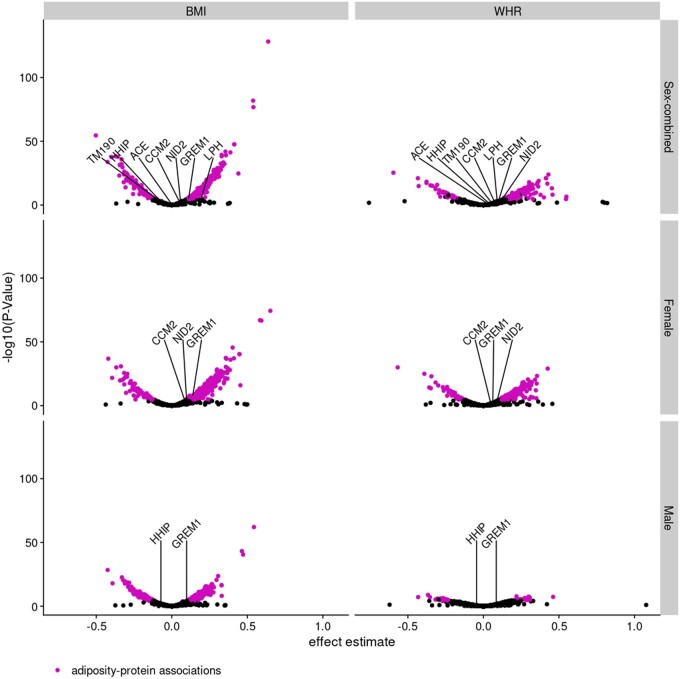
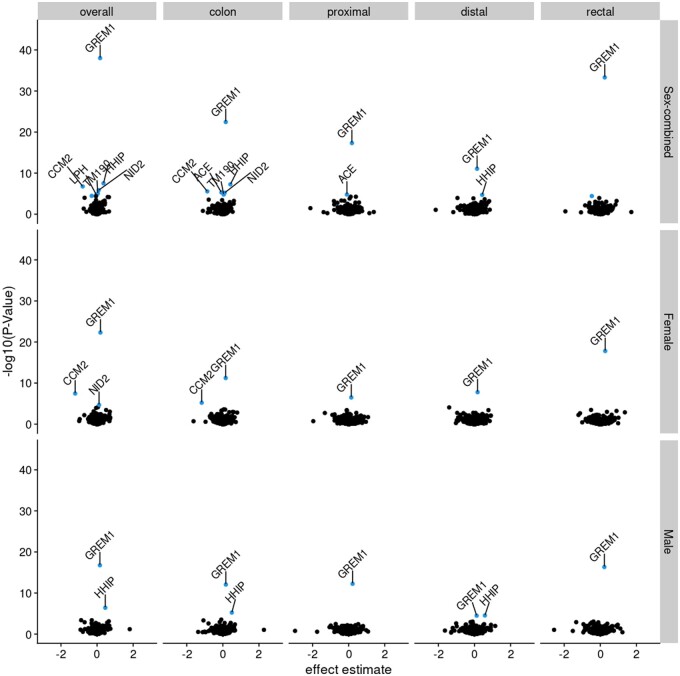
Utilizing two-sample univariable Mendelian randomization (UVMR), multivariable Mendelian randomization (MVMR), and colocalization, based on summary data from large sex-combined and sex-specific genetic studies, we estimated the univariable associations between: (i) body mass index (BMI) and waist-hip ratio (WHR) and overall and site-specific (colon, proximal colon, distal colon, and rectal) CRC risk, (ii) BMI and WHR and circulating proteins, and (iii) adiposity-associated circulating proteins and CRC risk. We used MVMR to investigate the potential mediating role of adiposity- and CRC-related circulating proteins in the adiposity-CRC association.
BMI and WHR were positively associated with CRC risk, with similar associations by anatomical tumor site. In total, 6591 adiposity-protein (2628 unique circulating proteins) and 33 protein-CRC (7 unique circulating proteins) associations were identified using UVMR and colocalization. One circulating protein, GREM1, was associated with BMI (only) and CRC outcomes in a manner that was consistent with a potential mediating role in sex-combined and female-specific analyses. In MVMR, adjusting the BMI-CRC association for GREM1, effect estimates were attenuated-suggestive of a potential mediating role-most strongly for the BMI-overall CRC association in women.
Results highlight the impact of adiposity on the plasma proteome and of adiposity-associated circulating proteins on the risk of CRC. Supported by evidence from UVMR and colocalization analyses using cis-single-nucleotide polymorphisms, GREM1 was identified as a potential mediator of the BMI-CRC association, particularly in women.
肥胖是结直肠癌(CRC)的既定风险因素。这种关系背后的途径,尤其是循环蛋白的作用尚不清楚。
利用基于大型性别合并和性别特异性基因研究的汇总数据进行的两样本单变量孟德尔随机化(UVMR)、多变量孟德尔随机化(MVMR)和共定位分析,我们估计了以下之间的单变量关联:(i)体重指数(BMI)和腰臀比(WHR)与总体及特定部位(结肠、近端结肠、远端结肠和直肠)CRC风险;(ii)BMI和WHR与循环蛋白;以及(iii)肥胖相关循环蛋白与CRC风险。我们使用MVMR研究肥胖和CRC相关循环蛋白在肥胖-CRC关联中的潜在中介作用。
BMI和WHR与CRC风险呈正相关,不同解剖肿瘤部位的关联相似。使用UVMR和共定位分析共鉴定出6591种肥胖-蛋白(2628种独特循环蛋白)和33种蛋白-CRC(7种独特循环蛋白)关联。一种循环蛋白GREM1与BMI(仅)和CRC结局相关,其方式与在性别合并和女性特异性分析中的潜在中介作用一致。在MVMR中,针对GREM1调整BMI-CRC关联后,效应估计值减弱,这表明在女性中,对于BMI-总体CRC关联,GREM1最有可能发挥潜在中介作用。
结果突出了肥胖对血浆蛋白质组的影响以及肥胖相关循环蛋白对CRC风险的影响。在使用顺式单核苷酸多态性进行的UVMR和共定位分析证据支持下,GREM1被确定为BMI-CRC关联的潜在中介因素,尤其是在女性中。