Cheng Ching-Feng, Cheng Evelyn, Ku Hui-Chen
Department of Pediatrics, Taipei Tzu Chi Hospital, Buddhist Tzu Chi Medical Foundation, New Taipei, Taiwan.
Institute of Biomedical Sciences, Academia Sinica, Taipei, Taiwan.
Tzu Chi Med J. 2024 Aug 28;37(1):10-16. doi: 10.4103/tcmj.tcmj_51_24. eCollection 2025 Jan-Mar.
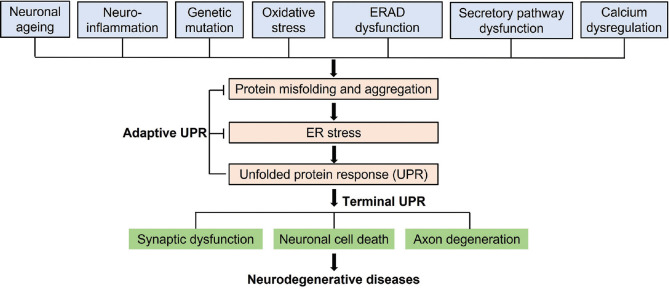
Endoplasmic reticulum (ER) is a crucial organelle associated with cellular homeostasis. Accumulation of improperly folded proteins results in ER stress, accompanied by the reaction involving triggering unfolded protein response (UPR). The UPR is mediated through ER membrane-associated sensors, such as protein kinase-like ER kinase (PERK), inositol-requiring transmembrane kinase/endoribonuclease 1α, and activating transcription factor 6 (ATF6). Prolonged stress triggers cell apoptotic reaction, resulting in cell death. Neuronal cells are especially susceptible to protein misfolding. Notably, ER and UPR malfunctions are linked to many neurodegenerative diseases, such as Alzheimer's disease (AD) and Parkinson's disease (PD), delineated by accumulation of misfolded proteins. Notably, ATF family members play key roles in AD and PD pathogenesis. However, the connection between ER stress, UPR, and neuropathology is not yet fully understood. Here, we discuss our present knowledge of the association between ER stress, the UPR, and neurodegeneration in AD and PD. We also discuss the roles of ATF family members in AD and PD pathogenesis. Moreover, we provide a mechanistic clarification of how disease-related molecules affect ER protein homeostasis and explore recent findings that connect the UPR to neuronal plasticity.
内质网(ER)是与细胞稳态相关的关键细胞器。错误折叠蛋白的积累会导致内质网应激,并伴随着触发未折叠蛋白反应(UPR)的反应。UPR是通过内质网膜相关传感器介导的,如蛋白激酶样内质网激酶(PERK)、肌醇需求跨膜激酶/核酸内切酶1α和激活转录因子6(ATF6)。长期应激会触发细胞凋亡反应,导致细胞死亡。神经元细胞尤其容易受到蛋白错误折叠的影响。值得注意的是,内质网和UPR功能障碍与许多神经退行性疾病有关,如阿尔茨海默病(AD)和帕金森病(PD),其特征是错误折叠蛋白的积累。值得注意的是,ATF家族成员在AD和PD发病机制中起关键作用。然而,内质网应激、UPR与神经病理学之间的联系尚未完全明确。在这里,我们讨论了目前关于内质网应激、UPR与AD和PD中神经退行性变之间关联的认识。我们还讨论了ATF家族成员在AD和PD发病机制中的作用。此外,我们对疾病相关分子如何影响内质网蛋白稳态提供了机制上的阐释,并探讨了将UPR与神经元可塑性联系起来的最新研究结果。