Iancu Doriana, Fulga Ana, Vesa Doina, Fulga Iuliu, Tutunaru Dana, Zenovia Andrei, Piraianu Alin Ionut, Stamate Elena, Sterian Corina, Dimofte Florentin, Badea Mihail Alexandru, Tatu Alin Laurentiu
ENT Department, "Sfantul Andrei" Emergency Hospital of Galati, 800578 Galati, Romania.
Faculty of Medicine and Pharmacy, Dunarea de Jos University of Galati, 800010 Galati, Romania.
Clin Pract. 2025 Jan 17;15(1):21. doi: 10.3390/clinpract15010021.
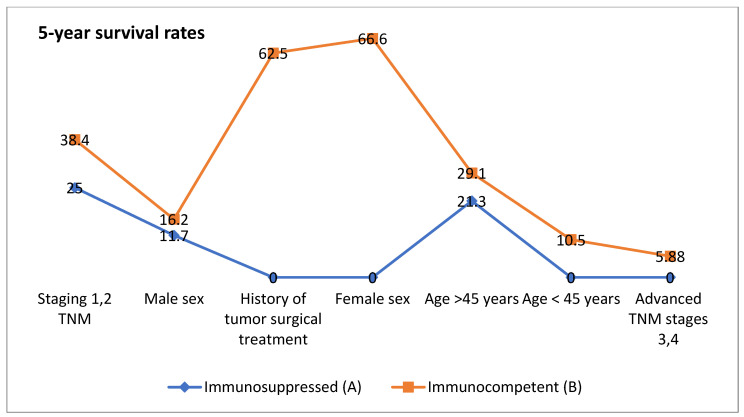
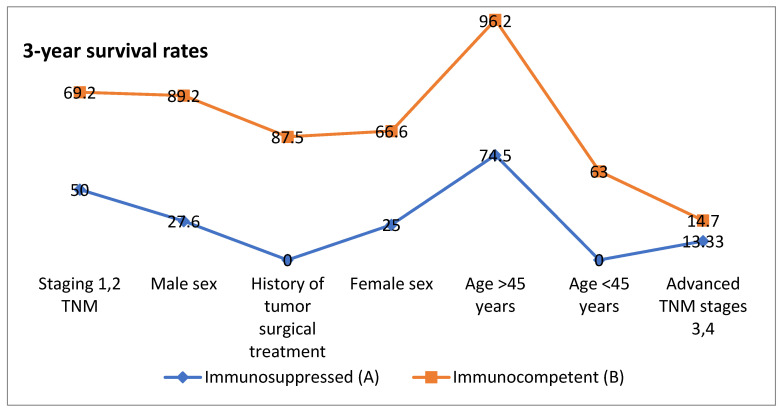
Cutaneous squamous scell carcinoma (cSCC) is a frequent non-melanoma skin cancer that originates from keratinocytes with increased prevalence. cSCC can be either in situ, as in Bowen's disease, or extended. Advanced age, accumulated sun exposure, light pigmentation, and prior skin cancer diagnosis are all significant risk factors for cSCC. Although most cSCCs can be treated surgically, some recur and metastasize, resulting in death. The role of immune status is not yet determined in the prognosis of these patients. . Immunosuppressed patients are more likely to develop cSCC, which is often characterized by more aggressive, multifocal lesions. This study aimed to determine the risks of mortality in patients with cSCC and immunosuppression versus non immunosuppression and to compare variations in overall survival based on different clinical features. . We evaluated clinical cases of patients at "Sfantul Apostol Andrei" Emergency Hospital of Galati, Romania, from 1 March 2018 to 1 April 2024. Subjects in the trial had to be at least 18 years old and have a pathologically confirmed diagnosis of cutaneous head and neck squamous cell carcinoma (cHNSCC). We divided the patients into two different categories based on whether they had immunosuppression. In this cohort of 68 subjects with cSCC, patients with immunosuppression had significantly lower overall survival, as well as lower three- and five-year survival rates compared with those without immunosuppression, even after adjustment for age, sex, stage, and previous surgical treatment. The median survival time for immunosuppressed individuals ranged from 11 to 21 months, varying based on their particular characteristics, and most critically, on the presence of other malignancies, while that of immunocompetent patients ranged from 18 to 51 months. In addition, immune-deficient patients with early-stage disease had a 21-month median survival rate that changed to11 months for advanced-stage cases. In a similar manner, immunocompetent patients with early-stage cancer had a significantly better median survival than those withadvancedstages,43 versus 18months. Our results indicate that immunosuppression is a distinct risk factors associated with a less favorable outcome in patients with cHNSCC.
皮肤鳞状细胞癌(cSCC)是一种常见的非黑色素瘤皮肤癌,起源于角质形成细胞,发病率呈上升趋势。cSCC可以是原位癌,如鲍恩病,也可以是浸润性癌。高龄、长期日晒、浅色素沉着以及既往皮肤癌诊断都是cSCC的重要危险因素。虽然大多数cSCC可以通过手术治疗,但有些会复发和转移,导致死亡。免疫状态在这些患者的预后中的作用尚未确定。免疫抑制患者更容易发生cSCC,其通常表现为更具侵袭性的多灶性病变。本研究旨在确定cSCC合并免疫抑制与非免疫抑制患者的死亡风险,并根据不同临床特征比较总生存率的差异。我们评估了罗马尼亚加拉茨“Sfantul Apostol Andrei”急诊医院2018年3月1日至2024年4月1日期间患者的临床病例。试验对象必须年满18岁,且经病理确诊为皮肤头颈鳞状细胞癌(cHNSCC)。我们根据患者是否存在免疫抑制将其分为两类。在这一队列的68例cSCC患者中,即使在调整年龄、性别、分期和既往手术治疗因素后,免疫抑制患者的总生存率以及三年和五年生存率仍显著低于非免疫抑制患者。免疫抑制个体的中位生存时间为11至21个月,具体取决于其特定特征,最关键的是取决于是否存在其他恶性肿瘤,而免疫功能正常患者的中位生存时间为18至51个月。此外,免疫缺陷的早期疾病患者中位生存时间为21个月,晚期病例则变为11个月。同样,免疫功能正常的早期癌症患者的中位生存时间明显优于晚期患者,分别为43个月和18个月。我们的结果表明,免疫抑制是cHNSCC患者预后不良的一个明显危险因素。