
长井筛管对淡水-咸水过渡带监测的影响
Impact of Long Well Screens on Monitoring of the Freshwater-Saltwater Transition Zone.
作者信息
Croteau Frédérik, Coulon Cécile, Molson John, Lemieux Jean-Michel
机构信息
Département de Géologie et de génie géologique, Université Laval, Québec, Canada.
Centre québécois de recherche sur l'eau, Québec, Canada.
出版信息
Ground Water. 2025 Mar-Apr;63(2):192-204. doi: 10.1111/gwat.13465. Epub 2025 Jan 24.
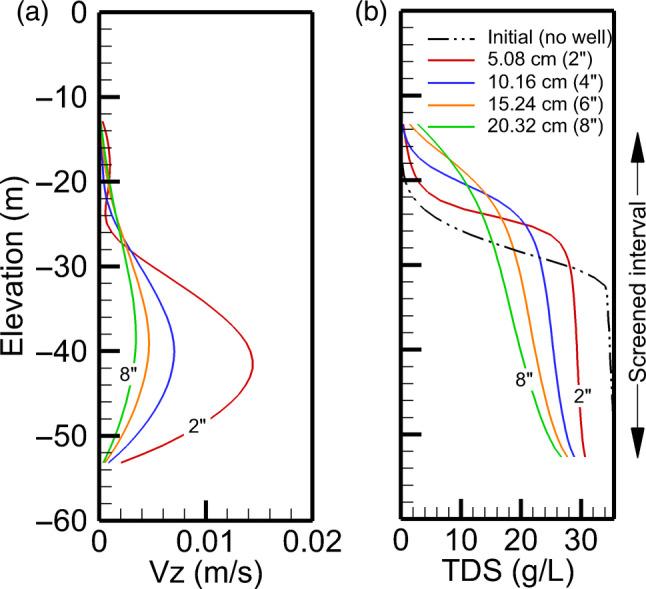
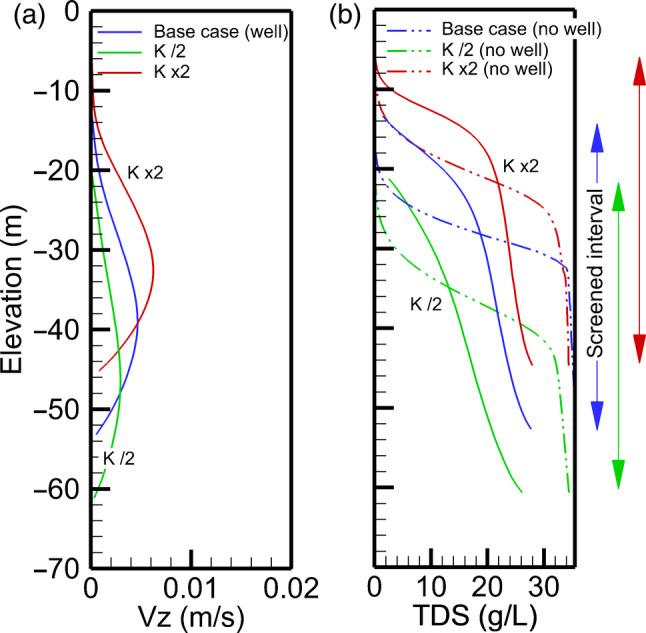
Deep monitoring wells with long screens crossing the transition zone between freshwater and saltwater are often used in coastal areas to characterize fresh groundwater resources and the depth of saline groundwater. However, past studies have demonstrated that long-screen wells can lead to biased observations of the transition zone, since vertical flow within the borehole can modify the shape and elevation of the transition zone in and around the borehole compared to undisturbed conditions without a well. Here, field observations and variable-density numerical flow simulations are used to evaluate, under natural flow conditions, how the installation of long-screen wells can provide time-varying biased observations of the freshwater-saltwater transition zone, and how various aquifer and well parameters affect the magnitude of these biases. Results show that long-screen wells can lead to a more dispersed interface, an upward displacement of the transition zone of between 5 and 10 m, and a salinity decrease in the saltwater portion of the well on the order of 10 to 15 g/L. The perturbations take up to 5 years to fully develop and stabilize. The degree of displacement depends on the screen diameter, screen length, aquifer anisotropy, and hydraulic conductivity, whereas the displacement is independent of the distance of the well from the coast. This analysis provides insight into which well and aquifer characteristics increase the risk of obtaining biased observations in long-screen wells, and provides orders of magnitude for these biases.
在沿海地区,常使用长滤网穿过淡水与盐水过渡带的深层监测井来表征淡水地下水资源及咸水地下水的深度。然而,过去的研究表明,长滤网井可能导致对过渡带的观测出现偏差,因为与没有井的未受干扰条件相比,钻孔内的垂直水流会改变钻孔内部及周围过渡带的形状和高程。在此,利用现场观测和变密度数值水流模拟,在自然水流条件下评估长滤网井的安装如何能提供随时间变化的对淡水 - 盐水过渡带的偏差观测,以及各种含水层和井的参数如何影响这些偏差的大小。结果表明,长滤网井会导致界面更加分散,过渡带向上位移5至10米,井的咸水部分盐度降低约10至15克/升。这些扰动需要长达5年才能充分发展并稳定下来。位移程度取决于滤网直径、滤网长度、含水层各向异性和水力传导率,而位移与井到海岸的距离无关。该分析深入了解了哪些井和含水层特征会增加长滤网井获取偏差观测结果的风险,并给出了这些偏差的数量级。




 Zotero 插件