Mantlo Emily, Maruyama Junki, Manning John T, Reyna Rachel A, Huang Cheng, Paessler Slobodan
Department of Microbiology and Immunology, University of Texas Medical Branch, Galveston, Texas, United States of America.
Department of Pathology, University of Texas Medical Branch, Galveston, Texas, United States of America.
PLoS Negl Trop Dis. 2025 Jan 24;19(1):e0012834. doi: 10.1371/journal.pntd.0012834. eCollection 2025 Jan.
Machupo virus (MACV) is a New World mammarenavirus (hereafter referred to as "arenavirus") and the etiologic agent of Bolivian hemorrhagic fever (BHF). No vaccine or antiviral therapy exists for BHF, which causes up to 35% mortality in humans. New World arenaviruses evolve separately in different locations. To date, up to eight lineages of MACV have been identified in Bolivia. While the prototype MACV Carvallo strain belongs to lineage I discovered in the Memore Province in the 1960s, the MACV lineage II strains have become the dominantly-circulating lineage in the same province since 1993.
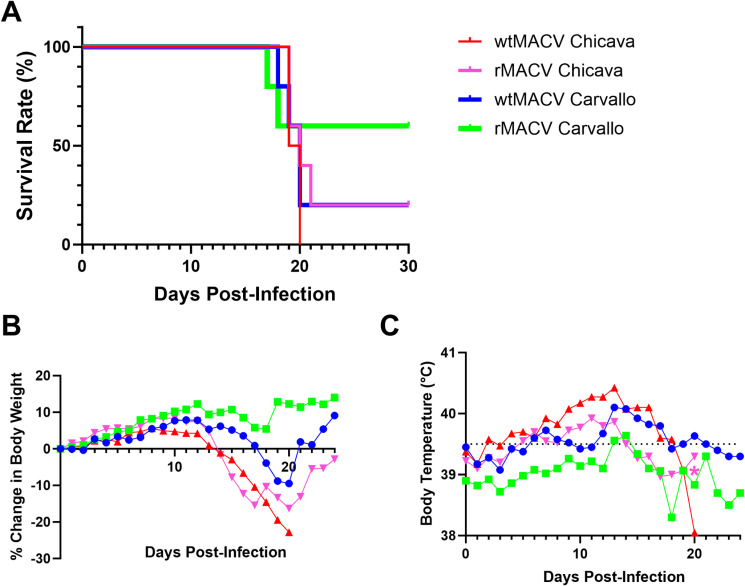
We report the development of a reverse genetics system for the MACV lineage II Chicava strain, using a pRF42 plasmid encoding the L and S segment genomic RNA under the transcriptional control of a murine DNA-dependent RNA polymerase I promoter sequence. Rescue of the recombinant MACV Chicava strain (rMACV-Chicava) was accomplished by expression of the L protein and nucleoprotein genes of the MACV Carvallo strain in trans in transfected baby hamster kidney (BHK-21) cells. We characterized the multiplication kinetics of rMACV-Chicava in African green monkey kidney epithelial Vero cells, followed by determining the virulence phenotype in outbred Hartley guinea pigs.
We demonstrated that the multiplication kinetics in Vero cells, virulence phenotype in guinea pigs, and neutralizing antibody titers are indistinguishable between rMACV-Chicava and the wild-type parental virus.
We conclude that rMACV-Chicava provides a useful model system to investigate the emergence of MACV lineage II strains and the guinea pig model has utility for the development of candidate vaccines and therapeutic antibodies for BHF.
马丘波病毒(MACV)是一种新大陆沙粒病毒(以下简称“沙粒病毒”),也是玻利维亚出血热(BHF)的病原体。目前尚无针对BHF的疫苗或抗病毒疗法,该疾病在人类中的致死率高达35%。新大陆沙粒病毒在不同地点独立进化。迄今为止,在玻利维亚已鉴定出多达8个MACV谱系。虽然原型MACV卡瓦洛毒株属于20世纪60年代在梅莫雷省发现的I谱系,但自1993年以来,MACV II谱系毒株已成为该省主要流行的谱系。
我们报告了MACV II谱系奇卡瓦毒株反向遗传学系统的开发,该系统使用了一个pRF42质粒,其在鼠源DNA依赖性RNA聚合酶I启动子序列的转录控制下编码L和S片段基因组RNA。通过在转染的幼仓鼠肾(BHK-21)细胞中反式表达MACV卡瓦洛毒株的L蛋白和核蛋白基因,实现了重组MACV奇卡瓦毒株(rMACV-Chicava)的拯救。我们对rMACV-Chicava在非洲绿猴肾上皮Vero细胞中的增殖动力学进行了表征,随后确定了其在远交系哈特利豚鼠中的毒力表型。
我们证明,rMACV-Chicava与野生型亲本病毒在Vero细胞中的增殖动力学、豚鼠中的毒力表型以及中和抗体滴度方面没有区别。
我们得出结论,rMACV-Chicava为研究MACV II谱系毒株的出现提供了一个有用的模型系统,豚鼠模型对于开发BHF候选疫苗和治疗性抗体具有实用性。