Idris Idayu Badilla, Dahlan Sarah Awang, Rahman Rahana Abd, Nawi Azmawati Mohammed
Department of Public Health Medicine, Faculty of Medicine, Universiti Kebangsaan Malaysia, Kuala Lumpur, 56000, Malaysia.
Family Health Development Division, Ministry of Health, Complex E, Putrajaya, 62590, Malaysia.
BMC Public Health. 2025 Jan 24;25(1):317. doi: 10.1186/s12889-024-20784-3.
The prevalence of diabetes mellitus among women increased consistently together with the increase in the overall prevalence of diabetes mellitus globally. One of the components in holistic diabetes care among women are preconception interventions. Family planning usage has been one of the components in preconception care among this group of population, especially among women with unoptimised diabetes mellitus, where family planning may allow disease optimisation prior to pregnancy. This systematic review thus aimed to synthesise evidences and improve understanding on the non-individual factors in influencing family planning practice among women with diabetes mellitus.
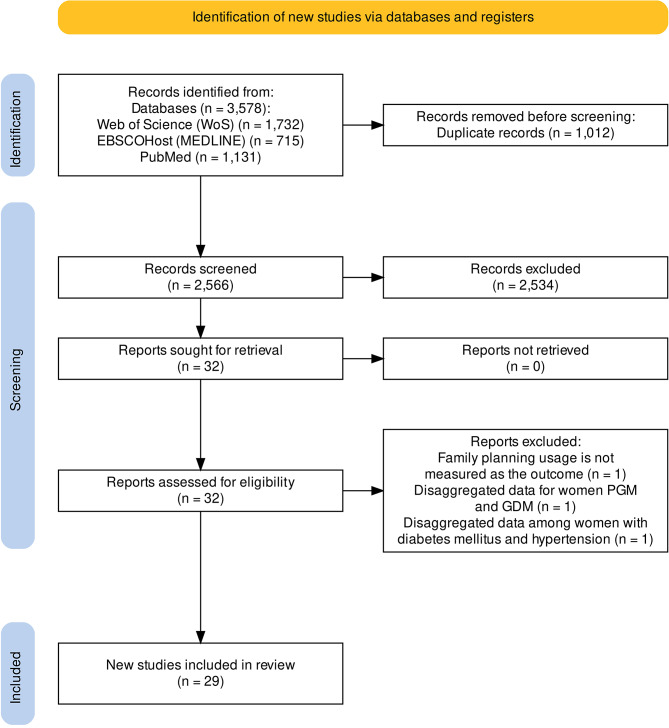
PubMed, Web of Science and EBSCOHost was systematically searched for empirical studies between 2000 and 2023 that discussed on factors that influenced family planning usage among women with diabetes. This systematic literature review was conducted in accordance to Joanna Briggs Institute's approach for conducting systematic review of associations. Factors were categorised to either individual and non-individual factors. Narrative synthesis approach was adopted that appropriately accommodates the heterogeneity of the reviewed studies.
A total of 29 studies met the inclusion criteria. Studies included in this review mostly reported individual-level factors that influence family planning practice among women with diabetes mellitus which were mainly the presence of diseases and other sociodemographic characteristics. Only six studies reported factors beyond individual variables which include geographic region, access to care, opinion of significant others, healthcare providers' perception, role of doctors and types of service providers.
This systematic review provides evidences that highlighted the gap in knowledge on variables that were beyond individual-level factors which influence family planning practice among women with diabetes mellitus. Further studies that explored structural and systemic factors may benefit future program planning to identify and target modifiable factors.
全球糖尿病总体患病率上升的同时,女性糖尿病患病率也持续增加。女性整体糖尿病护理的组成部分之一是孕前干预。计划生育的使用一直是这一人群孕前护理的组成部分,尤其是在糖尿病控制不佳的女性中,计划生育可使她们在怀孕前优化病情。因此,本系统评价旨在综合证据,增进对影响糖尿病女性计划生育实践的非个体因素的理解。
系统检索了PubMed、Web of Science和EBSCOHost数据库,查找2000年至2023年间讨论影响糖尿病女性计划生育使用因素的实证研究。本系统文献综述按照乔安娜·布里格斯研究所进行关联系统评价的方法进行。将因素分为个体因素和非个体因素。采用叙述性综合方法,以适当处理所纳入研究的异质性。
共有29项研究符合纳入标准。本综述纳入的研究大多报告了影响糖尿病女性计划生育实践的个体层面因素,主要是疾病的存在和其他社会人口学特征。只有六项研究报告了个体变量以外的因素,包括地理区域、获得护理的机会、重要他人的意见、医疗服务提供者的看法、医生的作用和服务提供者类型。
本系统评价提供的证据凸显了在影响糖尿病女性计划生育实践的个体层面因素以外的变量方面的知识空白。探索结构和系统因素的进一步研究可能有助于未来的项目规划,以确定和针对可改变的因素。