Institute for Health Metrics and Evaluation, University of Washington, Seattle, WA, USA; Department of Health Metrics Sciences, University of Washington, Seattle, WA, USA.
Institute for Health Metrics and Evaluation, University of Washington, Seattle, WA, USA.
Lancet. 2022 Jul 23;400(10348):295-327. doi: 10.1016/S0140-6736(22)00936-9.
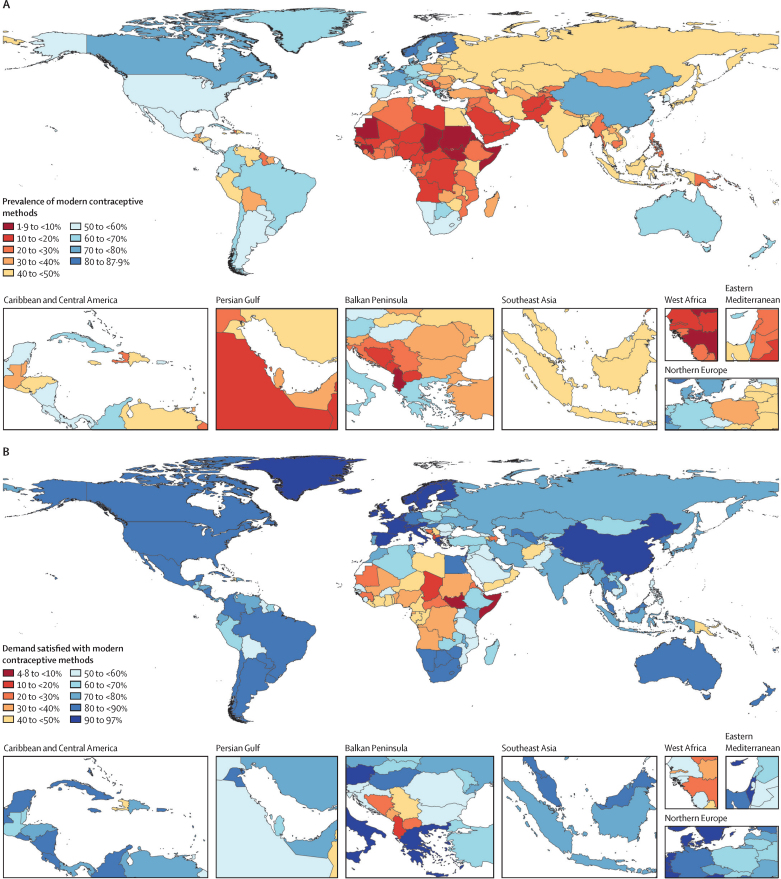
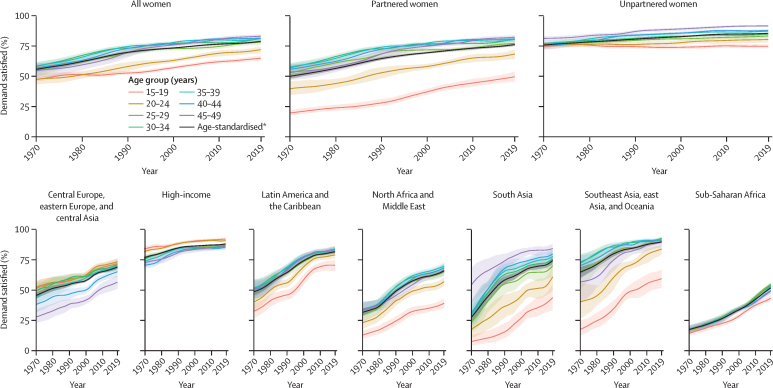
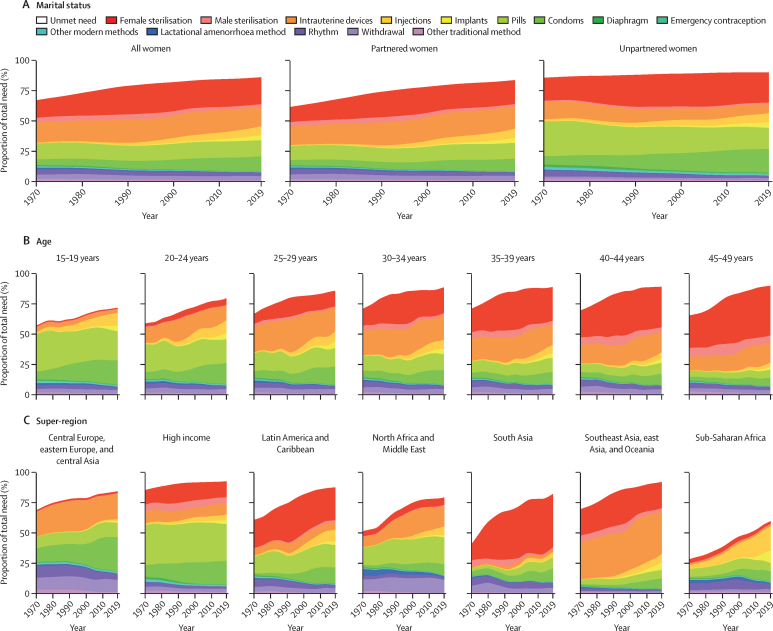
Meeting the contraceptive needs of women of reproductive age is beneficial for the health of women and children, and the economic and social empowerment of women. Higher rates of contraceptive coverage have been linked to the availability of a more diverse range of contraceptive methods. We present estimates of the contraceptive prevalence rate (CPR), modern contraceptive prevalence rate (mCPR), demand satisfied, and the method of contraception used for both partnered and unpartnered women for 5-year age groups in 204 countries and territories between 1970 and 2019.
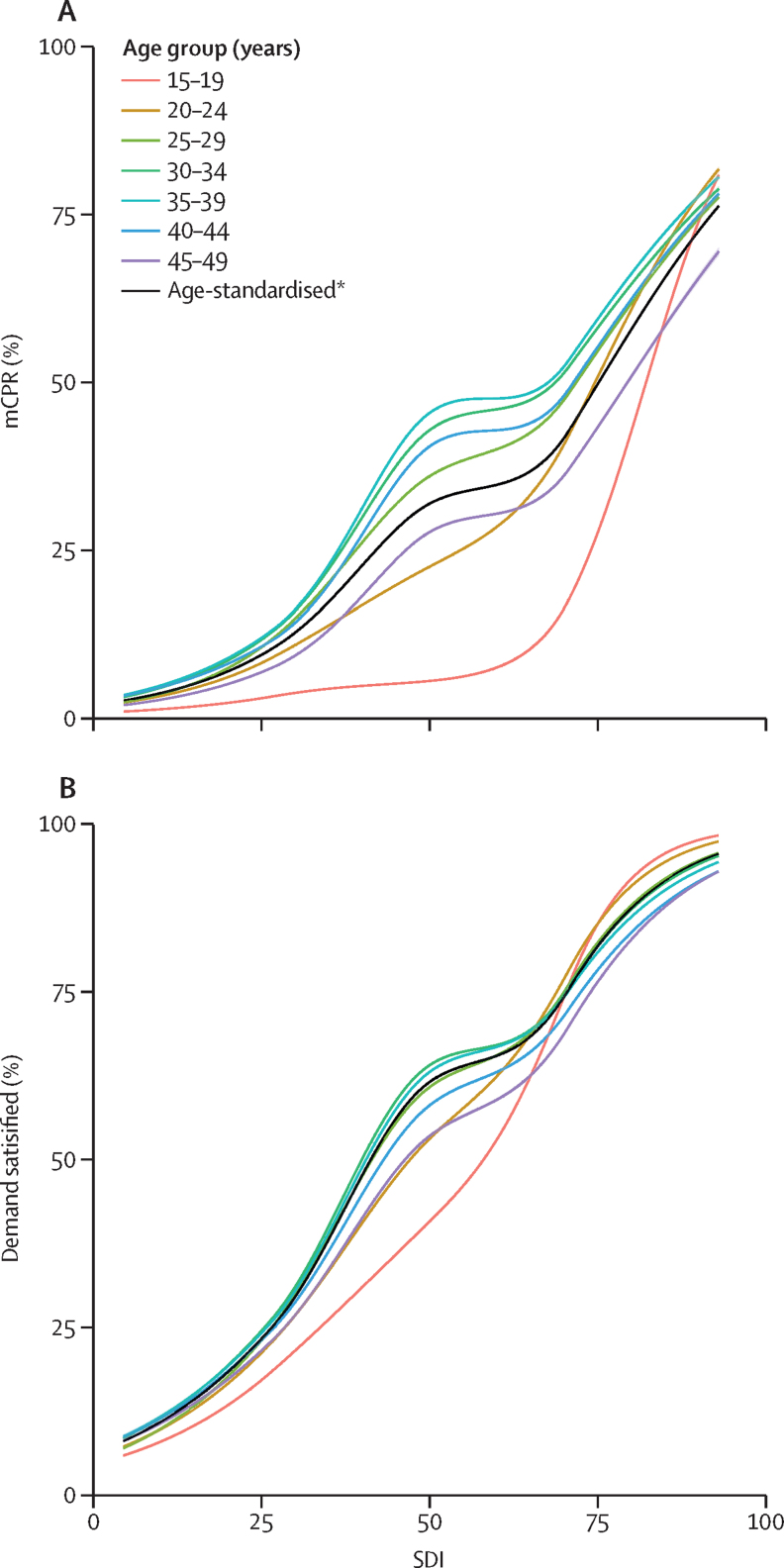
We used 1162 population-based surveys capturing contraceptive use among women between 1970 and 2019, in which women of reproductive age (15-49 years) self-reported their, or their partner's, current use of contraception for family planning purposes. Spatiotemporal Gaussian process regression was used to generate estimates of the CPR, mCPR, demand satisfied, and method mix by age and marital status. We assessed how age-specific mCPR and demand satisfied changed with the Socio-demographic Index (SDI), a measure of social and economic development, using the meta-regression Bayesian, regularised, trimmed method from the Global Burden of Diseases, Injuries, and Risk Factors Study.
In 2019, 162·9 million (95% uncertainty interval [UI] 155·6-170·2) women had unmet need for contraception, of whom 29·3% (27·9-30·6) resided in sub-Saharan Africa and 27·2% (24·4-30·3) resided in south Asia. Women aged 15-19 years (64·8% [62·9-66·7]) and 20-24 years (71·9% [68·9-74·2]) had the lowest rates of demand satisfied, with 43·2 million (95% UI 39·3-48·0) women aged 15-24 years with unmet need in 2019. The mCPR and demand satisfied among women aged 15-19 years were substantially lower than among women aged 20-49 years at SDI values below 60 (on a 0-100 scale), but began to equalise as SDI increased above 60. Between 1970 and 2019, the global mCPR increased by 20·1 percentage points (95% UI 18·7-21·6). During this time, traditional methods declined as a proportion of all contraceptive methods, whereas the use of implants, injections, female sterilisation, and condoms increased. Method mix differs substantially depending on age and geography, with the share of female sterilisation increasing with age and comprising more than 50% of methods in use in south Asia. In 28 countries, one method was used by more than 50% of users in 2019.
The dominance of one contraceptive method in some locations raises the question of whether family planning policies should aim to expand method mix or invest in making existing methods more accessible. Lower rates of demand satisfied among women aged 15-24 years are also concerning because unintended pregnancies before age 25 years can forestall or eliminate education and employment opportunities that lead to social and economic empowerment. Policy makers should strive to tailor family planning programmes to the preferences of the groups with the most need, while maintaining the programmes used by existing users.
Bill & Melinda Gates Foundation.
满足育龄妇女的避孕需求有利于妇女和儿童的健康,以及妇女的经济和社会赋权。更高的避孕覆盖率与更广泛的避孕方法的可用性有关。我们报告了 1970 年至 2019 年期间,在 204 个国家和地区,针对 5 岁年龄组的已婚和未婚妇女的避孕普及率(CPR)、现代避孕普及率(mCPR)、需求满足情况以及使用的避孕方法的估计值。
我们使用了 1162 项基于人群的调查,这些调查在 1970 年至 2019 年间收集了妇女的避孕使用情况,其中育龄妇女(15-49 岁)自我报告了她们或其伴侣目前出于计划生育目的使用的避孕方法。时空高斯过程回归用于根据年龄和婚姻状况生成 CPR、mCPR、需求满足情况和方法组合的估计值。我们使用来自全球疾病、伤害和风险因素研究的贝叶斯元回归、正则化、修剪方法评估了特定年龄的 mCPR 和需求满足情况如何随社会人口发展指数(SDI)变化,SDI 是衡量社会和经济发展的指标。
2019 年,有 1.629 亿(95%不确定性区间[UI] 1.556-1.702)名妇女有未满足的避孕需求,其中 29.3%(27.9-30.6)居住在撒哈拉以南非洲,27.2%(24.4-30.3)居住在南亚。15-19 岁(64.8%[62.9-66.7])和 20-24 岁(71.9%[68.9-74.2])的妇女需求满足率最低,2019 年有 4320 万(95%UI 3930-4800)名 15-24 岁的妇女有未满足的避孕需求。在 SDI 值低于 60(0-100 分制)的情况下,15-19 岁妇女的 mCPR 和需求满足率明显低于 20-49 岁妇女,但随着 SDI 高于 60 而逐渐趋于一致。1970 年至 2019 年间,全球 mCPR 增加了 20.1 个百分点(95%UI 18.7-21.6)。在此期间,传统方法在所有避孕方法中的比例下降,而植入物、注射剂、女性绝育和避孕套的使用增加。方法组合在很大程度上取决于年龄和地理位置,女性绝育的比例随着年龄的增长而增加,并且在南亚的使用方法中占比超过 50%。在 28 个国家,2019 年有一种方法被超过 50%的使用者使用。
在某些地方一种避孕方法的主导地位引发了一个问题,即计划生育政策是否应该旨在扩大方法组合,还是投资于提高现有方法的可及性。15-24 岁妇女需求满足率较低也令人担忧,因为 25 岁之前的意外怀孕可能会阻碍或消除导致社会和经济赋权的教育和就业机会。政策制定者应该努力根据最有需要的群体的偏好来调整计划生育方案,同时保持现有使用者使用的方案。
比尔及梅琳达·盖茨基金会。