Yu Wenting, Wang Xinwen, Yang Huifang
Department of Orthodontics, School of Stomatology, Beijing Stomatological Hospital, Capital Medical University, Beijing, 100050, PR China.
Third Clinical Division, Peking University School and Hospital of Stomatology & National Center of Stomatology & National Clinical Research Center for Oral Diseases & National Engineering Research Center of Oral Biomaterials and Digital Medical Devices, Beijing, CN, China.
BMC Oral Health. 2025 Jan 24;25(1):133. doi: 10.1186/s12903-024-05385-1.
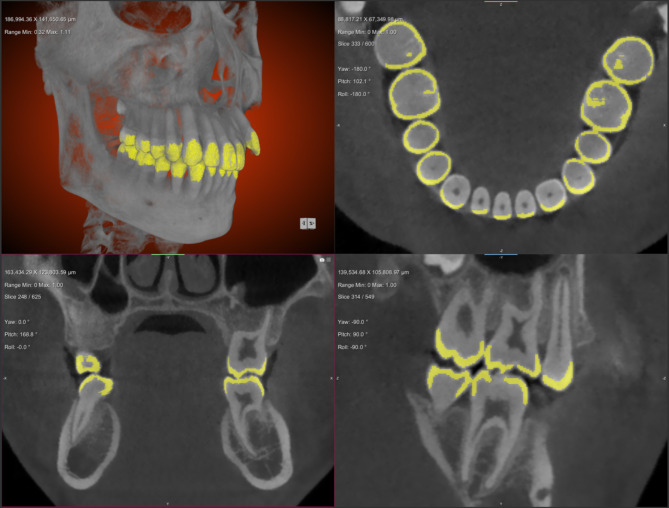
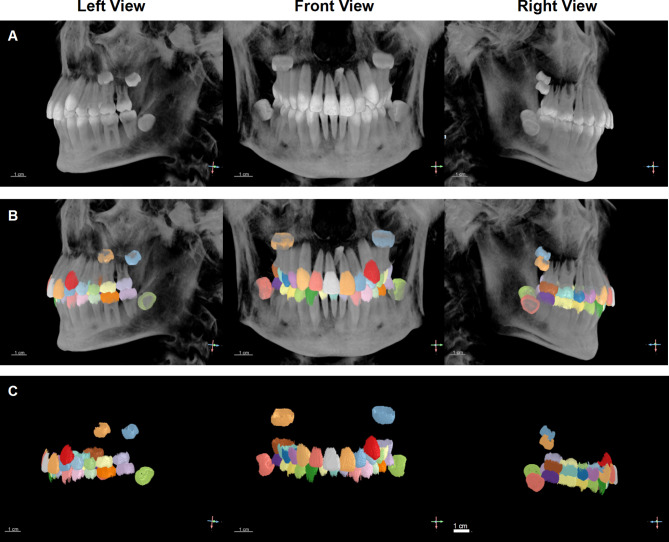
Establishing accurate, reliable, and convenient methods for enamel segmentation and analysis is crucial for effectively planning endodontic, orthodontic, and restorative treatments, as well as exploring the evolutionary patterns of mammals. However, no mature, non-destructive method currently exists in clinical dentistry to quickly, accurately, and comprehensively assess the integrity and thickness of enamel chair-side. This study aims to develop a deep learning work, 2.5D Attention U-Net, trained on small sample datasets, for the automatical, efficient, and accurate segmentation of enamel across all teeth in clinical settings.
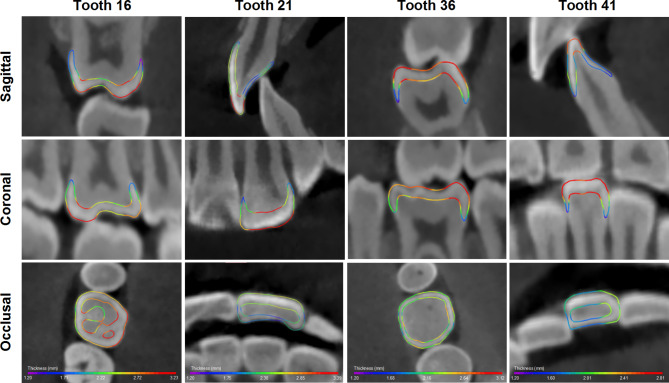
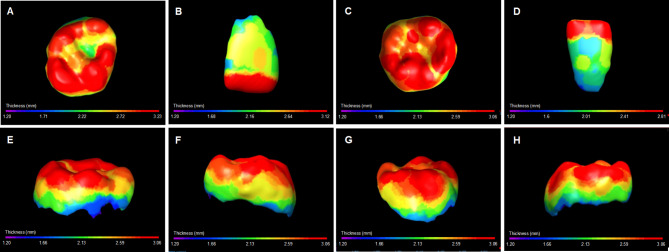
We propose a fully automated computer-aided enamel segmentation model based on an instance segmentation network, 2.5D Attention U-Net. After data annotation and augmentation, the model is trained using manually annotated segmented enamel data, and its performance is evaluated using the Dice similarity coefficient metrics. A satisfactory image segmentation model is applied to generate a 3D enamel model for each tooth and to calculate the thickness value of individual enclosed 3D enamel meshes using a normal ray-tracing directional method.
The model achieves the Dice score on the enamel segmentation task of 96.6%. This study provides an intuitive visualization of irregular enamel morphology and a quantitative analysis of three-dimensional enamel thickness variations. The results indicate that enamel is thickest at the incisal edges of anterior teeth and the cusps of posterior teeth, thinning towards the roots. For posterior teeth, the enamel is thinnest at the central fossae area, with mandibular molars having thicker enamel in the central fossae compared to maxillary molars. The average enamel thickness of maxillary incisors, canines, and premolars is greater than that of mandibular incisors, while the opposite is true for molars. Although there are individual variations in enamel thickness, the average enamel thickness graduallly increases from the incisors to the molars among all teeth within the same quadrant.
This study introduces an automatic, efficient, and accurate 2.5D Attention U-Net system to enhance precise and efficient chair-side diagnosis and treatment of enamel-related diseases in clinical settings, marking a significant advancement in automated diagnostics for enamel-related conditions.
建立准确、可靠且便捷的牙釉质分割与分析方法,对于有效规划牙髓病、正畸和修复治疗,以及探索哺乳动物的进化模式至关重要。然而,目前临床牙科中尚无成熟的非破坏性方法能够在椅旁快速、准确且全面地评估牙釉质的完整性和厚度。本研究旨在开发一种深度学习模型——2.5D注意力U-Net,在小样本数据集上进行训练,以在临床环境中自动、高效且准确地分割所有牙齿的牙釉质。
我们提出了一种基于实例分割网络2.5D注意力U-Net的全自动计算机辅助牙釉质分割模型。在数据标注和增强后,使用手动标注的分割牙釉质数据对模型进行训练,并使用Dice相似系数指标评估其性能。应用一个令人满意的图像分割模型为每颗牙齿生成三维牙釉质模型,并使用法线光线追踪定向方法计算各个封闭三维牙釉质网格的厚度值。
该模型在牙釉质分割任务上的Dice分数达到96.6%。本研究提供了不规则牙釉质形态的直观可视化以及三维牙釉质厚度变化的定量分析。结果表明,牙釉质在前牙切缘和后牙牙尖处最厚,向牙根方向逐渐变薄。对于后牙,牙釉质在中央窝区域最薄,下颌磨牙中央窝处牙釉质比上颌磨牙更厚。上颌切牙、尖牙和前磨牙的平均牙釉质厚度大于下颌切牙,而磨牙则相反。尽管牙釉质厚度存在个体差异,但同一象限内所有牙齿的平均牙釉质厚度从切牙到磨牙逐渐增加。
本研究引入了一种自动、高效且准确地2.5D注意力U-Net系统,以加强临床环境中牙釉质相关疾病的精确和高效椅旁诊断与治疗,标志着牙釉质相关病症自动诊断方面的重大进展。