Oliveira Charles Paranhos, Sousa Fernanda Campos de, Silva Alex Lopes da, Schultz Érica Beatriz, Valderrama Londoño Roger Iván, Souza Pedro Antônio Reinoso de
Departament of Agricultural Engineering, Universidade Federal de Viçosa, Viçosa 36570-900, Brazil.
Departament of Animal Science, Universidade Federal de Viçosa, Viçosa 36570-900, Brazil.
Animals (Basel). 2025 Jan 17;15(2):249. doi: 10.3390/ani15020249.
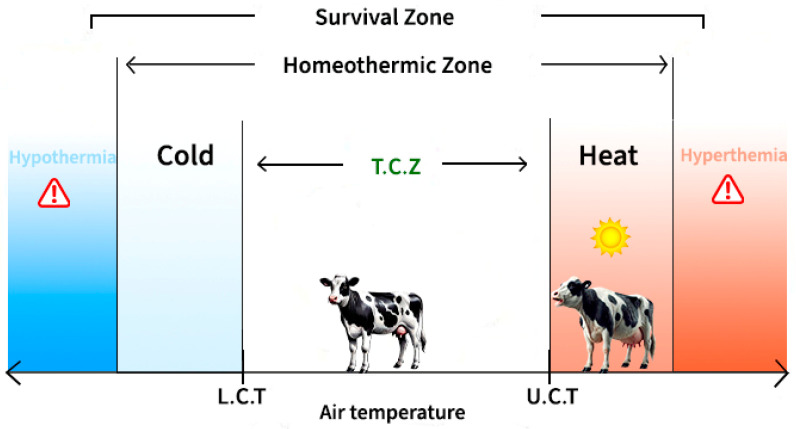
Heat stress in animals affects productivity, health, and reproduction, with particularly pronounced effects in dairy cows. Identifying heat stress requires understanding both physiological and environmental indicators, such as increased heart rate, respiratory rate, and rectal temperature, which reflect the animal's thermal condition within its environment. Thermoregulation in cows involves behavioral and physiological adjustments to maintain homeothermy, aiming to stabilize their internal thermal state. To assess the thermal condition of animals, machine learning models have been developed, leveraging both environmental and physiological indicators for more accurate stress detection. Among the various indices of thermal environment, the Temperature and Humidity Index (THI) is the most widely used. Cooling strategies for animals and their environments are essential to mitigate the effects of heat stress. One effective approach involves the use of evaporative adiabatic cooling combined with forced ventilation systems in feeding alleys and pre-milking holding areas. This method enhances evaporative exchanges and facilitates heat dissipation between the animal and its surroundings, thereby alleviating heat stress and improving both the welfare and productivity of dairy cows.
动物热应激会影响其生产性能、健康和繁殖,对奶牛的影响尤为显著。识别热应激需要了解生理和环境指标,如心率加快、呼吸频率增加和直肠温度升高,这些指标反映了动物在其环境中的热状况。奶牛的体温调节涉及行为和生理调节,以维持体温恒定,旨在稳定其内部热状态。为了评估动物的热状况,已经开发了机器学习模型,利用环境和生理指标进行更准确的应激检测。在各种热环境指标中,温度湿度指数(THI)是使用最广泛的。动物及其环境的降温策略对于减轻热应激的影响至关重要。一种有效的方法是在饲养通道和挤奶前的待挤区使用蒸发绝热冷却与强制通风系统相结合。这种方法增强了蒸发交换,促进了动物与其周围环境之间的散热,从而减轻热应激,提高奶牛的福利和生产性能。