Gardetto Alexander, Müller-Putz Gernot R, Eberlin Kyle R, Bassetto Franco, Atkins Diane J, Turri Mara, Peternell Gerfried, Neuper Ortrun, Ernst Jennifer
Division of Plastic, Aesthetic and Reconstructive Surgery with Hand Surgery, Brixsana Private Clinic, Julius Durst 28, 39042 Bressanone, Italy.
Clinic of Plastic, Reconstructive and Aesthetic Surgery, Padova University Hospital, Via Nicolo Giustiniani 2, 35128 Padova, Italy.
J Clin Med. 2025 Jan 10;14(2):417. doi: 10.3390/jcm14020417.
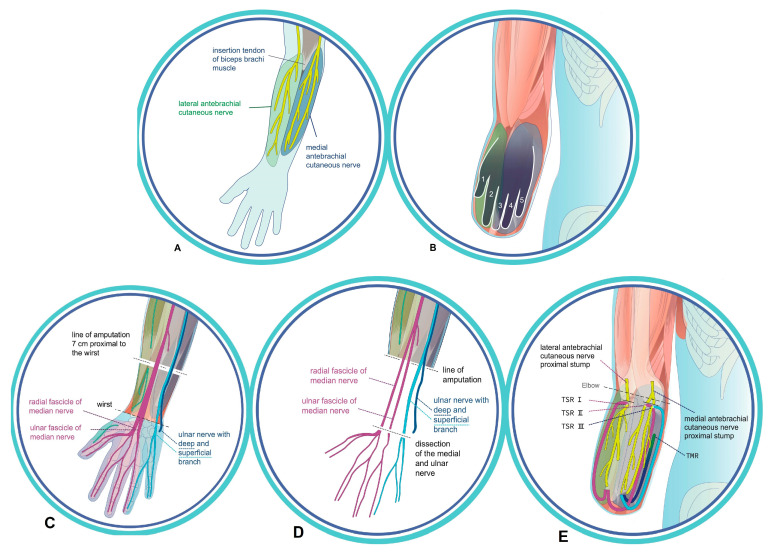
: Tactile gnosis derives from the interplay between the hand's tactile input and the memory systems of the brain. It is the prerequisite for complex hand functions. Impaired sensation leads to profound disability. Various invasive and non-invasive sensory substitution strategies for providing feedback from prostheses have been unsuccessful when translated to clinical practice, since they fail to match the feeling to genuine sensation of the somatosensory cortex. Herein, we describe a novel surgical technique for upper-limb-targeted sensory reinnervation (ulTSR) and report how single digital nerves selectively reinnervate the forearm skin and restore the spatial sensory capacity of single digits of the amputated hand in a case series of seven patients. We explore the interplay of the redirected residual digital nerves and the interpretation of sensory perception after reinnervation of the forearm skin in the somatosensory cortex by evaluating sensory nerve action potentials (SNAPs), somatosensory evoked potentials (SEPs), and amputation-associated pain qualities. Digital nerves were rerouted and reliably reinnervated the forearm skin after hand amputation, leading to somatotopy and limb maps of the thumb and four individual fingers. SNAPs were obtained from the donor digital nerves after stimulating the recipient sensory nerves of the forearm. Matching SEPs were obtained after electrocutaneous stimulation of the reinnervated skin areas of the forearm where the thumb, index, and little fingers are perceived. Pain incidence was significantly reduced or even fully resolved. We propose that ulTSR can lead to higher acceptance of prosthetic hands and substantially reduce the incidence of phantom limb and neuroma pain. In addition, the spatial restoration of lost-hand sensing and the somatotopic reinnervation of the forearm skin may serve as a machine interface, allowing for genuine sensation and embodiment of the prosthetic hand without the need for complex neural coding adjustments.
触觉认知源于手部触觉输入与大脑记忆系统之间的相互作用。它是复杂手部功能的先决条件。感觉受损会导致严重残疾。各种用于从假肢提供反馈的侵入性和非侵入性感觉替代策略在转化为临床实践时均未成功,因为它们无法使感觉与体感皮层的真实感觉相匹配。在此,我们描述一种用于上肢靶向感觉再支配(ulTSR)的新型手术技术,并报告在一组7例患者中,单根指神经如何选择性地再支配前臂皮肤并恢复截肢手单个手指的空间感觉能力。我们通过评估感觉神经动作电位(SNAPs)、体感诱发电位(SEPs)和截肢相关的疼痛性质,探讨重新定向的残余指神经之间的相互作用以及前臂皮肤在体感皮层再支配后感觉感知的解释。手部截肢后,指神经被重新路由并可靠地再支配前臂皮肤,形成拇指和四个手指的躯体定位和肢体图谱。在前臂的受体感觉神经受到刺激后,从供体指神经获得SNAPs。在前臂重新支配的皮肤区域进行电皮肤刺激后,获得匹配的SEPs,在这些区域可感知到拇指、食指和小指。疼痛发生率显著降低甚至完全缓解。我们提出,ulTSR可提高对假肢手的接受度,并大幅降低幻肢和神经瘤疼痛的发生率。此外,失去手部感觉的空间恢复和前臂皮肤的躯体定位再支配可作为一种机器接口,无需复杂的神经编码调整就能实现假肢手的真实感觉和实体化。