
基于迁移学习的地面目标识别方法
Ground-Target Recognition Method Based on Transfer Learning.
作者信息
Zhou Qiuzhan, Hu Jikang, Wu Huinan, Wang Cong, Liu Pingping, Yao Xinyi
机构信息
College of Communication Engineering, Jilin University, Changchun 130012, China.
College of Computer Science and Technology, Jilin University, Changchun 130012, China.
出版信息
Sensors (Basel). 2025 Jan 20;25(2):576. doi: 10.3390/s25020576.
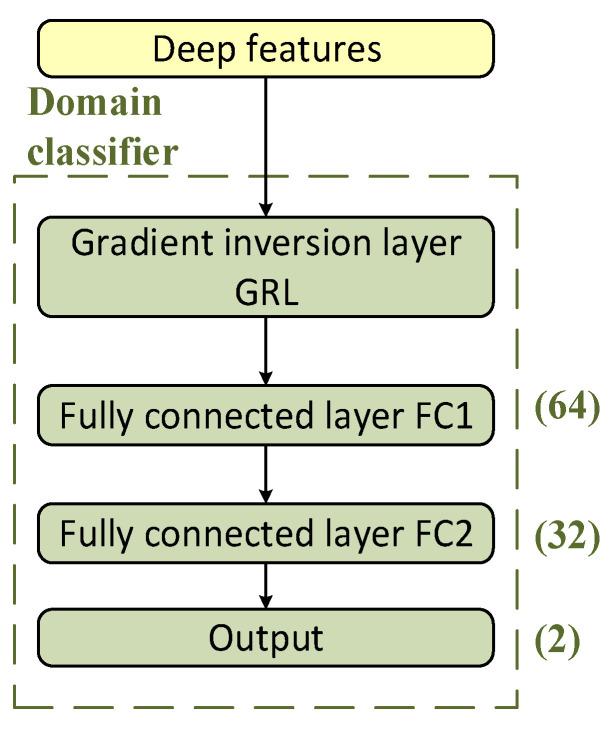
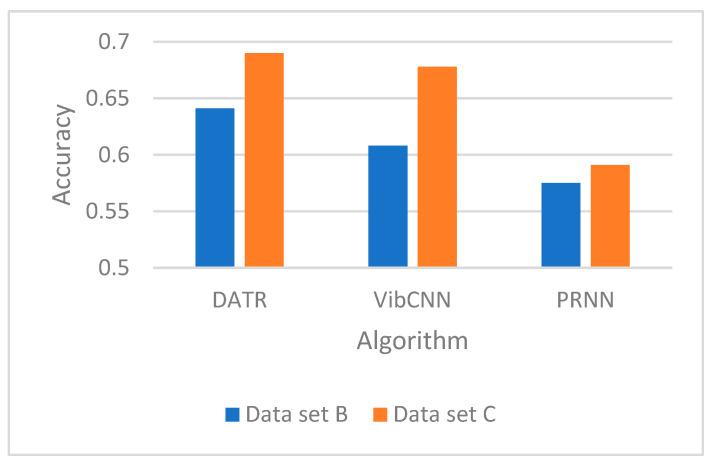
A moving ground-target recognition system can monitor suspicious activities of pedestrians and vehicles in key areas. Currently, most target recognition systems are based on devices such as fiber optics, radar, and vibration sensors. A system based on vibration sensors has the advantages of small size, low power consumption, strong concealment, easy installation, and low power consumption. However, existing recognition algorithms generally suffer from problems such as the inability to recognize long-distance moving targets and adapt to new environments, as well as low recognition accuracy. Here, we demonstrate that applying transfer learning to recognition algorithms can adapt to new environments and improve accuracy. We proposed a new moving ground-target recognition algorithm based on CNN and domain adaptation. We used convolutional neural networks (CNNS) to extract depth features from target vibration signals to identify target types. We used transfer learning to make the algorithm more adaptable to environmental changes. Our results show that the proposed moving ground-target recognition algorithm can identify target types, improve accuracy, and adapt to a new environment with good performance. We anticipate that our algorithm will be the starting point for more complex recognition algorithms. For example, target recognition algorithms based on multi-modal fusion and transfer learning can better meet actual needs.
移动地面目标识别系统可以监测关键区域内行人及车辆的可疑活动。当前,大多数目标识别系统基于光纤、雷达和振动传感器等设备。基于振动传感器的系统具有体积小、功耗低、隐蔽性强、易于安装且功耗低等优点。然而,现有的识别算法普遍存在无法识别远距离移动目标、难以适应新环境以及识别准确率低等问题。在此,我们证明将迁移学习应用于识别算法能够适应新环境并提高准确率。我们提出了一种基于卷积神经网络(CNN)和域自适应的新型移动地面目标识别算法。我们使用卷积神经网络(CNNS)从目标振动信号中提取深度特征以识别目标类型。我们利用迁移学习使算法更能适应环境变化。我们的结果表明,所提出的移动地面目标识别算法能够识别目标类型、提高准确率并以良好的性能适应新环境。我们预计我们的算法将成为更复杂识别算法的起点。例如,基于多模态融合和迁移学习的目标识别算法能够更好地满足实际需求。





 Zotero 插件