de Mezer Mateusz, Chalama Nina, Bratt Cheyanna, Kiebalo Melanie, Dolata Natalia, Rogaliński Jan, Leszczyńska Małgorzata
Department of Immunobiology, Poznań University of Medical Sciences, Rokietnicka 8 St., 60-812 Poznań, Poland.
Department of Otolaryngology and Laryngological Oncology, Poznań University of Medical Sciences, Przybyszewskiego 49 St., 60-355 Poznań, Poland.
Pathogens. 2024 Dec 30;14(1):14. doi: 10.3390/pathogens14010014.
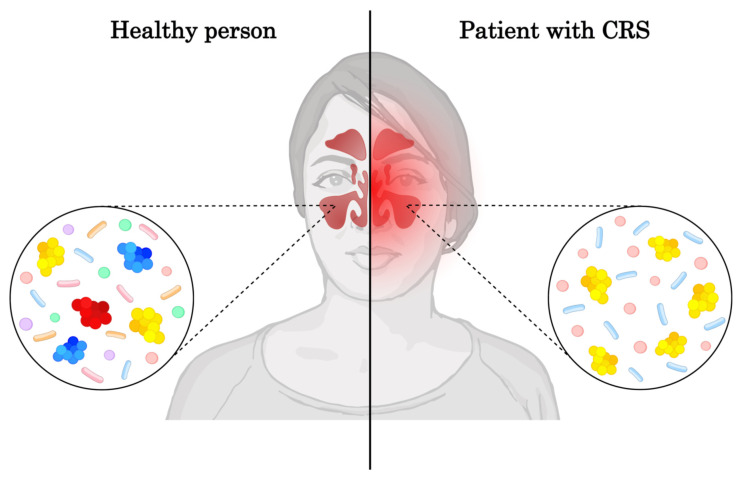
Chronic rhinosinusitis (CRS) is a common inflammatory disease of the paranasal sinuses with a yet unknown etiology. As studies continue to elucidate the disease's heterogeneity inflammatory profile and presentation, there is a growing interest in the influence of the nasal microbiome on disease pathogenesis and chronicity. The sinus microbiota appear dominated by the and genera; known upper airway pathogens, such as , are present in the upper airways of healthy individuals, though at relatively lower abundances than in CRS patients. Viral culprits may induce an unhindered local immune response that contributes to the recurrence and chronicity of inverted papillomas-benign mucosal lesions with the propensity for local destruction and malignant transformation that can be found in patients with a history of nasal infection. The persistence of inverted papillomas warrants investigation into their pathogenesis and how they may contribute to a nasal landscape promoting the chronicity of CRS. Further investigation is needed to uncover the interplay between resident microbiota and viral, fungal, and immunological influence. Discerning between 'healthy' and 'diseased' sinonasal microbiomes and 'keystone' species could shed light on CRS etiology and provide the opportunity for CRS treatment tailored to an individual's microbiome. This review aims to explore the interrelation of microbial residents in the pathogenesis and chronicity of the diseased sinonasal environment.
慢性鼻-鼻窦炎(CRS)是一种常见的鼻窦炎性疾病,其病因尚不明确。随着研究不断阐明该疾病的异质性炎症特征和表现,鼻腔微生物群对疾病发病机制和慢性化的影响越来越受到关注。鼻窦微生物群似乎以[具体菌属1]和[具体菌属2]为主;已知的上呼吸道病原体,如[具体病原体],在健康个体的上呼吸道中也存在,但其丰度相对低于CRS患者。病毒病原体可能引发不受阻碍的局部免疫反应,这有助于内翻性乳头状瘤(一种良性黏膜病变,有局部破坏和恶变倾向,可在有鼻感染病史的患者中发现)的复发和慢性化。内翻性乳头状瘤的持续存在值得对其发病机制以及它们如何促进CRS慢性化的鼻腔环境进行研究。需要进一步研究以揭示常驻微生物群与病毒、真菌和免疫影响之间的相互作用。区分“健康”和“患病”的鼻窦微生物群以及“关键”物种,可能有助于阐明CRS的病因,并为根据个体微生物群定制CRS治疗提供机会。本综述旨在探讨患病鼻窦环境中微生物群落与发病机制和慢性化之间的相互关系。