Tyagi Suresh C
Department of Physiology, University of Louisville School of Medicine, Louisville, KY 40202, USA.
Nutrients. 2025 Jan 8;17(2):216. doi: 10.3390/nu17020216.
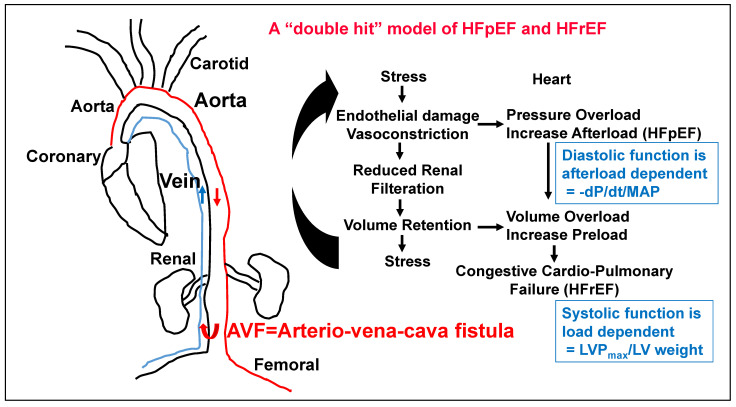
BACKGROUND/OBJECTIVES: Chronic gut dysbiosis due to a high-fat diet (HFD) instigates cardiac remodeling and heart failure with preserved ejection fraction (HFpEF), in particular, kidney/volume-dependent HFpEF. Studies report that although mitochondrial ATP citrate lyase (ACLY) supports cardiac function, it decreases more in human HFpEF than HFrEF. Interestingly, ACLY synthesizes lipids and creates hyperlipidemia. Epigenetically, ACLY acetylates histone. The mechanism(s) are largely unknown.
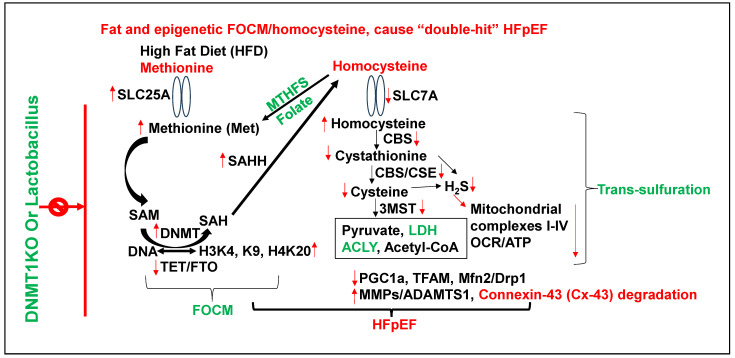
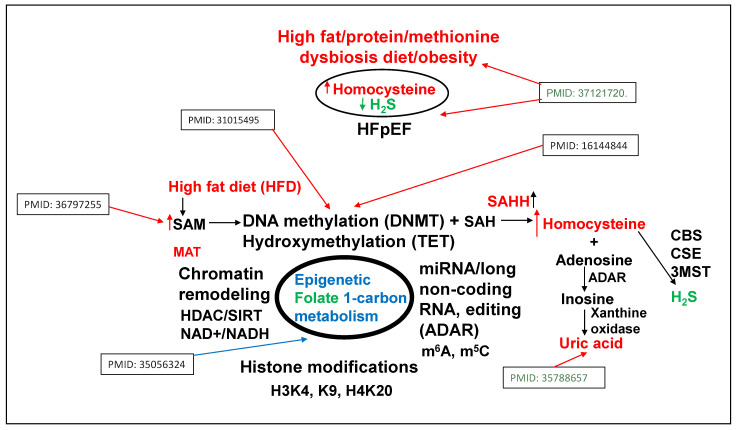
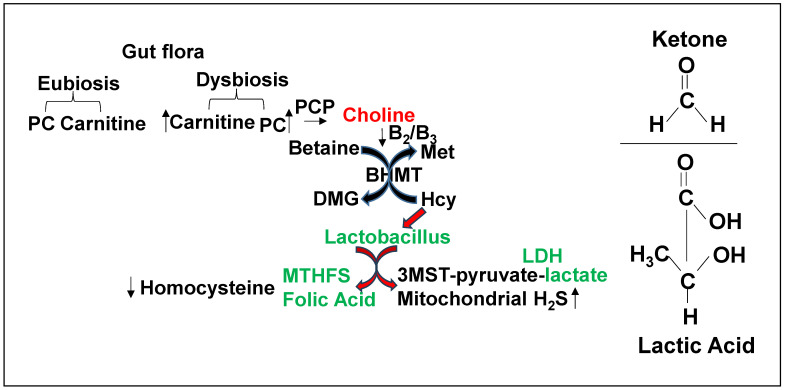
METHODS/RESULTS: One hypothesis is that an HFD induces epigenetic folate 1-carbon metabolism (FOCM) and homocystinuria. This abrogates dipping in sleep-time blood pressure and causes hypertension and morning heart attacks. We observed that probiotics/lactobacillus utilize fat/lipids post-biotically, increasing mitochondrial bioenergetics and attenuating HFpEF. We suggest novel and paradigm-shift epigenetic mitochondrial sulfur trans-sulfuration pathways that selectively target HFD-induced HFpEF. Previous studies from our laboratory, using a single-cell analysis, revealed an increase in the transporter (SLC25A) of s-adenosine-methionine (SAM) during elevated levels of homocysteine (Hcy, i.e., homocystinuria, HHcy), a consequence of impaired epigenetic recycling of Hcy back to methionine due to an increase in the FOCM methylation of H3K4, K9, H4K20, and gene writer (DNMT) and decrease in eraser (TET/FTO). Hcy is transported to mitochondria by SLC7A for clearance via sulfur metabolomic trans-sulfuration by 3-mercaptopyruvate sulfur transferase (3MST).
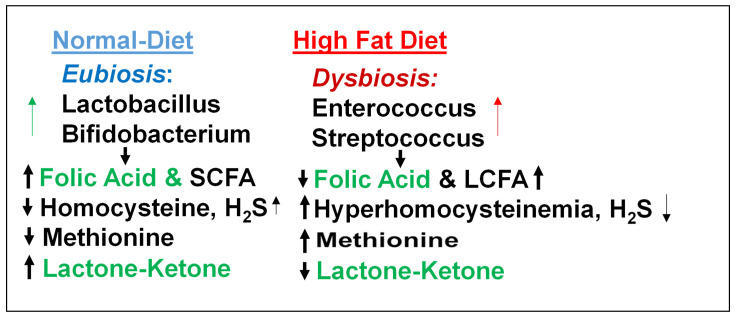
We conclude that gut dysbiosis due to HFD disrupts rhythmic epigenetic memory via FOCM and increases in DNMT1 and creates homocystinuria, leading to a decrease in mitochondrial trans-sulfuration and bioenergetics. The treatment with lactobacillus metabolites fat/lipids post-biotically and bi-directionally produces folic acid and lactone-ketone body that mitigates the HFD-induced mitochondrial remodeling and HFpEF.
背景/目的:高脂饮食(HFD)导致的慢性肠道菌群失调会引发心脏重塑以及射血分数保留的心力衰竭(HFpEF),尤其是肾/容量依赖性HFpEF。研究报告称,尽管线粒体ATP柠檬酸裂解酶(ACLY)对心脏功能有支持作用,但在人类HFpEF中其减少程度比射血分数降低的心力衰竭(HFrEF)更大。有趣的是,ACLY能合成脂质并导致高脂血症。在表观遗传学上,ACLY会使组蛋白乙酰化。其机制在很大程度上尚不清楚。
方法/结果:一种假说认为,高脂饮食会诱导表观遗传叶酸一碳代谢(FOCM)和高同型半胱氨酸尿症。这会消除睡眠时血压的下降,并导致高血压和清晨心脏病发作。我们观察到,益生菌/乳酸菌在生物转化后利用脂肪/脂质,增加线粒体生物能量学并减轻HFpEF。我们提出了新的、范式转变的表观遗传线粒体硫转硫途径,该途径选择性地针对高脂饮食诱导的HFpEF。我们实验室之前的研究使用单细胞分析发现,在同型半胱氨酸(Hcy,即高同型半胱氨酸尿症,HHcy)水平升高期间,s-腺苷甲硫氨酸(SAM)的转运体(SLC25A)增加,这是由于Hcy表观遗传循环回甲硫氨酸受损所致,原因是H3K4、K9、H4K20的FOCM甲基化增加以及基因写入器(DNMT)增加和擦除器(TET/FTO)减少。Hcy通过SLC7A转运到线粒体,通过3-巯基丙酮酸硫转移酶(3MST)的硫代谢组转硫作用进行清除。
我们得出结论,高脂饮食导致的肠道菌群失调通过FOCM破坏节律性表观遗传记忆,增加DNMT1并导致高同型半胱氨酸尿症,从而导致线粒体转硫和生物能量学下降。乳酸菌代谢产物对脂肪/脂质进行生物转化后双向产生叶酸和内酯-酮体,可减轻高脂饮食诱导的线粒体重塑和HFpEF。