Arani Gayatri, Arora Amit, Yang Shuai, Wu Jingyue, Kraszewski Jennifer N, Martins Amy, Miller Alexandra, Zeba Zebunnesa, Jafri Ayan, Hu Chengcheng, Farland Leslie V, Bea Jennifer W, Coletta Dawn K, Aslan Daniel H, Sayre M Katherine, Bharadwaj Pradyumna K, Ally Madeline, Maltagliati Silvio, Lai Mark H C, Wilcox Rand, de Geus Eco, Alexander Gene E, Raichlen David A, Klimentidis Yann C
Department of Epidemiology and Biostatistics, College of Public Health, University of Arizona, Tucson, AZ, USA.
Department of Biomedical Informatics, College of Health Solutions, Arizona State University, Tempe, AZ, USA.
medRxiv. 2025 Jan 31:2025.01.16.25320290. doi: 10.1101/2025.01.16.25320290.
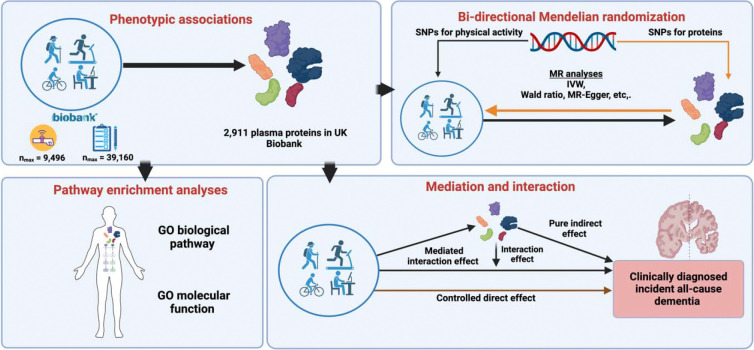
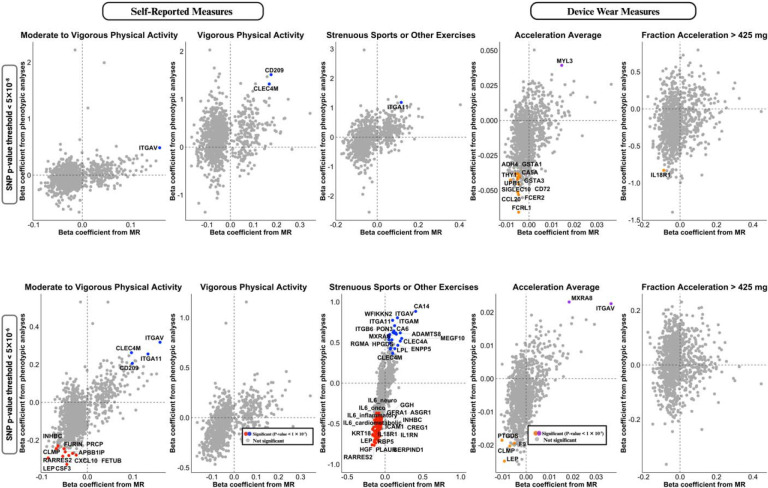
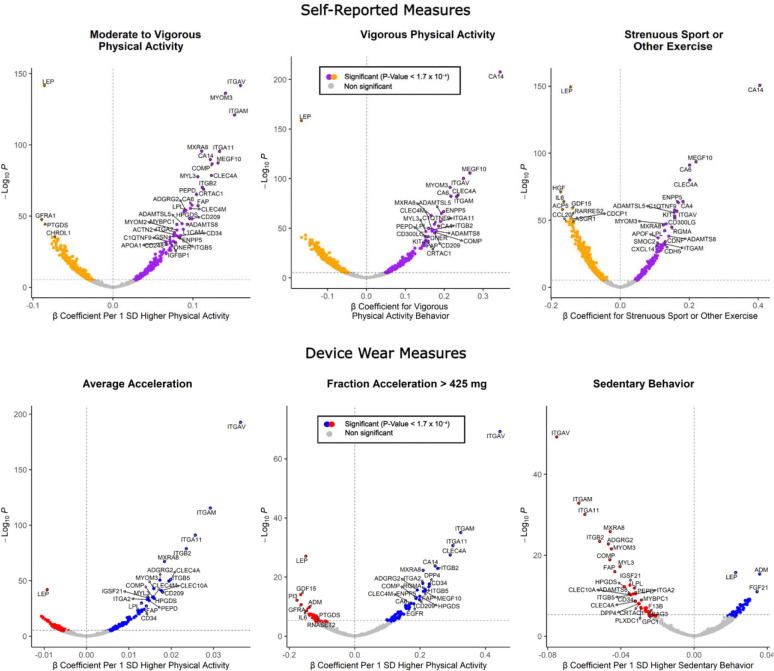
Physical activity (PA), including sedentary behavior, is associated with many diseases, including Alzheimer's disease and all-cause dementia. However, the specific biological mechanisms through which PA protects against disease are not entirely understood. To address this knowledge gap, we first assessed the conventional observational associations of three self-reported and three device-based PA measures with circulating levels of 2,911 plasma proteins measured in the UK Biobank (n=39,160) and assessed functional enrichment of identified proteins. We then used bi-directional Mendelian randomization (MR) to further evaluate the evidence for causal relationships of PA with protein levels. Finally, we performed mediation analyses to identify proteins that may mediate the relationship of PA with incident all-cause dementia. Our findings revealed 41 proteins consistently associated with all PA measures and 1,027 proteins associated with at least one PA measure. Both conventional observational and MR study designs converged on proteins that appear to increase as a result of PA, including integrin proteins such as ITGAV and ITGAM, as well as MXRA8, CLEC4A, CLEC4M, GFRA1, and ADGRG2; and on proteins that appear to decrease as a result of PA such as LEP, LPL, INHBC, CLMP, PTGDS, ADM, OGN, and PI3. Functional enrichment analyses revealed several relevant processes, including cell-matrix adhesion, integrin-mediated signaling, and collagen binding. Finally, several proteins, including GDF15, ITGAV, HPGDS, BCAN, and MENT, were found to mediate the relationship of PA with all-cause dementia, implicating processes such as synaptic plasticity, neurogenesis and inflammation, through which PA protects against dementia. Our results provide insights into how PA may affect biological processes and protect from all-cause dementia, and provide avenues for future research into the health-promoting effects of PA.
身体活动(PA),包括久坐行为,与许多疾病相关,包括阿尔茨海默病和全因性痴呆。然而,PA预防疾病的具体生物学机制尚未完全明确。为填补这一知识空白,我们首先评估了三种自我报告的和三种基于设备的PA测量方法与英国生物银行(n = 39160)中测量的2911种血浆蛋白循环水平之间的传统观察性关联,并评估了所鉴定蛋白质的功能富集情况。然后,我们使用双向孟德尔随机化(MR)进一步评估PA与蛋白质水平因果关系的证据。最后,我们进行了中介分析,以确定可能介导PA与全因性痴呆发病关系的蛋白质。我们的研究结果显示,41种蛋白质与所有PA测量方法始终相关,1027种蛋白质与至少一种PA测量方法相关。传统观察性研究设计和MR研究设计均聚焦于因PA而似乎增加的蛋白质,包括整合素蛋白如ITGAV和ITGAM,以及MXRA8、CLEC4A、CLEC4M、GFRA1和ADGRG2;以及因PA而似乎减少的蛋白质,如LEP、LPL、INHBC、CLMP、PTGDS、ADM、OGN和PI3。功能富集分析揭示了几个相关过程,包括细胞-基质粘附、整合素介导的信号传导和胶原蛋白结合。最后,发现包括GDF15、ITGAV、HPGDS、BCAN和MENT在内的几种蛋白质介导了PA与全因性痴呆的关系,暗示了诸如突触可塑性、神经发生和炎症等过程,PA通过这些过程预防痴呆。我们的结果为PA如何影响生物学过程和预防全因性痴呆提供了见解,并为未来研究PA的健康促进作用提供了途径。