Sloan Katylynn B, Maughan Michele N, Sharpes Caitlin E, Greubel Robin R, Gallegos Shawna F, Miklos Aleksandr E, Waldrop Lindsay D
Advanced Research and Capabilities Division, United States Secret Service, Washington, DC, United States.
Precise Systems, Inc., Lexington Park, MD, United States.
Front Allergy. 2025 Jan 7;5:1445570. doi: 10.3389/falgy.2024.1445570. eCollection 2024.
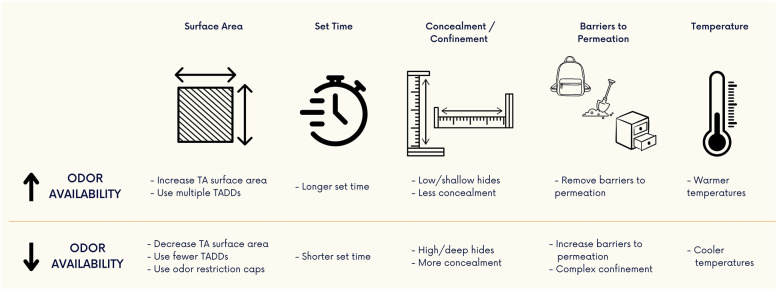
Detection canines can identify numerous substances for which they have been trained. Historically, and a point of ongoing contention, detection canine threshold (i.e., sensitivity or limit of detection) training has primarily focused on changing the weight of the training aid substance used. There has been minimal focus on other principles, such as surface area, confinement, and temperature, which can be manipulated to affect odor availability. That said, trainers have been manipulating odor availability for years without necessarily understanding the governing scientific principles. The aim of this review is to highlight the principles that control odor availability of a substance and how an end user can apply these principles for operational detection canine training needs.
缉毒犬能够识别许多它们接受过训练的物质。从历史上看,并且这也是一个持续存在争议的问题,缉毒犬阈值(即灵敏度或检测限)训练主要集中在改变所使用的训练辅助物质的重量上。对于其他一些可以操控以影响气味可获得性的因素,比如表面积、封闭性和温度,关注极少。也就是说,训练人员多年来一直在操控气味可获得性,但不一定理解其中起主导作用的科学原理。这篇综述的目的是强调控制物质气味可获得性的原理,以及终端用户如何将这些原理应用于缉毒犬的实际训练需求。