Nishioka Kentaro, Ishimoto Takahiro, Sato Mariko, Yasuda Ruki, Nakamura Yumi, Watanabe Hiroshi, Suzuki Toshihide, Araragi Yudai, Kato Yukio, Yoshida Ken-Ichi, Murayama Norihito
Research Institute, Suntory Global Innovation Center Ltd., Kyoto, Japan.
Faculty of Pharmacy, Institute of Medical, Pharmaceutical and Health Sciences, Kanazawa University, Kanazawa, Japan.
Front Nutr. 2025 Jan 8;11:1470331. doi: 10.3389/fnut.2024.1470331. eCollection 2024.
The brain uses ketones, mainly 3-hydroxybutyrate (3-HB), as an alternative energy source. Therefore, oral intake of 3-HB may help maintain brain health. Previous studies indicated that achieving a maximum concentration (C) of 3-HB in plasma at 0.28 mM could initiate ketone metabolism in the brain; we hypothesized that attaining this C would improve brain health.
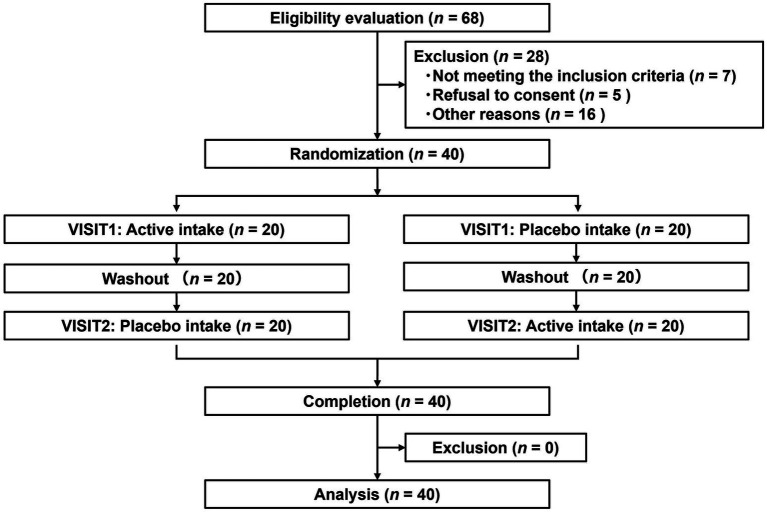
We aimed to demonstrate the efficacy of an optimized single oral dose of 3-HB on cognitive function and mood through two clinical studies: a pharmacokinetic study and an efficacy study. In the pharmacokinetic study, healthy subjects were ingested 2 and 4 g of 3-HB to construct a compartment model to predict the minimum oral dose of 3-HB needed to achieve the target C. In the efficacy study, a randomized, double-blinded, and placebo-controlled crossover trial, the effects of 3-HB at the predicted doses on cognitive function and mood in healthy subjects were assessed by a serial arithmetic test (SAT), the cognitrax, the profile of mood states 2nd edition (POMS2), and fatigue visual analog scale (VAS).
In the pharmacokinetic study, a one-compartment model that includes saturable and non-saturable absorption pathways, constant biosynthesis, and the linear elimination of 3-HB after oral administration were constructed. The model principally reflected the observed serum 3-HB concentrations profiles and predicted a minimum dose of 3.5 g needed to achieve the target C. In the efficacy study, although no significant difference was observed in any cognitive domains assessed by the Cognitrax, total responses and correct answers in the SAT were significantly improved in the active group receiving 3.5 g of 3-HB compared to the placebo group. Regarding the POMS2, confusion-bewilderment, fatigue-inertia, vigor-activity, and total mood disturbance scales were significantly improved in the active group compared to the placebo group. Additionally, fatigue VAS were also significantly improved in the active group compared to the placebo group.
We successfully established a one-compartment model for oral 3-HB intake and demonstrated partial efficacy on cognitive function and broad efficacy on mood in healthy subjects with a single oral dose of 3.5 g of 3-HB optimized by the model.
https://www.umin.ac.jp/ctr/index-j.htm, identifier [UMIN000042095, UMIN000046666].
大脑将酮类,主要是3-羟基丁酸(3-HB)用作替代能源。因此,口服3-HB可能有助于维持大脑健康。先前的研究表明,血浆中3-HB的最大浓度(C)达到0.28 mM时可启动大脑中的酮代谢;我们假设达到该C值将改善大脑健康。
我们旨在通过两项临床研究证明优化后的单次口服剂量3-HB对认知功能和情绪的疗效:一项药代动力学研究和一项疗效研究。在药代动力学研究中,健康受试者摄入2克和4克3-HB以构建房室模型,以预测达到目标C所需的3-HB最小口服剂量。在疗效研究中,进行了一项随机、双盲、安慰剂对照的交叉试验,通过串行算术测试(SAT)、认知轨迹测试、情绪状态量表第二版(POMS2)和疲劳视觉模拟量表(VAS)评估了预测剂量的3-HB对健康受试者认知功能和情绪的影响。
在药代动力学研究中,构建了一个房室模型,该模型包括饱和和非饱和吸收途径、恒定的生物合成以及口服给药后3-HB的线性消除。该模型主要反映了观察到的血清3-HB浓度曲线,并预测达到目标C所需的最小剂量为3.5克。在疗效研究中,尽管认知轨迹测试评估的任何认知领域均未观察到显著差异,但与安慰剂组相比,接受3.5克3-HB的活性组在SAT中的总反应和正确答案有显著改善。关于POMS2,与安慰剂组相比,活性组的困惑-迷茫、疲劳-惰性、活力-活动和总情绪紊乱量表有显著改善。此外,与安慰剂组相比,活性组的疲劳VAS也有显著改善。
我们成功建立了口服3-HB摄入的房室模型,并通过该模型优化的单次口服3.5克3-HB证明了其对健康受试者认知功能的部分疗效和对情绪的广泛疗效。
https://www.umin.ac.jp/ctr/index-j.htm,标识符[UMIN000042095,UMIN000046666]。