Song Wei, Ovcharenko Ivan
Computational Biology Branch, National Center for Biotechnology Information, National Library of Medicine, National Institutes of Health, Bethesda, MD, USA.
iScience. 2024 Dec 20;28(1):111658. doi: 10.1016/j.isci.2024.111658. eCollection 2025 Jan 17.
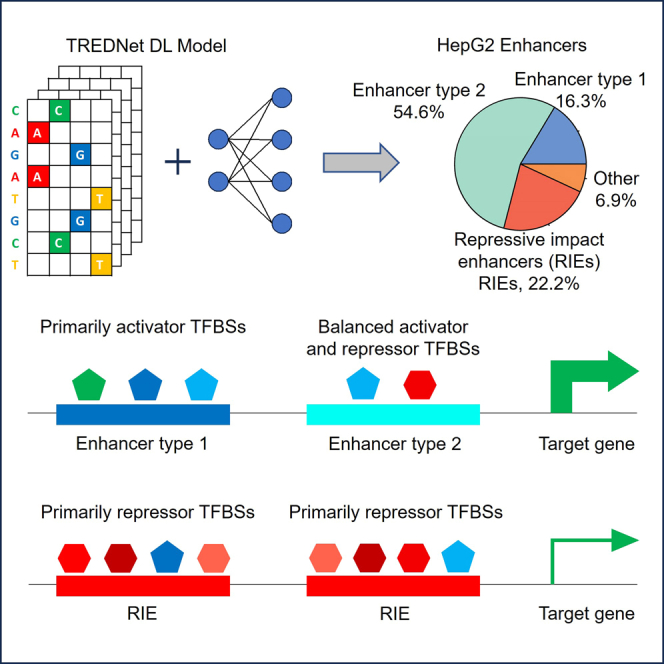
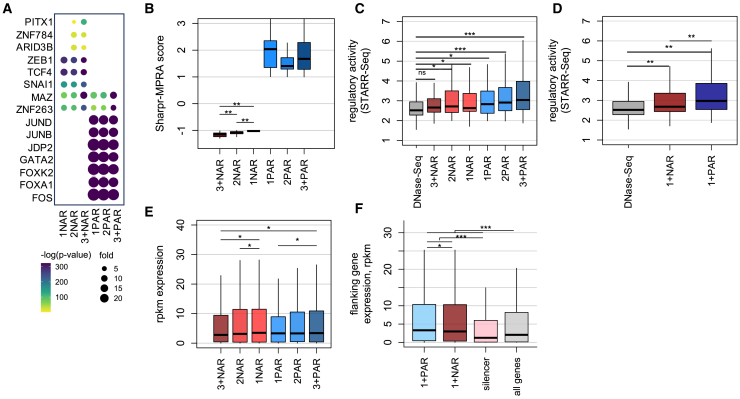
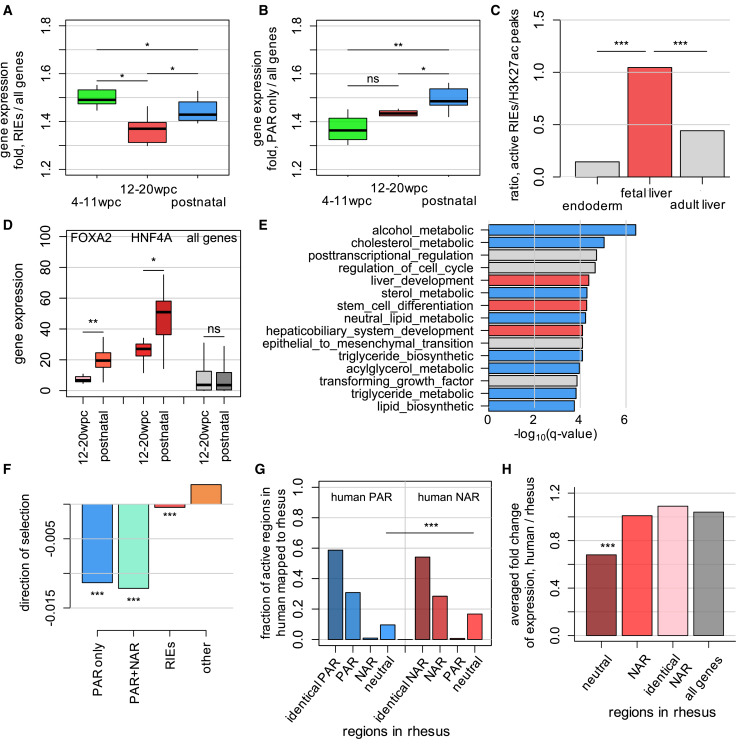
The regulation of gene expression relies on the coordinated action of transcription factors (TFs) at enhancers, including both activator and repressor TFs. We employed deep learning (DL) to dissect HepG2 enhancers into positive (PAR), negative (NAR), and neutral activity regions. Sharpr-MPRA and STARR-seq highlight the dichotomy impact of NARs and PARs on modulating and catalyzing the activity of enhancers, respectively. Approximately 22% of HepG2 enhancers, termed "repressive impact enhancers" (RIEs), are predominantly populated by NARs and transcriptional repression motifs. Genes flanking RIEs exhibit a stage-specific decline in expression during late development, suggesting RIEs' role in trimming enhancer activities. About 16.7% of human NARs emerge from neutral rhesus macaque DNA. This gain of repressor binding sites in RIEs is associated with a 30% decrease in the average expression of flanking genes in humans compared to rhesus macaque. Our work reveals modulated enhancer activity and adaptable gene regulation through the evolutionary dynamics of TF binding sites.
基因表达的调控依赖于转录因子(TFs)在增强子上的协同作用,包括激活型和抑制型转录因子。我们运用深度学习(DL)将HepG2增强子解析为正性(PAR)、负性(NAR)和中性活性区域。Sharpr-MPRA和STARR-seq分别突出了NAR和PAR对调节和催化增强子活性的二分法影响。约22%的HepG2增强子,称为“抑制性影响增强子”(RIEs),主要由NAR和转录抑制基序组成。RIEs侧翼的基因在发育后期表现出阶段特异性的表达下降,表明RIEs在微调增强子活性中的作用。约16.7%的人类NARs源自恒河猴的中性DNA。与恒河猴相比,RIEs中抑制因子结合位点的增加与人类侧翼基因平均表达降低30%相关。我们的工作揭示了通过转录因子结合位点的进化动态来调节增强子活性和适应性基因调控。