Loban Katya, Trinh Emilie, Gaudio Kathleen, Nijjar Diya, Robert Jorane-Tiana, Lam Ngan, McKay Scott, Badenoch Heather, Fortin Marie-Chantal, Bugeja Ann, Mainra Rahul, Dipchand Christine, Sandal Shaifali
MEDIC, Research Institute of the McGill University Health Centre, Montreal, Quebec, Canada.
Division of Experimental Medicine, Department of Medicine, McGill University, Montreal, Quebec, Canada.
Clin Transplant. 2025 Feb;39(2):e70085. doi: 10.1111/ctr.70085.
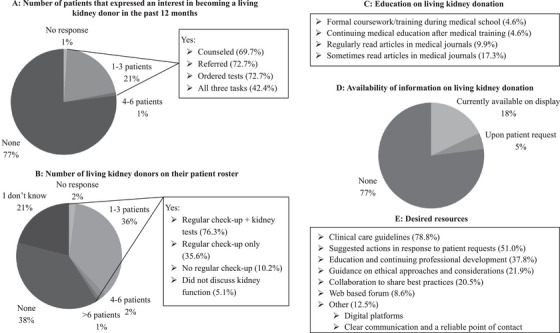
Optimizing the long-term care and follow-up of living kidney donors (LKDs) has been challenging, and prior LKDs have reported suboptimal healthcare experiences. Long-term care of LKDs is largely undertaken by primary care practitioners such as family physicians (FPs). We conducted a cross-sectional survey of Canadian FPs (n = 151). In our sample, 21.9% of participants reported that ≥1 patient had expressed interest in becoming a LKD, and 39.9% provided care to prior LKDs. While 55.5% knew how to find information on living kidney donation, 75.5% reported that information was not available in their practice. Only a minority had formal training in living kidney donation (<5%), and self-reported knowledge was low (median = 3 [scale 1 = not strong to 10 = very strong]). Knowledge improved significantly with educational activities, resources, experience, and practice needs. Attitudes toward living kidney donation were generally favorable with 71.5% stating that FPs should be involved in post-donation care. Clinical care guidelines (78.8%) were the most desired resource, followed by clear communication and reliable contact at transplant centers. Our findings inform the transplant community of an avenue to optimize LKD care by better-supporting FPs, who provide care to LKDs. This may enhance data collection on LKD outcomes and potentially increase donation rates.
优化活体肾供体(LKDs)的长期护理和随访一直具有挑战性,既往的活体肾供体报告称其医疗体验欠佳。LKDs的长期护理主要由家庭医生等初级保健从业者承担。我们对加拿大的家庭医生(n = 151)进行了一项横断面调查。在我们的样本中,21.9%的参与者报告称有≥1名患者表示有兴趣成为活体肾供体,39.9%的参与者为既往的活体肾供体提供护理。虽然55.5%的人知道如何获取有关活体肾捐赠的信息,但75.5%的人报告称其所在机构没有相关信息。只有少数人接受过活体肾捐赠方面的正规培训(<5%),自我报告的知识水平较低(中位数 = 3 [范围1 = 不强到10 = 非常强])。通过教育活动、资源、经验和实践需求,知识水平有了显著提高。对活体肾捐赠的态度总体上是积极的,71.5%的人表示家庭医生应参与捐赠后的护理。临床护理指南(78.8%)是最需要的资源,其次是清晰的沟通和移植中心可靠的联系方式。我们的研究结果为移植界提供了一条途径,即通过更好地支持为LKDs提供护理的家庭医生来优化LKD护理。这可能会加强关于LKD结果的数据收集,并有可能提高捐赠率。