Di Gaohong, Vázquez-Reyes Sandra, Díaz Blanca, Peña-Martinez Carolina, García-Culebras Alicia, Cuartero María I, Moraga Ana, Pradillo Jesús M, Esposito Elga, Lo Eng H, Moro María A, Lizasoain Ignacio
Neurovascular Research Unit, Pharmacology Department, Complutense Medical School, Instituto Investigación Hospital 12 Octubre, Madrid, Spain (G.D., B.D., A.M., J.M.P., I.L.).
Now with Anesthesiology Department, Sixth Hospital Wuhan, Jianghan University, China (G.D.).
Stroke. 2025 Feb;56(2):527-532. doi: 10.1161/STROKEAHA.124.049961. Epub 2025 Jan 27.
Acute ischemic stroke treatment typically involves tissue-type plasminogen activator (tPA) or tenecteplase, but about 50% of patients do not achieve successful reperfusion. The causes of tPA resistance, influenced by thrombus composition and timing, are not fully clear. Neutrophil extracellular traps (NETs), associated with poor outcomes and reperfusion resistance, contribute to thrombosis. DNase-I, which degrades neutrophil extracellular traps, could improve thrombolytic efficacy. However, more studies are needed to understand the impact of DNase-I in tPA-sensitive stroke models, the safety of coadministering DNase-I and tPA regarding hemorrhagic transformation (HT), optimal timing for use, and effects on aspirin-treated animals.
We used in situ thromboembolic stroke, a tPA-sensitive model, where late tPA administration causes HT. Middle cerebral artery occlusion was induced at different zeitgeber times (ZT) to study the optimal timing for administration. DNase-I, tPA, and aspirin were administered at various times to evaluate their effects.
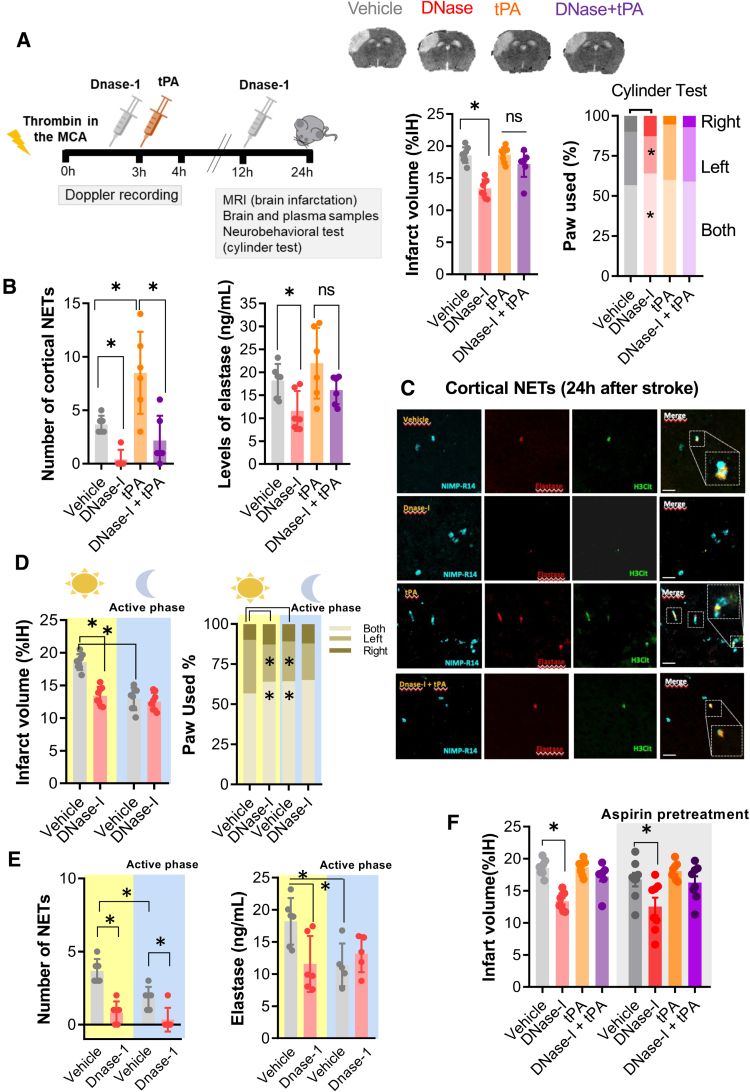
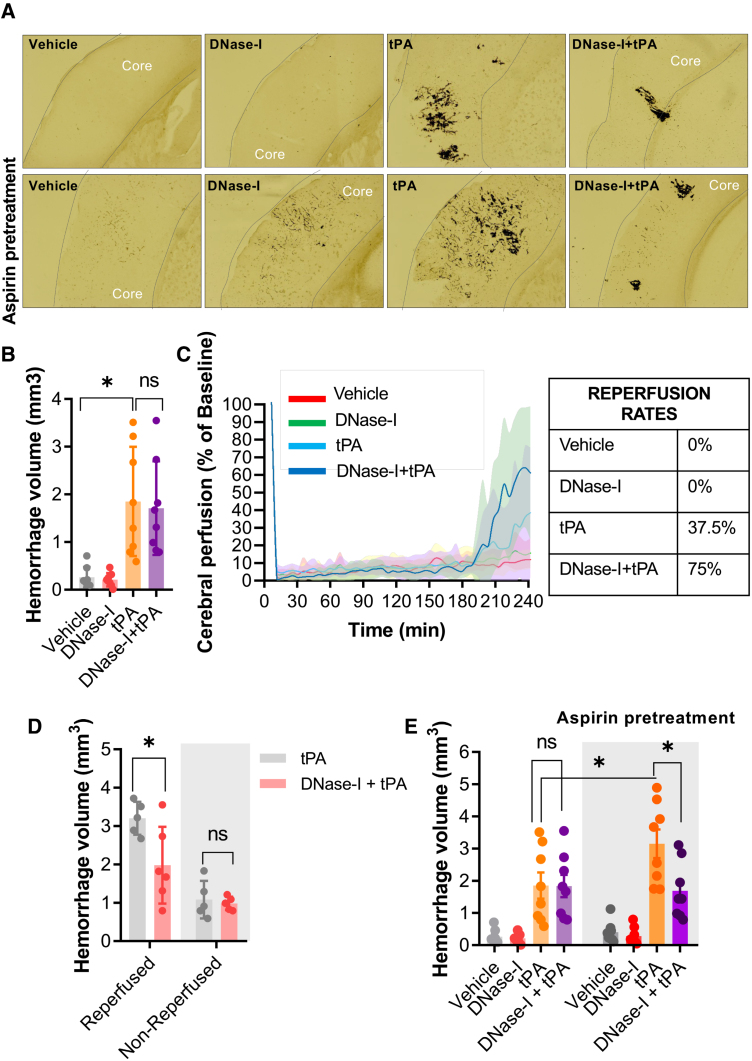
DNase-I reduced infarct volume and improved functional outcomes 24 hours post-middle cerebral artery occlusion by decreasing plasma and cortical neutrophil extracellular trap levels. DNase-I caused no bleeding or impact on HT induced by late tPA. Its protective effect was only seen when given during the daytime (rodent inactive phase; ZT4-7), not overnight (active phase; ZT13-16). Chronic aspirin pretreatment increased tPA-induced HT but did not change the protective effects of DNase-I, with or without tPA.
Our study demonstrates that daytime (inactive phase) DNase-I administration is a safe and effective treatment for experimental stroke. This is particularly important given the 2 ongoing clinical trials for stroke patients.
URL: https://www.clinicaltrials.gov; Unique identifier: NCT05203224 and NCT05880524.
急性缺血性卒中的治疗通常涉及组织型纤溶酶原激活剂(tPA)或替奈普酶,但约50%的患者未能实现成功再灌注。受血栓成分和时间影响,tPA抵抗的原因尚不完全清楚。中性粒细胞胞外诱捕网(NETs)与不良预后和再灌注抵抗相关,会导致血栓形成。可降解中性粒细胞胞外诱捕网的脱氧核糖核酸酶I(DNase-I)可能会提高溶栓疗效。然而,需要更多研究来了解DNase-I在tPA敏感型卒中模型中的作用、DNase-I与tPA联合使用对出血转化(HT)的安全性、最佳使用时机以及对阿司匹林治疗动物的影响。
我们使用原位血栓栓塞性卒中这一tPA敏感型模型,在该模型中晚期给予tPA会导致HT。在不同的授时时间(ZT)诱导大脑中动脉闭塞,以研究给药的最佳时机。在不同时间给予DNase-I、tPA和阿司匹林,以评估它们的效果。
DNase-I通过降低血浆和皮质中性粒细胞胞外诱捕网水平,在大脑中动脉闭塞后24小时减少了梗死体积并改善了功能结局。DNase-I未引起出血,也未对晚期tPA诱导的HT产生影响。其保护作用仅在白天(啮齿动物非活动期;ZT4 - 7)给药时可见,夜间(活动期;ZT13 - 16)给药则未见此效果。慢性阿司匹林预处理增加了tPA诱导的HT,但无论有无tPA,均未改变DNase-I的保护作用。
我们的研究表明,白天(非活动期)给予DNase-I是治疗实验性卒中的一种安全有效的方法。鉴于正在进行的两项针对卒中患者的临床试验,这一点尤为重要。
网址:https://www.clinicaltrials.gov;唯一标识符:NCT05203224和NCT05880524。