
基于流固耦合模拟研究转杯纺纤维输送通道中弯钩纤维的伸直轨迹
Straightening trajectory of hooked fibers in the fiber transport channel of rotor spinning investigated by fluid solid coupled simulation.
作者信息
Li Fengyan, Zhang Dingtiao, Wang Qianru, Zhou Baoming, Qiu Fang
机构信息
School of Textile Science and Engineering, Tiangong University, Tianjin, 300387, China.
Ministry of Education Key Laboratory for Advanced Textile Composite Materials, Tiangong University, Tianjin, 300387, China.
出版信息
Sci Rep. 2025 Jan 27;15(1):3359. doi: 10.1038/s41598-025-86538-2.
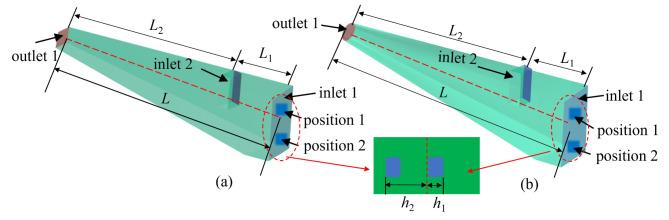
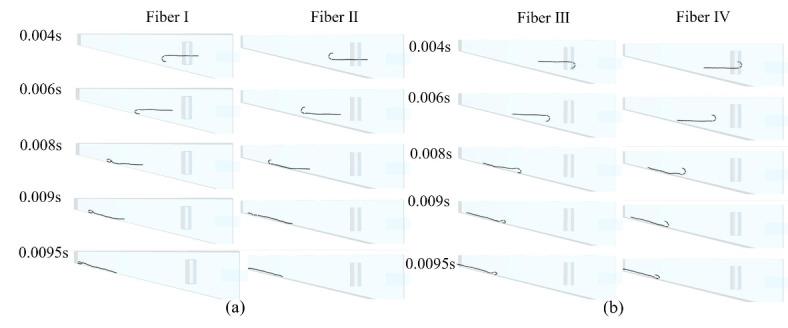
The airflow in the transport channel contributes to the accelerated straightening of the hooked fibers, which greatly influences the structural properties of the yarn. To study the straightening process of hooked fiber in the fiber transport channel, Altair EDEM 2022 software was used to establish flexible fiber models, and combined with ANSYS Fluent 2022R1 simulation software, the fluid-solid coupling method was used to simulate the air velocity distribution in the fiber transport channel and the straightening process of the hooked fibers in the airflow field. The numerical simulated air flow is verified by Hagen-Poissuille pipe flow equation. The effects of different fiber transport channels on the straightening of various hooked fibers were discussed. The results show that the straightening effect of leading hooked fiber in the airflow field is better than that of trailing hooked fiber with significant straight. In the case of the fiber transport channel with a circular cross-section outlet, the straightening of trailing hooked fiber can be slightly enhanced. Considering the feeding position of fibers transferred from carding roller to inlet of fiber transport channel, the collision of hooked fibers with the wall influences straightening of hook part or even reduces the straightness. Through the comparision on straightness between simulated and the experimental fibers, it is verified the better straightening of leading hooked fiber in the fiber sliver in the channel. The straightening process of hooked fibers influenced by airflow field and input location of fiber transport channel are simulated, which provides a reference for optimizing fiber transport channel structure and spinning prameters.
输送通道中的气流有助于使弯钩纤维加速伸直,这对纱线的结构性能有很大影响。为了研究纤维输送通道中弯钩纤维的伸直过程,使用Altair EDEM 2022软件建立柔性纤维模型,并结合ANSYS Fluent 2022R1仿真软件,采用流固耦合方法模拟纤维输送通道中的空气速度分布以及气流场中弯钩纤维的伸直过程。通过哈根 - 泊肃叶管流方程对数值模拟的气流进行验证。讨论了不同纤维输送通道对各种弯钩纤维伸直的影响。结果表明,气流场中前弯钩纤维的伸直效果优于后弯钩纤维,且伸直效果显著。在具有圆形横截面出口的纤维输送通道情况下,后弯钩纤维的伸直可略有增强。考虑从梳理罗拉转移到纤维输送通道入口的纤维喂入位置,弯钩纤维与壁面的碰撞会影响弯钩部分的伸直,甚至降低伸直度。通过对模拟纤维和实验纤维伸直度的比较,验证了通道中条子内前弯钩纤维的伸直效果更好。模拟了气流场和纤维输送通道输入位置对弯钩纤维伸直过程的影响,为优化纤维输送通道结构和纺纱参数提供了参考。





 Zotero 插件