Kuwamura Hiroshi, Terayama Takero, Hamabe Fumiko, Edo Hiromi, Matsuda Kenta, Miyamoto Morikazu, Takano Masashi, Shinmoto Hiroshi
Department of Radiology, National Defense Medical College, 3-2 Namiki, Tokorozawa, Saitama, 359-8513, Japan.
Department of Emergency, Self-Defense Forces Central Hospital, 1-2-24 Ikejiri, Setagaya, Tokyo, 154-8532, Japan.
Arch Gynecol Obstet. 2025 May;311(5):1285-1295. doi: 10.1007/s00404-024-07909-0. Epub 2025 Jan 28.
To comprehensively compare the diagnostic ability and inter-reader agreement of magnetic resonance imaging (MRI) findings for predicting massive hemorrhage after cesarean section in patients with placental malposition, aiming to identify the most reliable and objective indicators.
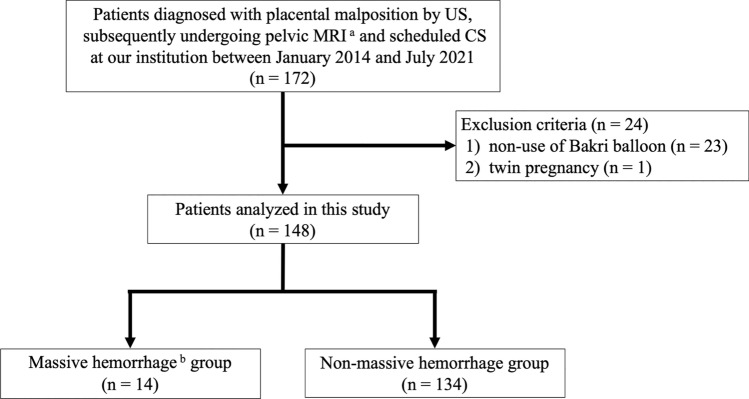
Totally, 148 consecutive patients with placental malposition underwent MRI and cesarean section at our hospital between January 2014 and July 2021. The patients were divided into massive and non-massive hemorrhage groups. MRI findings of placenta accreta, placental position, and placental volume were evaluated by two radiologists, and inter-reader agreement was calculated. Diagnostic ability for predicting massive hemorrhage was evaluated using receiver operating characteristic analysis.
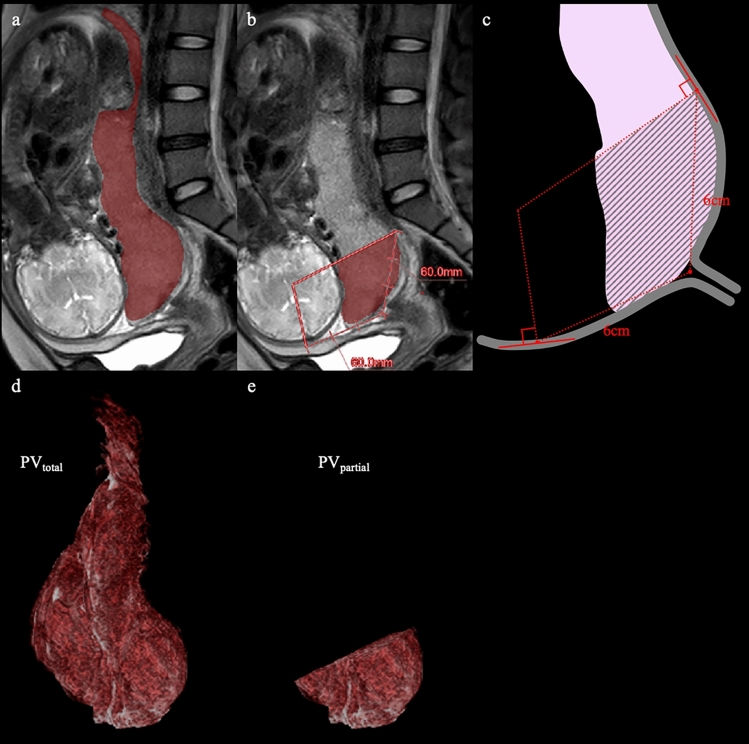
Intraplacental T2 dark bands (100% vs. 58.2%, p = 0.001), placental bulge (50% vs. 3.7%, p < 0.001), loss of retroplacental T2 hypointense line (100% vs. 67.2%, p = 0.01), myometrial thinning (92.9% vs. 57.5%, p = 0.009), total placenta previa (64.3% vs. 23.9%, p = 0.033), and anterior placenta (35.7% vs. 10.5%, p = 0.02) were significantly observed in massive hemorrhage group. Partial placental volume of lower uterine segment (PV) was larger in massive hemorrhage group (166 [108-214] cm vs. 70 [43-112] cm p < 0.001), had the second highest intraclass correlation coefficient (0.84), and had the highest area under the curve (0.81) for diagnosing massive hemorrhage.
This study revealed PV is an accurate and objective indicator for massive hemorrhage, independent of radiologists' experience. This indicator potentially enables prediction of massive hemorrhage, improving pre-operative planning in high-risk pregnancies.
全面比较磁共振成像(MRI)结果对前置胎盘患者剖宫产术后大出血的诊断能力及阅片者间的一致性,旨在确定最可靠、客观的指标。
2014年1月至2021年7月期间,我院共有148例连续的前置胎盘患者接受了MRI检查及剖宫产手术。将患者分为大出血组和非大出血组。由两名放射科医生评估胎盘植入、胎盘位置及胎盘体积的MRI表现,并计算阅片者间的一致性。采用受试者操作特征分析评估预测大出血的诊断能力。
大出血组胎盘内T2低信号带(100% 对58.2%,p = 0.001)、胎盘隆起(50% 对3.7%,p < 0.001)、胎盘后T2低信号线消失(100% 对67.2%,p = 0.01)、子宫肌层变薄(92.9% 对57.5%,p = 0.009)、完全性前置胎盘(64.3% 对23.