Ho Jung Jennifer, Cheng Edith, Wong Cassandra J, St-Germain Jonathan R, Dunham Wade H, Raught Brian, Gingras Anne-Claude, Brown Grant W
Department of Biochemistry, University of Toronto, 1 King's College Circle, Toronto, ON, M5S 1A8, Canada.
Donnelly Centre for Cellular and Biomolecular Research, University of Toronto, 160 College Street, Toronto, ON, M5S 3E1, Canada.
EMBO Rep. 2025 Mar;26(5):1290-1314. doi: 10.1038/s44319-025-00374-z. Epub 2025 Jan 27.
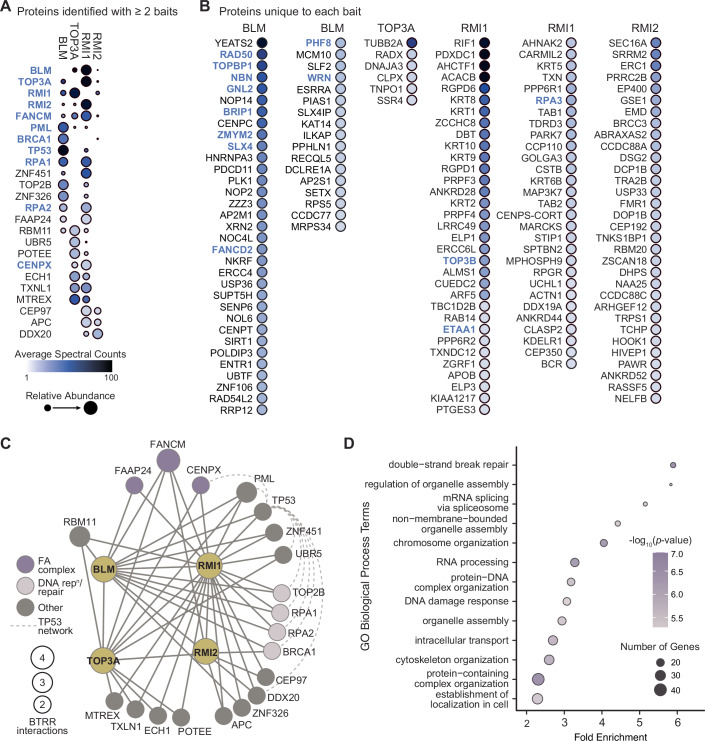
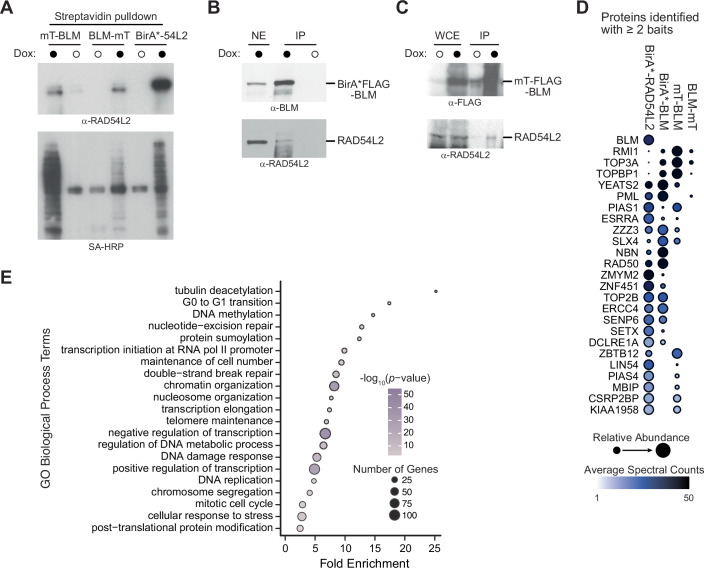
Homologous recombination is a largely error-free DNA repair mechanism conserved across all domains of life and is essential for the maintenance of genome integrity. Not only are the mutations in homologous recombination repair genes probable cancer drivers, some also cause genetic disorders. In particular, mutations in the Bloom (BLM) helicase cause Bloom Syndrome, a rare autosomal recessive disorder characterized by increased sister chromatid exchanges and predisposition to a variety of cancers. The pathology of Bloom Syndrome stems from the impaired activity of the BLM-TOP3A-RMI1-RMI2 (BTRR) complex which suppresses crossover recombination to prevent potentially deleterious genome rearrangements. We provide a comprehensive BTRR proximal proteome, revealing proteins that suppress crossover recombination. We find that RAD54L2, a SNF2-family protein, physically interacts with BLM and suppresses sister chromatid exchanges. RAD54L2 is important for recruitment of BLM to chromatin and requires an intact ATPase domain to promote non-crossover recombination. Thus, the BTRR proximity map identifies a regulator of recombination.
同源重组是一种在生命的所有领域中保守的基本无差错的DNA修复机制,对于维持基因组完整性至关重要。同源重组修复基因中的突变不仅可能是癌症驱动因素,有些还会导致遗传疾病。特别是,布鲁姆(BLM)解旋酶的突变会导致布鲁姆综合征,这是一种罕见的常染色体隐性疾病,其特征是姐妹染色单体交换增加以及易患多种癌症。布鲁姆综合征的病理源于BLM-TOP3A-RMI1-RMI2(BTRR)复合体活性受损,该复合体抑制交叉重组以防止潜在有害的基因组重排。我们提供了一个全面的BTRR近端蛋白质组,揭示了抑制交叉重组的蛋白质。我们发现,一种SNF2家族蛋白RAD54L2与BLM发生物理相互作用并抑制姐妹染色单体交换。RAD54L2对于将BLM招募到染色质上很重要,并且需要完整的ATP酶结构域来促进非交叉重组。因此,BTRR邻近图谱确定了一种重组调节因子。