Sas David J, Bakkaloglu Sevcan A, Belostotsky Vladimir, Hayes Wesley, Ariceta Gema, Zhou Jing, Rawson Verity
Division of Pediatric Nephrology and Hypertension, Mayo Clinic, Rochester, MN, USA.
Department of Laboratory Medicine and Pathology, Mayo Clinic, Rochester, MN, USA.
Pediatr Nephrol. 2025 Jun;40(6):1939-1948. doi: 10.1007/s00467-025-06675-8. Epub 2025 Jan 28.
Primary hyperoxaluria type 1 (PH1) is an autosomal recessive disorder with dysregulated glyoxylate metabolism in the liver. Oxalate over-production leads to renal stones, progressive kidney damage and renal failure, with potentially life-threatening systemic oxalosis. Nedosiran is a synthetic RNA interference therapy, designed to reduce hepatic lactate dehydrogenase (LDH) to decrease oxalate burden in PH.
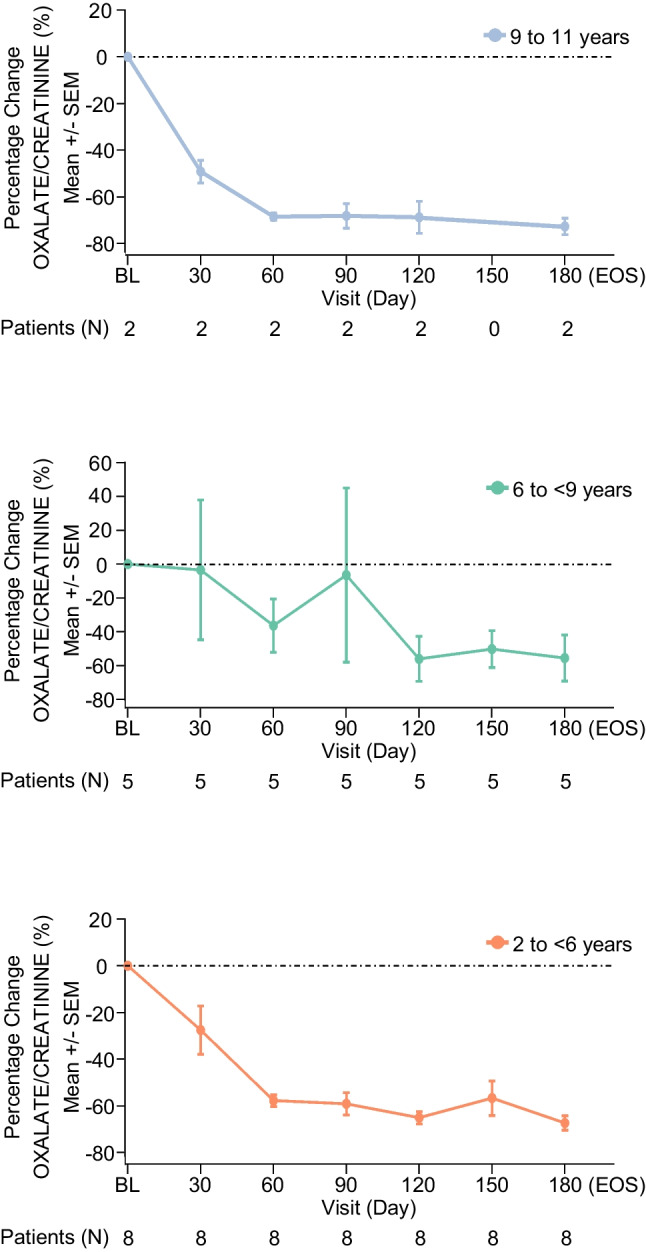
Currently, in the PHYOX8 study (NCT05001269), pediatric participants (2-11 years) with PH1 (N = 15) and estimated glomerular filtration rate (eGFR) ≥ 30mL/min/1.73m received nedosiran once monthly for 6 months.
Urinary oxalate:creatinine (Uox:Ucr) levels reduced by 64% on average. Mean Uox:Ucr reduction was 52% at day 60 and ˃60% at day 180. At one or more study visits, 93.3% (N = 14) of participants reached Uox:Ucr < 1.5 × upper limit of normal (ULN), and 53.3% (N = 8) reached ≤ 1.0 × ULN. Median percent change in plasma oxalate (12.0 µmol/L at baseline) to day 180 was -39.23% (n = 10). Average number of kidney stones per participant remained stable, whilst a 10.1% average decrease in summed surface area was observed. Median percent change from baseline in eGFR was 2.5%, indicating preservation of renal function.
Nedosiran was well tolerated, with only 3 participants experiencing at least one serious adverse event, none considered treatment-related. The incidence of injection site reactions was 6.7% (1/15 participants). In conclusion, nedosiran treatment led to a significant and sustained reduction of Uox levels in children with PH1. These findings support nedosiran treatment in pediatric patients to reduce Uox and shows promise for limiting PH1-related complications.
1型原发性高草酸尿症(PH1)是一种常染色体隐性疾病,肝脏中乙醛酸代谢失调。草酸盐产生过多会导致肾结石、进行性肾损伤和肾衰竭,并可能引发危及生命的全身性草酸中毒。奈多司然是一种合成的RNA干扰疗法,旨在降低肝脏乳酸脱氢酶(LDH),以减轻PH患者的草酸盐负担。
目前,在PHYOX8研究(NCT05001269)中,15名2至11岁的PH1患儿且估计肾小球滤过率(eGFR)≥30mL/min/1.73m²,每月接受一次奈多司然治疗,持续6个月。
尿草酸:肌酐(Uox:Ucr)水平平均降低了64%。在第60天时,Uox:Ucr平均降低52%,在第180天时降低超过60%。在一次或多次研究访视中,93.3%(n = 14)的参与者Uox:Ucr < 1.5×正常上限(ULN),53.3%(n = 8)的参与者Uox:Ucr≤1.0×ULN。至第180天时,血浆草酸盐(基线时为12.0µmol/L)的中位数变化百分比为-39.23%(n = 10)。每位参与者的肾结石平均数量保持稳定,而结石总面积平均减少了10.1%。eGFR较基线的中位数变化百分比为2.5%,表明肾功能得以保留。
奈多司然耐受性良好,只有3名参与者经历了至少一次严重不良事件,均不认为与治疗相关。注射部位反应的发生率为6.7%(1/15名参与者)。总之,奈多司然治疗可使PH1患儿的Uox水平显著且持续降低。这些发现支持在儿科患者中使用奈多司然来降低Uox,并有望限制与PH1相关的并发症。