Guo Yuhuan, Zhang Yan, Li Yuhao, Wu Yichao, Liao Mingli, Peng Zhengsong, Yang Zaijun, Zhou Yonghong
Triticeae Research Institute, Sichuan Agricultural University, Chengdu, 611130, China.
Key Laboratory of Southwest China Wildlife Resource Conservation (ministry of education), College of Life Science, China West Normal University, Nanchong, 637002, China.
BMC Plant Biol. 2025 Jan 29;25(1):123. doi: 10.1186/s12870-025-06133-5.
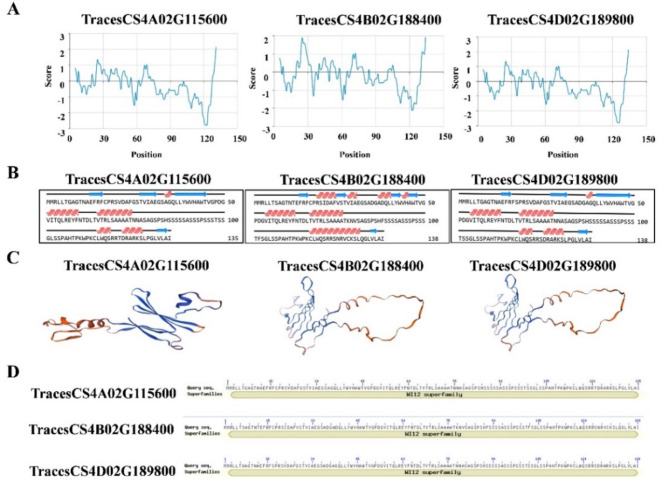
TaWI12 is a member of the wound-induced (WI) protein family, which has been implicated in plant stress responses and developmental processes. Wheat (Triticum aestivum L.) is a crucial staple crop upon which human sustenance relies. Consequently, investigating the developmental mechanisms of pistils and stamens in wheat is profoundly significant for enhancing wheat characteristics and boosting productivity. In this study, we cloned TaWI12, from common wheat and observed a significant resemblance among the three homoeologs of TaWI12. The open reading frames (ORFs) of TaWI12-4A, TaWI12-4B and TaWI12-4D were 408 bp, 417 bp and 417 bp, respectively, and encoded 135, 138 and 138 amino acids, respectively. The phylogenetic tree revealed a high degree of homology between the protein sequences of TaWI12 and the wound-induced proteins of Hordeum vulgare (KAI4994568) and Aegilops tauschii (XP_020196548). To clarify the characteristics and functions of TaWI12 homoeologs, we obtained transgenic positive plants of Arabidopsis thaliana and observed significant filament shortening and decrease. Simultaneously, we used the CRISPR/Cas9 system to generate mutant plants via the modification of three homoeologs of TaWI12 in wheat. We noticed two distinct phenotypic differences in the knockout mutant. First, we observed the different degrees of homologous conversion of stamens to pistils in the single mutant TaWI12-4D. Second, we observed leaf cracking in both the single mutant TaWI12-4A and the double mutants TaWI12-4A and TaWI12-4D. Our findings further revealed that TaWI12 plays an important role in flower development, which is important for revealing the molecular mechanisms of pistil and stamen development in wheat and has important application value for high-yield wheat breeding.
TaWI12是伤口诱导(WI)蛋白家族的成员,该家族与植物应激反应和发育过程有关。小麦(Triticum aestivum L.)是人类赖以生存的重要主食作物。因此,研究小麦雌蕊和雄蕊的发育机制对于改良小麦性状和提高产量具有重要意义。在本研究中,我们从小麦中克隆了TaWI12,并观察到TaWI12的三个同源基因之间有显著相似性。TaWI12-4A、TaWI12-4B和TaWI12-4D的开放阅读框(ORF)分别为408 bp、417 bp和417 bp,分别编码135、138和138个氨基酸。系统发育树显示TaWI12的蛋白质序列与大麦(KAI4994568)和节节麦(XP_020196548)的伤口诱导蛋白之间具有高度同源性。为了阐明TaWI12同源基因的特征和功能,我们获得了拟南芥转基因阳性植株,并观察到明显的花丝缩短和减少。同时,我们使用CRISPR/Cas9系统通过对小麦中TaWI12的三个同源基因进行修饰来产生突变植株。我们在敲除突变体中注意到两个明显的表型差异。第一,我们在单突变体TaWI12-4D中观察到雄蕊向雌蕊不同程度的同源转化。第二,我们在单突变体TaWI12-4A以及双突变体TaWI12-4A和TaWI12-4D中都观察到了叶片开裂。我们的研究结果进一步表明TaWI12在花发育中起重要作用,这对于揭示小麦雌蕊和雄蕊发育的分子机制具有重要意义,并且对高产小麦育种具有重要的应用价值。