Vahedi Luissa, Orjuela-Grimm Manuela, Chan Pui Man Pamela, Meyer Sarah R
Brown School, Washington University in St. Louis, St. Louis, MO, United States; Factor-Inwentash Faculty of Social Work, University of Toronto, Toronto, ON, Canada; The Center for Global Child Health, SickKids Hospital, Toronto, ON, Canada.
Department of Epidemiology and Pediatrics, Columbia University Irving Medical Center, New York City, NY, United States.
J Nutr. 2025 Apr;155(4):1236-1245. doi: 10.1016/j.tjnut.2025.01.024. Epub 2025 Jan 27.
Intimate partner violence (IPV) poses a significant threat to the well-being of women and girls and is a highly prevalent form of gender-based violence. Evidence regarding the nutritional implications of IPV has focused primarily on intergenerational relationships with child nutrition and growth. There remains a knowledge gap regarding the association with women's own dietary intake.
We investigated relationships between past-year IPV (physical, emotional, and sexual) and women's dietary habits, using the Minimum Dietary Diversity for Women tool.
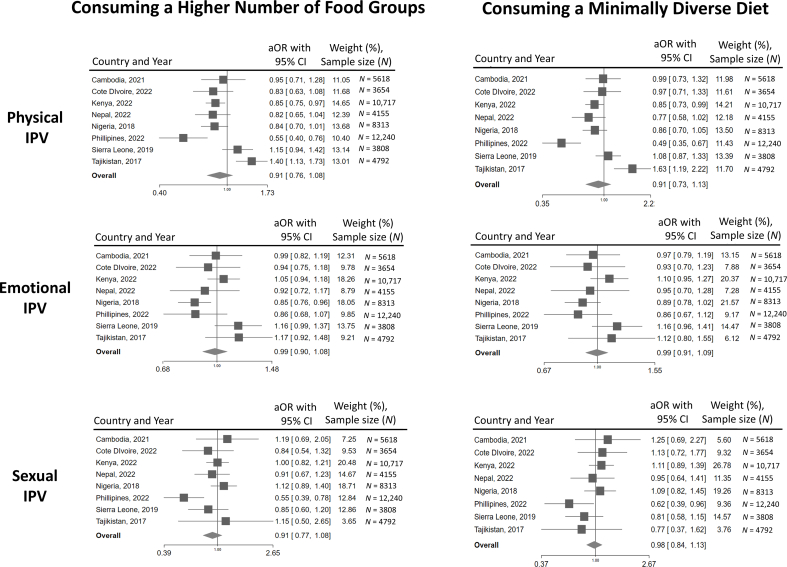
The data sources analyzed were the cross-sectional Demographic and Health Surveys conducted in Cambodia (2021, N = 5618), Nepal (2022, N = 4155), Sierra Leone (2019, N = 3808), Nigeria (2018, N = 8313), Tajikistan (2017, N = 4792), Cote D'Ivoire (2022, N = 3654), Kenya (2022, N = 10,717), and the Philippines (2022, N = 12,240). Utilizing multivariable generalized linear models, we assessed the overall relationship between women's exposure to IPV and 1) the number of food groups consumed and 2) minimum dietary diversity.
Our results reveal heterogeneous relationship patterns between IPV and women's diet. Although none of the pooled estimates were significant and there were a large number of nonsignificant associations, IPV was associated with consuming a lower number of total food groups and reduced consumption of a diverse diet in Nigeria, Kenya, and the Philippines. There is evidence that in Tajikistan, physical violence relates to an increased number of food groups consumed.
IPV is associated with altered dietary intake patterns within certain low- and middle-income countries. The directionality of associations may depend on local food environments and food access. Further research is needed to clarify the pathways underlying these findings. These pathways may involve impacts of IPV that influence diet and food access, for example, mental health symptoms and disorders and related coping mechanisms.
亲密伴侣暴力对妇女和女孩的福祉构成重大威胁,是一种极为普遍的性别暴力形式。关于亲密伴侣暴力对营养影响的证据主要集中在与儿童营养和成长的代际关系上。在亲密伴侣暴力与女性自身饮食摄入之间的关联方面,仍存在知识空白。
我们使用女性最低饮食多样性工具,调查了过去一年的亲密伴侣暴力(身体暴力、情感暴力和性暴力)与女性饮食习惯之间的关系。
所分析的数据来源是在柬埔寨(2021年,N = 5618)、尼泊尔(2022年,N = 4155)、塞拉利昂(2019年,N = 3808)、尼日利亚(2018年,N = 8313)、塔吉克斯坦(2017年,N = 4792)、科特迪瓦(2022年,N = 3654)、肯尼亚(2022年,N = 10717)和菲律宾(2022年,N = 12240)进行的横断面人口与健康调查。利用多变量广义线性模型,我们评估了女性遭受亲密伴侣暴力与1)所消费食物组数量和2)最低饮食多样性之间的总体关系。
我们的结果揭示了亲密伴侣暴力与女性饮食之间存在异质性关系模式。尽管汇总估计均无统计学意义,且存在大量无显著关联,但在尼日利亚、肯尼亚和菲律宾,亲密伴侣暴力与所消费的食物组总数较少以及多样化饮食的摄入量减少有关。有证据表明,在塔吉克斯坦,身体暴力与所消费的食物组数量增加有关。
在某些低收入和中等收入国家,亲密伴侣暴力与饮食摄入模式的改变有关。关联的方向性可能取决于当地的食物环境和食物获取情况。需要进一步研究以阐明这些发现背后的途径。这些途径可能涉及亲密伴侣暴力对饮食和食物获取产生影响的方面,例如心理健康症状和障碍以及相关的应对机制。