Roumeliotis Stefanos, Kontogiorgos Ioannis, de Vries Femke, Maresz Katarzyna, Jeanne Jean-François, Leivaditis Konstantinos, Schurgers Leon J
Second Department of Nephrology, School of Medicine, AHEPA Hospital, Aristotle University of Thessaloniki, Thessaloniki, Greece.
Department of Biochemistry, Cardiovascular Research Institute Maastricht, Maastricht, Netherlands.
Front Aging Neurosci. 2025 Jan 15;16:1527535. doi: 10.3389/fnagi.2024.1527535. eCollection 2024.
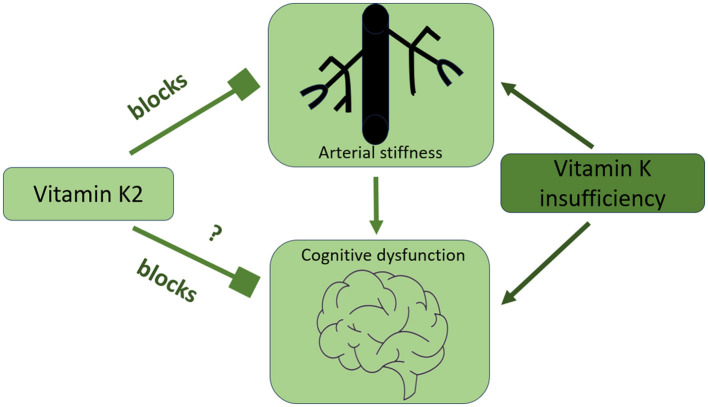
Cognitive impairment, marked by a decline in essential mental aspects such as attention, memory, and problem-solving, is significantly correlated with advancing age. This condition presents a major challenge for the elderly, adversely affecting quality of life, diminishing independence, and imposing substantial burdens on healthcare systems. Recent research indicates that vitamin K2 may be vital for preserving brain health and cognitive function. Traditionally recognized primarily for its role in blood coagulation, vitamin K has emerged in recent years as a nutrient with diverse biological effects essential for healthy aging. A growing body of evidence from both observational and interventional studies underscores the pivotal role of vitamin K2 in mitigating arterial calcification. This mechanism may link vascular health to cognitive function, suggesting that vitamin K2 could play a critical role in the prevention of cognitive impairment in aging populations.
认知障碍以注意力、记忆力和解决问题能力等基本心理方面的衰退为特征,与年龄增长显著相关。这种情况给老年人带来了重大挑战,对生活质量产生不利影响,降低独立性,并给医疗系统带来沉重负担。最近的研究表明,维生素K2对于维持大脑健康和认知功能可能至关重要。维生素K传统上主要因其在血液凝固中的作用而为人所知,近年来已成为一种对健康衰老至关重要的具有多种生物学效应的营养素。越来越多的观察性和干预性研究证据强调了维生素K2在减轻动脉钙化方面的关键作用。这一机制可能将血管健康与认知功能联系起来,表明维生素K2在预防老年人群认知障碍方面可能发挥关键作用。