van Dun S C J, Verheul M, Pijls B G C W, Scheper H, van der Does A M, Nibbering P H, de Boer M G J
Center for Infectious Diseases, Lab of Infectious Diseases, Leiden University Medical Center, Leiden, the Netherlands.
Department of Orthopaedics, Leiden University Medical Center, Leiden, the Netherlands.
Microbiol Spectr. 2025 Mar 4;13(3):e0194724. doi: 10.1128/spectrum.01947-24. Epub 2025 Jan 30.
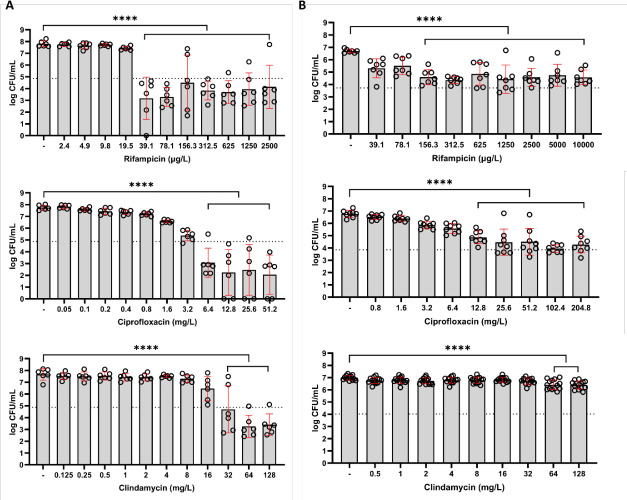
Due to increasing antimicrobial resistance and side effects caused by current standard antimicrobial regimens used for treatment of prosthetic joint infection (PJI), alternative options are urgently needed. We aimed to investigate the effect of clindamycin in different exposure strategies against in an mature biofilm model. In short, 7-day biofilms were generated on polystyrene plates and titanium-aluminum-vanadium discs using a clinical PJI isolate. Next, biofilms were exposed to clindamycin according to four strategies: single 24-h exposure; prolonged 48- or 72-h exposure; repeated 24-h exposures during a 4-day period, and sequential exposures of initial 24-h rifampicin-based therapy followed by 24-h exposure to clindamycin. The remaining bacterial load (colony-forming unit [CFU]/mL) after antibiotic exposure was assessed. Confocal laser scanning and atomic force microscopy were applied to evaluate the biofilm structure. Single exposure to clindamycin for 24 h or prolonged up to 72 h did not result in any relevant reduction in bacterial load. Repeated 24-h exposures demonstrated relevant reductions of >3 log CFU/mL at clindamycin concentrations ≥16 mg/L for the 3rd and 4th consecutive doses. Sequential rifampicin-ciprofloxacin combination exposure followed by clindamycin showed bacterial load reductions of 3- to 4-log CFU/mL, similar to continued rifampicin-ciprofloxacin exposure. This was achieved for concentrations equivalent to levels achieved after standard dosing of clindamycin in clinical practice. These experimental findings support that clindamycin monotherapy is not an optimal choice when starting antimicrobial treatment of PJI but that later on, rifampicin may be safely switched to clindamycin in patients with PJI who do not tolerate prolonged rifampicin-based treatment.
Rifampicin-in combination with another antibiotics-is recommended in all guidelines as first choice treatment of prosthetic joint infections (PJIs), despite adverse interactions and side effects associated with this antibiotic. In a search for alternative approaches, the switch to clindamycin in patients after rifampicin-based antibiotic treatment was found to be effective in some recent observational clinical studies. In our in vitro study, we determined the effect of clindamycin on in mature biofilms, to obtain further insight. Our study showed that clindamycin was effective in reducing mature biofilm-residing after initial exposure to rifampicin-ciprofloxacin, while it was not effective as first treatment. These in vitro findings provide evidence for the hypothesis that rifampicin-ciprofloxacin can be successfully switched to clindamycin monotherapy in PJI patients in a later phase of treatment.
由于用于治疗人工关节感染(PJI)的当前标准抗菌方案导致的抗菌耐药性增加和副作用,迫切需要替代方案。我们旨在研究克林霉素在不同暴露策略下对成熟生物膜模型中[细菌名称未给出]的影响。简而言之,使用临床PJI分离株在聚苯乙烯板和钛铝钒盘上形成7天的生物膜。接下来,根据四种策略将生物膜暴露于克林霉素:单次24小时暴露;延长48或72小时暴露;在4天内重复24小时暴露,以及初始基于利福平的24小时治疗后依次暴露于24小时克林霉素。评估抗生素暴露后剩余的细菌载量(菌落形成单位[CFU]/mL)。应用共聚焦激光扫描和原子力显微镜评估生物膜结构。单次暴露于克林霉素24小时或延长至72小时均未导致细菌载量有任何相关降低。连续24小时重复暴露显示,在克林霉素浓度≥16mg/L时,第3剂和第4剂连续给药后细菌载量有>3 log CFU/mL的相关降低。利福平 - 环丙沙星联合暴露后再用克林霉素显示细菌载量降低3至4 log CFU/mL,类似于持续的利福平 - 环丙沙星暴露。这是在相当于临床实践中克林霉素标准给药后达到的浓度下实现的。这些实验结果支持,在开始PJI抗菌治疗时,克林霉素单药治疗不是最佳选择,但后来,对于不能耐受基于利福平的长期治疗的PJI患者,利福平可以安全地换用克林霉素。
尽管利福平与另一种抗生素联合使用存在不良相互作用和副作用,但所有指南均推荐其作为人工关节感染(PJI)的首选治疗方法。在寻找替代方法时,最近的一些观察性临床研究发现,在基于利福平的抗生素治疗后,患者换用克林霉素是有效的。在我们的体外研究中,我们确定了克林霉素对成熟生物膜中[细菌名称未给出]的影响,以获得进一步的见解。我们的研究表明,在初始暴露于利福平 - 环丙沙星后,克林霉素在减少成熟生物膜中的[细菌名称未给出]方面是有效的,而作为首次治疗则无效。这些体外研究结果为以下假设提供了证据:在PJI患者治疗的后期阶段,利福平 - 环丙沙星可以成功换用克林霉素单药治疗。