Zhang Kun, Nie Qichang, Li Maolin, Chen Xiaona, Zhong Liting, Dai Tianle, Guo Xiaofan, Zhao Haizhou, Lau Terrence Chi-Kong, Wang Huating, Chen Shuo-Bin, Kwok Chun Kit
Department of Chemistry and State Key Laboratory of Marine Pollution, City University of Hong Kong, Hong Kong SAR 999077, China.
Department of Biomedical Sciences, College of Veterinary Medicine and Life Sciences, City University of Hong Kong, Hong Kong SAR 999077, China.
Nucleic Acids Res. 2025 Jan 24;53(3). doi: 10.1093/nar/gkaf039.
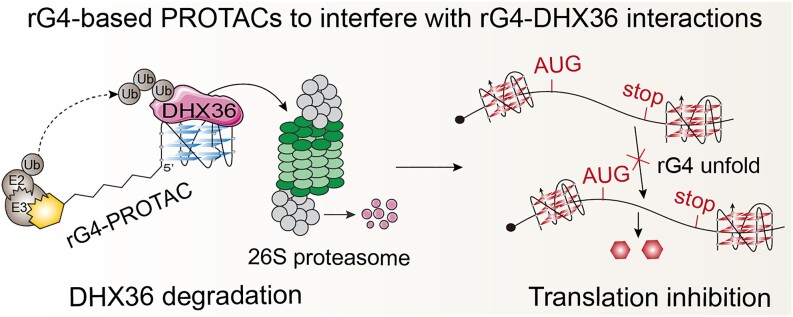
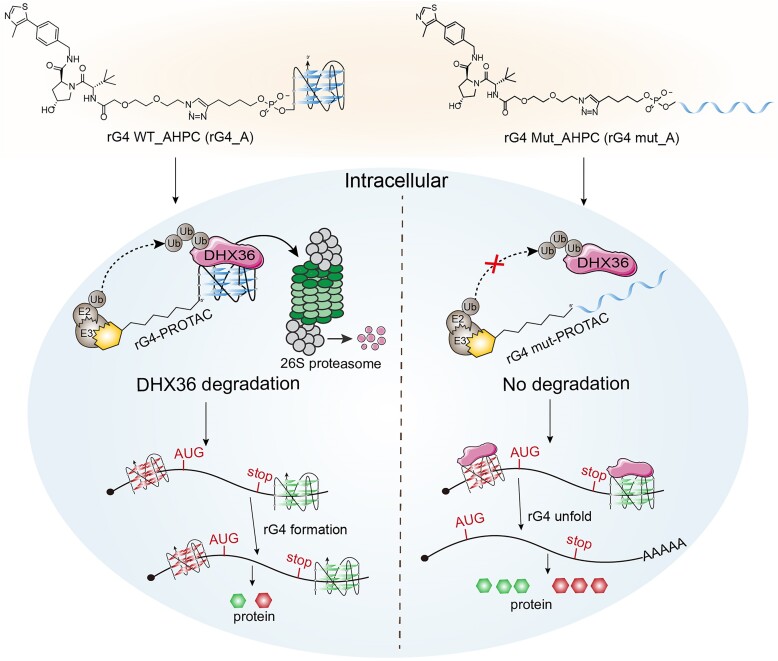
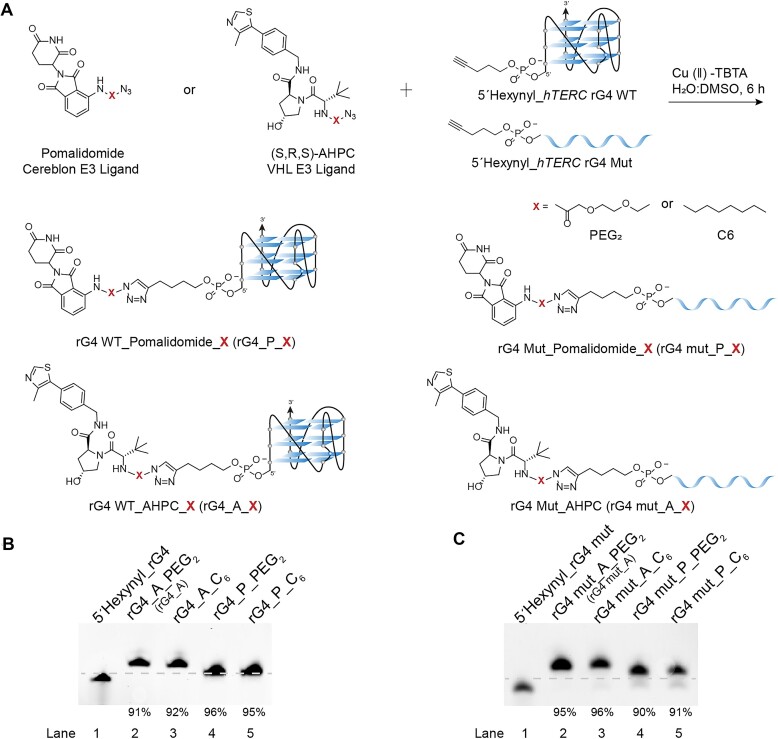
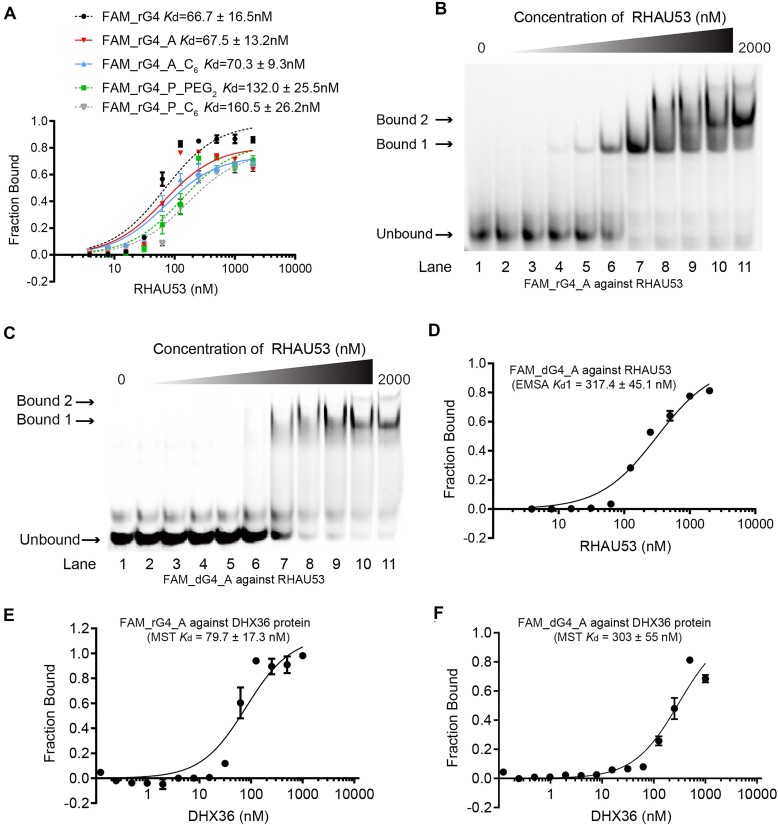
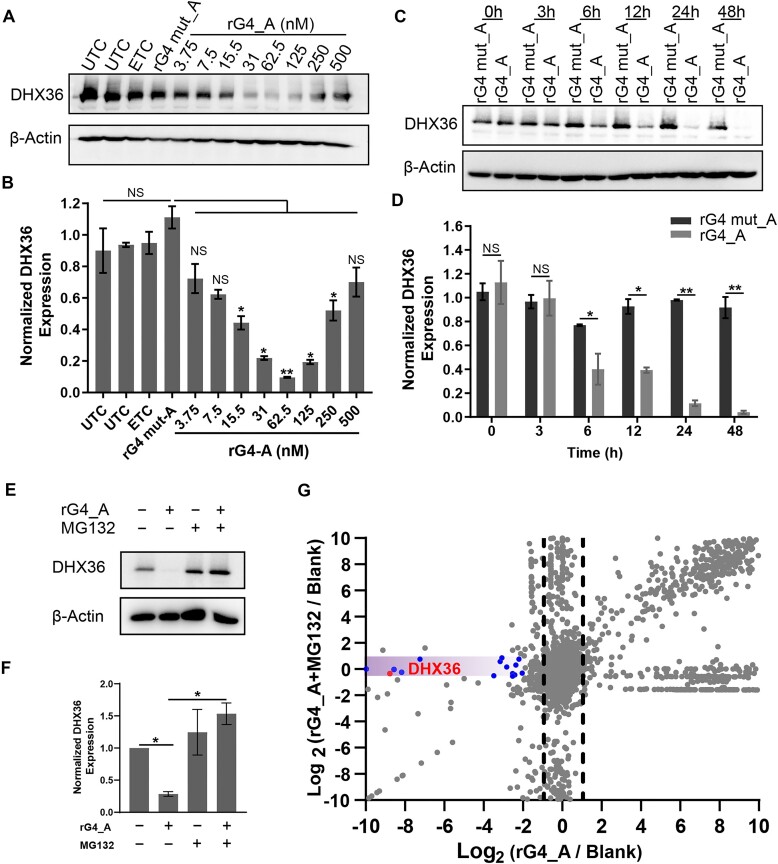
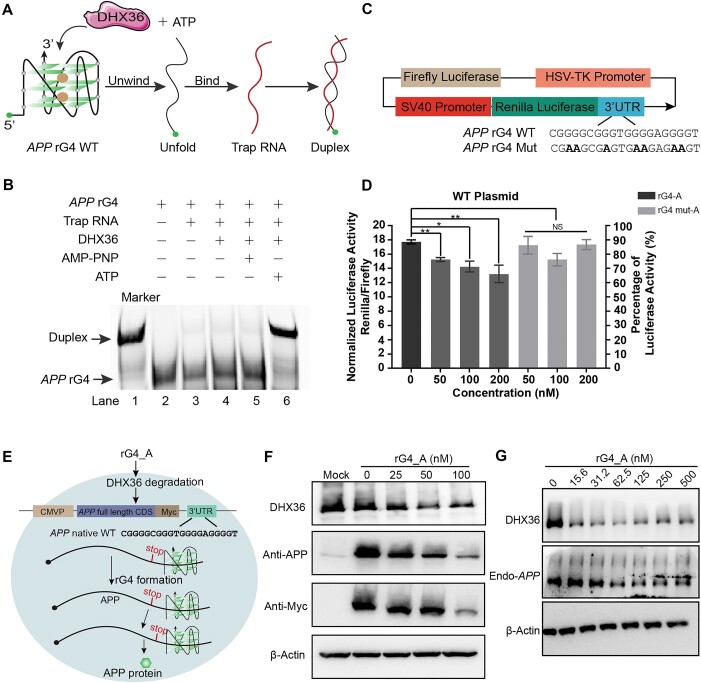
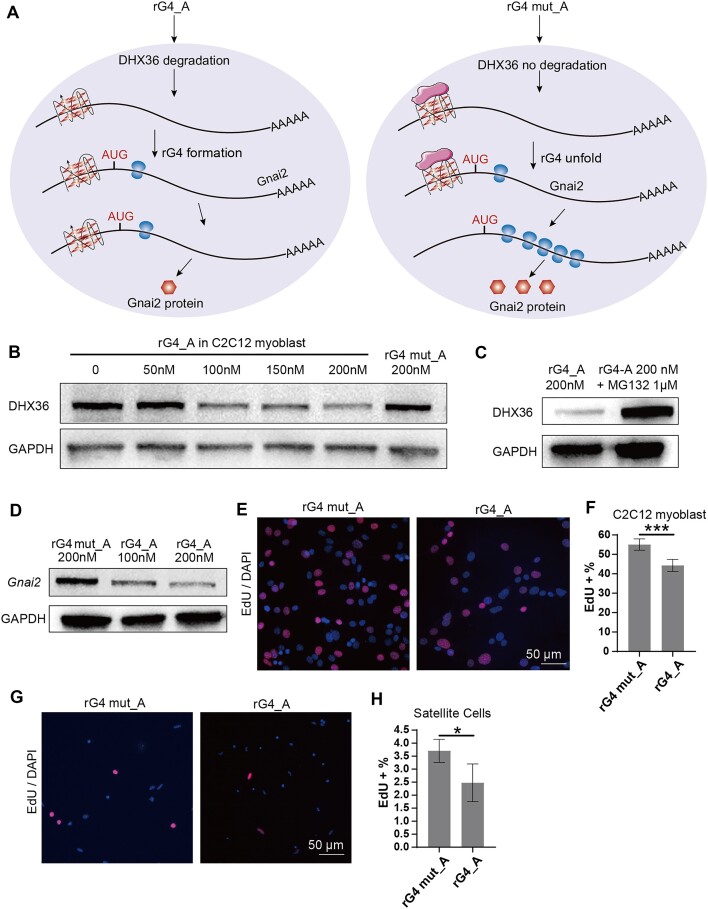
RNA G-quadruplexes (rG4s) are non-canonical secondary nucleic acid structures found in the transcriptome. They play crucial roles in gene regulation by interacting with G4-binding proteins (G4BPs) in cells. rG4-G4BP complexes have been associated with human diseases, making them important targets for drug development. Generating innovative tools to disrupt rG4-G4BP interactions will provide a unique opportunity to explore new biological mechanisms and potentially treat related diseases. Here, we have rationally designed and developed a series of rG4-based proteolytic targeting chimeras (rG4-PROTACs) aimed at degrading G4BPs, such as DHX36, a specific G4BP that regulates gene expression by binding to and unraveling rG4 structures in messenger RNAs (mRNAs). Our comprehensive data and systematic analysis reveals that rG4-PROTACs predominantly and selectively degrade DHX36 through a proteosome-dependent mechanism, which promotes the formation of the rG4 structure in mRNA, leading to the translation inhibition of rG4-containing transcripts. Notably, rG4-PROTACs inhibit rG4-mediated APP protein expression, and impact the proliferative capacity of skeletal muscle stem cells by negatively regulating Gnai2 protein expression. In summary, rG4-PROTACs provide a new avenue to understand rG4-G4BP interactions and the biological implications of dysregulated G4BPs, promoting the development of PROTACs technology based on the non-canonical structure of nucleic acids.
RNA G-四链体(rG4s)是在转录组中发现的非规范二级核酸结构。它们通过与细胞中的G4结合蛋白(G4BPs)相互作用,在基因调控中发挥关键作用。rG4-G4BP复合物与人类疾病有关,使其成为药物开发的重要靶点。生成破坏rG4-G4BP相互作用的创新工具将为探索新的生物学机制和潜在治疗相关疾病提供独特机会。在这里,我们合理设计并开发了一系列基于rG4的蛋白水解靶向嵌合体(rG4-PROTACs),旨在降解G4BPs,例如DHX36,一种通过结合并解开信使核糖核酸(mRNAs)中的rG4结构来调节基因表达的特异性G4BP。我们全面的数据和系统分析表明,rG4-PROTACs主要通过蛋白酶体依赖性机制选择性降解DHX36,这促进了mRNA中rG4结构的形成,导致含rG4转录本的翻译抑制。值得注意的是,rG4-PROTACs抑制rG4介导的APP蛋白表达,并通过负调节Gnai2蛋白表达影响骨骼肌干细胞的增殖能力。总之,rG4-PROTACs为理解rG4-G4BP相互作用以及G4BPs失调的生物学影响提供了一条新途径,推动了基于核酸非规范结构的PROTAC技术的发展。