
减数分裂恢复后,RNA G-四链体的去除促进翻译转换。
RNA G-quadruplex removal promotes a translational switch after meiosis resumption.
作者信息
Lu Qiong-Wen, Liu Shao-Yuan, Liao Xiu-Quan, Chen Jing, Jiang Zhi-Yan, Wu Yu-Ke, Fan Heng-Yu, Lu Yu-Jing, Sha Qian-Qian
机构信息
GMU-GIBH Joint School of Life Sciences, The Guangdong-Hong Kong-Macau Joint Laboratory for Cell Fate Regulation and Diseases, Guangzhou Medical University, Guangzhou 510006, China.
School of Biomedical and Pharmaceutical Sciences, Guangdong University of Technology, Guangzhou 510006, China.
出版信息
Nucleic Acids Res. 2025 Apr 22;53(8). doi: 10.1093/nar/gkaf067.
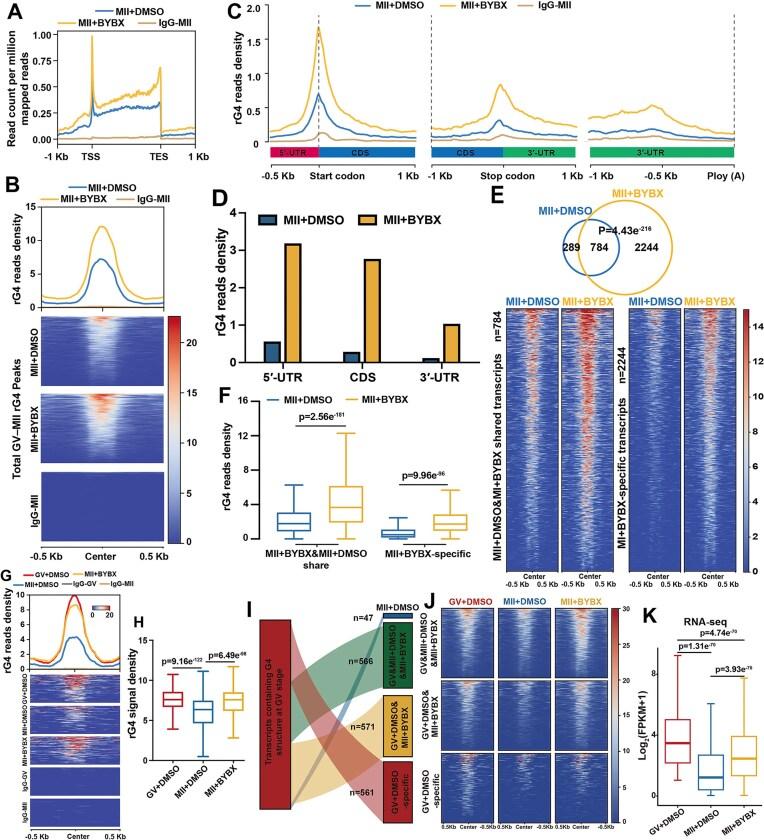
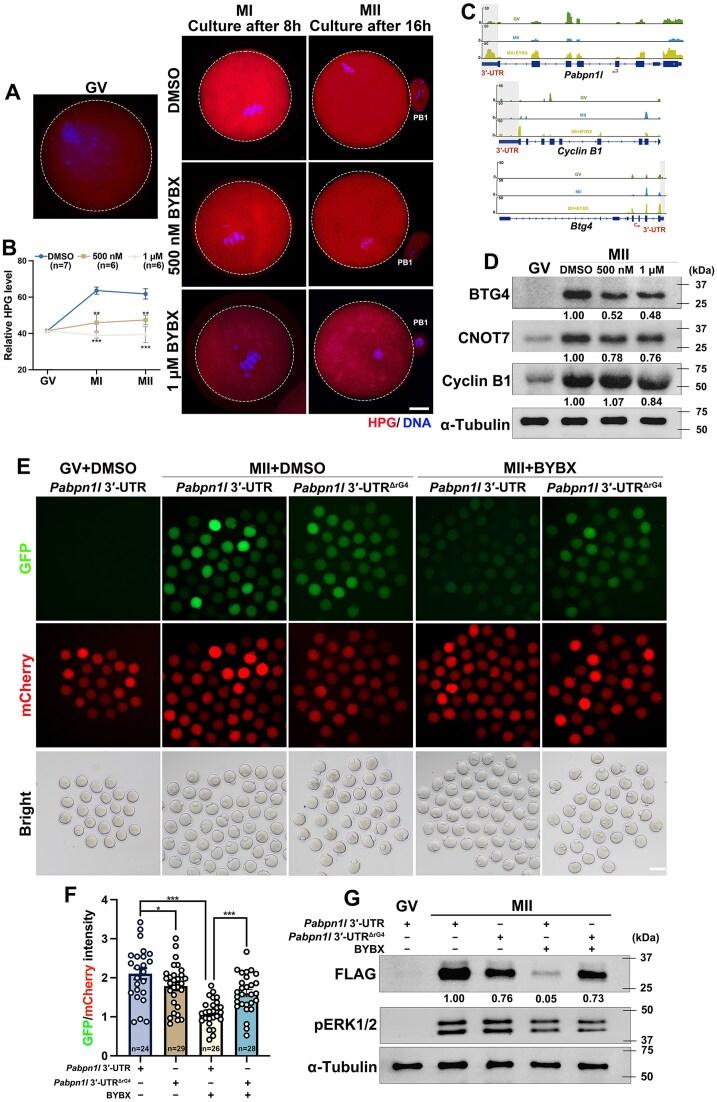
Oocyte maturation-coupled mRNA post-transcriptional regulation is essential for the establishment of developmental potential. Previously, oocyte mRNA translation efficiencies focused on the trans-regulation of key RNA-binding protein (RBPs), rarely related to RNA structure. RNA G-quadruplexes (rG4s) are four-stranded RNA secondary structures involved in many different aspects of RNA metabolism. In this study, we have developed a low-input technique for rG4 detection (G4-LACE-seq) in mouse oocytes and found that rG4s were widely distributed in maternal transcripts, with enrichment in untranslated regions, and they underwent transcriptome-wide removal during meiotic maturation. The rG4-selective small-molecule ligand BYBX stabilized rG4s in the oocyte transcriptome and impaired spindle assembly and meiotic cell cycle progression. The proteomic spectrum results revealed that rG4 accumulation weakened the binding of a large number of RBPs to mRNAs, especially those associated with translational initiation. Ribosomal immunoprecipitation and translational reporter assays further proved that rG4s in the untranslated regions negatively affected the translational efficiency of key maternal mRNAs. Overexpression DEAH/RHA family helicase-36 partially reverses BYBX-induced oocyte developmental defects, suggesting its importance in rG4 regulation. Collectively, this study describes the distribution, dynamic changes, and regulation of rG4s in the mouse maternal transcriptome. Before meiosis resumption, a large number of rG4s in oocytes are necessary to maintain the translatome at a low level, and DHX36-mediated rG4 removal promotes a translational switch and is required for successful maternal-to-zygotic transition.
卵母细胞成熟耦合的mRNA转录后调控对于发育潜能的建立至关重要。此前,卵母细胞mRNA翻译效率主要关注关键RNA结合蛋白(RBPs)的反式调控,很少涉及RNA结构。RNA G-四链体(rG4s)是参与RNA代谢多个不同方面的四链RNA二级结构。在本研究中,我们开发了一种用于小鼠卵母细胞rG4检测的低输入技术(G4-LACE-seq),发现rG4s广泛分布于母源转录本中,在非翻译区富集,并且在减数分裂成熟过程中经历全转录组范围的去除。rG4选择性小分子配体BYBX使卵母细胞转录组中的rG4s稳定,并损害纺锤体组装和减数分裂细胞周期进程。蛋白质组谱结果显示,rG4积累削弱了大量RBPs与mRNA的结合,尤其是那些与翻译起始相关的RBPs。核糖体免疫沉淀和翻译报告基因分析进一步证明,非翻译区的rG4s对关键母源mRNA的翻译效率产生负面影响。过表达DEAH/RHA家族解旋酶-36部分逆转了BYBX诱导的卵母细胞发育缺陷,表明其在rG4调控中的重要性。总体而言,本研究描述了小鼠母源转录组中rG4s的分布、动态变化及调控。在减数分裂恢复之前,卵母细胞中的大量rG4s对于维持翻译组处于低水平是必要的,而DHX36介导的rG4去除促进翻译转换,并且是母源-合子成功转变所必需的。





 Zotero 插件