Mayer Anja, Hege Inga, Kononowicz Andrzej A, Müller Anja, Sudacka Małgorzata
Medical Education Sciences, University of Augsburg, Augsburg, Germany.
Institute for Research in Health Science Education, Brandenburg Medical School Theodor Fontane, Neuruppin, Germany.
JMIR Med Educ. 2025 Jan 30;11:e57331. doi: 10.2196/57331.
Concept maps are a suitable method for teaching clinical reasoning (CR). For example, in a concept map, findings, tests, differential diagnoses, and treatment options can be documented and connected to each other. When combined with virtual patients, automated feedback can be provided to the students' concept maps. However, as CR is a nonlinear process, feedback concept maps that are created together by several individuals might address this issue and cover perspectives from different health professionals.
In this study, we aimed to develop a collaborative process for creating feedback concept maps in virtual patient-based CR education.
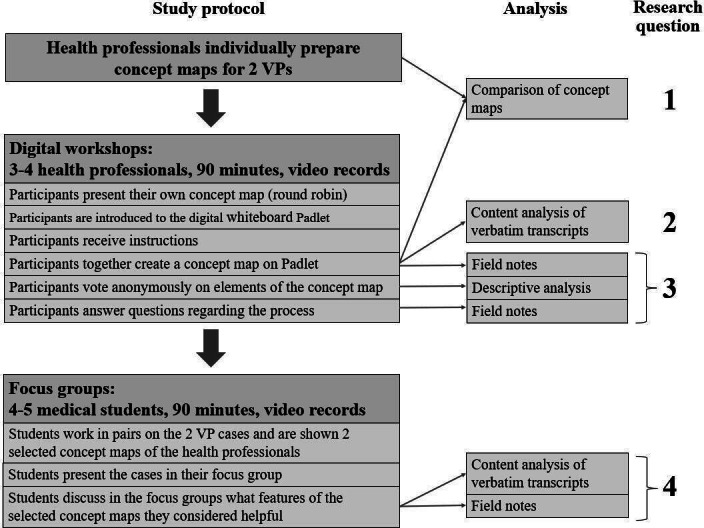
Health professionals of different specialties, nationalities, and levels of experience in education individually created concept maps and afterward reached a consensus on them in structured workshops. Then, medical students discussed the health professionals' concept maps in focus groups. We performed a qualitative content analysis of the transcribed audio records and field notes and a descriptive comparison of the produced concept maps.
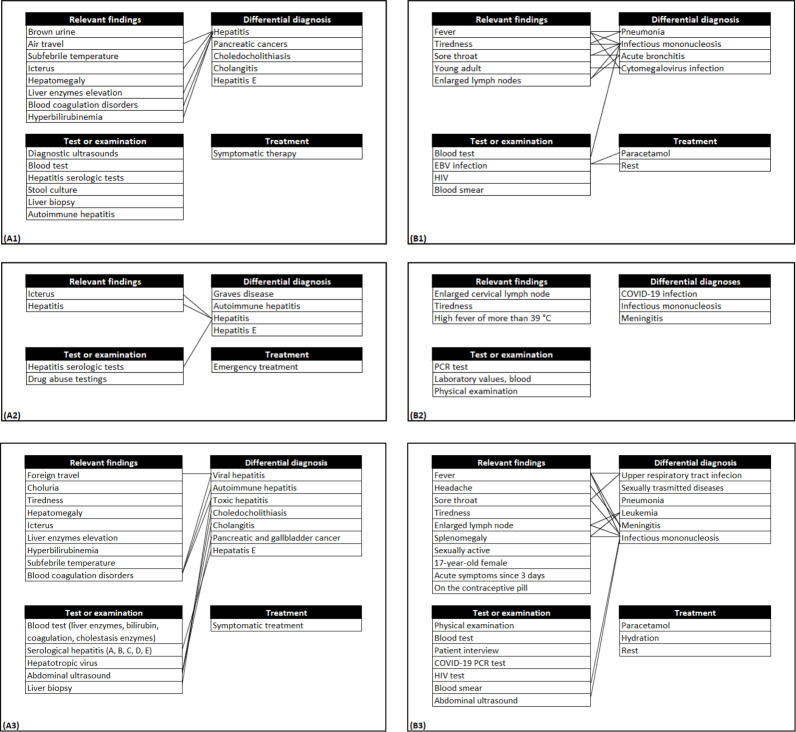
A total of 14 health professionals participated in 4 workshops, each with 3-4 participants. In each workshop, they reached a consensus on 1 concept map, after discussing content and presentation, as well as rationales, and next steps. Overall, the structure of the workshops was well-received. The comparison of the produced concept maps showed that they varied widely in their scope and content. Consensus concept maps tended to contain more nodes and connections than individual ones. A total of 9 medical students participated in 2 focus groups of 4 and 5 participants. Their opinions on the concept maps' features varied widely, balancing between the wish for an in-depth explanation and the flexibility of CR.
Although the number of participating health professionals and students was relatively low, we were able to show that consensus workshops are a constructive method to create feedback concept maps that include different perspectives of health professionals with content that is useful to and accepted by students. Further research is needed to determine which features of feedback concept maps are most likely to improve learner outcomes and how to facilitate their construction in collaborative consensus workshops.
概念图是一种适用于临床推理(CR)教学的方法。例如,在概念图中,可以记录发现、检查、鉴别诊断和治疗方案,并将它们相互关联。当与虚拟患者相结合时,可以为学生的概念图提供自动反馈。然而,由于临床推理是一个非线性过程,由多个人共同创建的反馈概念图可能会解决这个问题,并涵盖不同健康专业人员的观点。
在本研究中,我们旨在开发一种协作过程,用于在基于虚拟患者的临床推理教育中创建反馈概念图。
不同专业、国籍和教育经验水平的健康专业人员分别创建概念图,然后在结构化研讨会上就这些概念图达成共识。然后,医学生在焦点小组中讨论健康专业人员的概念图。我们对转录的音频记录和现场笔记进行了定性内容分析,并对生成的概念图进行了描述性比较。
共有14名健康专业人员参加了4次研讨会,每次研讨会有3 - 4名参与者。在每次研讨会上,他们在讨论了内容、呈现方式、基本原理和下一步措施后,就1个概念图达成了共识。总体而言,研讨会的结构受到好评。对生成的概念图的比较表明,它们在范围和内容上差异很大。共识概念图往往比个人概念图包含更多的节点和连接。共有9名医学生参加了2个焦点小组,每个小组有4名和5名参与者。他们对概念图特征的看法差异很大,在希望获得深入解释和临床推理灵活性之间取得平衡。
尽管参与的健康专业人员和学生数量相对较少,但我们能够表明,共识研讨会是创建反馈概念图的一种建设性方法,这些概念图包含健康专业人员的不同观点,其内容对学生有用且被学生接受。需要进一步研究以确定反馈概念图的哪些特征最有可能改善学习者的学习成果,以及如何在协作共识研讨会上促进其构建。