Postgraduate Clinical Training Center, Shimane University Hospital, 89-1, Enya-cho, Izumo shi Shimane 693-8501, Japan.
Okinawa Muribushi Project for Teaching Hospitals, Okinawa 901-2132, Japan.
Int J Environ Res Public Health. 2020 Jul 24;17(15):5325. doi: 10.3390/ijerph17155325.
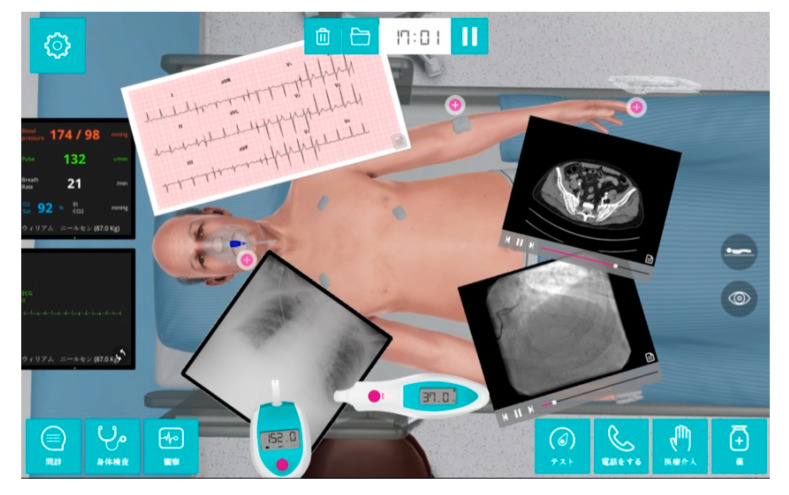
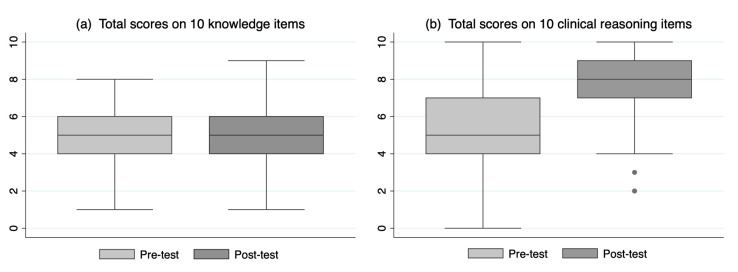
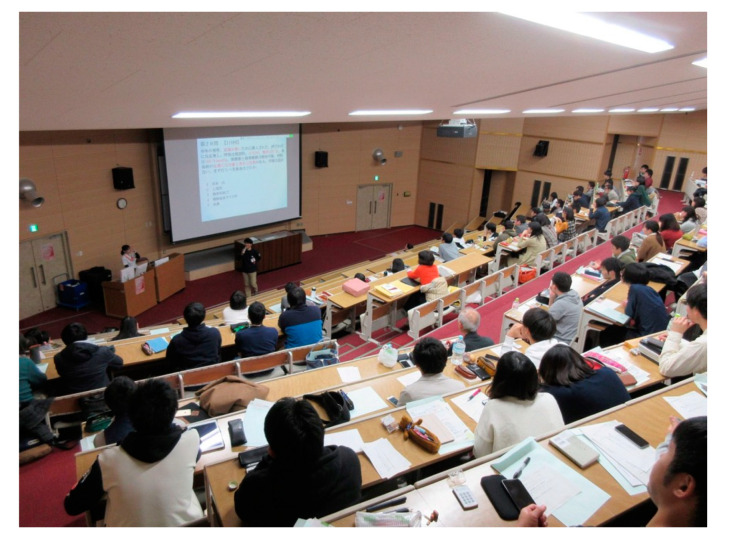
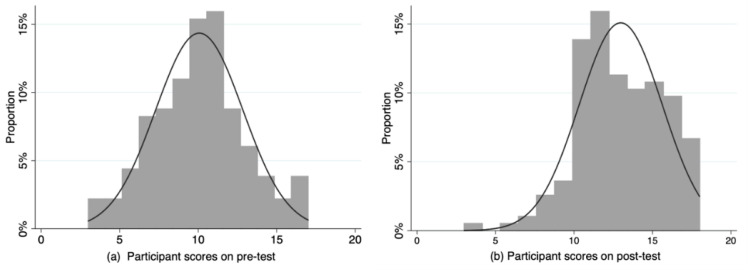
Virtual Patient Simulations (VPSs) have been cited as a novel learning strategy, but there is little evidence that VPSs yield improvements in clinical reasoning skills and medical knowledge. This study aimed to clarify the effectiveness of VPSs for improving clinical reasoning skills among medical students, and to compare improvements in knowledge or clinical reasoning skills relevant to specific clinical scenarios. We enrolled 210 fourth-year medical students in March 2017 and March 2018 to participate in a real-time pre-post experimental design conducted in a large lecture hall by using a clicker. A VPS program (Body Interact, Portugal) was implemented for one two-hour class session using the same methodology during both years. A pre-post 20-item multiple-choice questionnaire (10 knowledge and 10 clinical reasoning items) was used to evaluate learning outcomes. A total of 169 students completed the program. Participants showed significant increases in average total post-test scores, both on knowledge items (pre-test: median = 5, mean = 4.78, 95% CI (4.55-5.01); post-test: median = 5, mean = 5.12, 95% CI (4.90-5.43); -value = 0.003) and clinical reasoning items (pre-test: median = 5, mean = 5.3 95%, CI (4.98-5.58); post-test: median = 8, mean = 7.81, 95% CI (7.57-8.05); -value < 0.001). Thus, VPS programs could help medical students improve their clinical decision-making skills without lecturer supervision.
虚拟患者模拟 (VPS) 已被认为是一种新颖的学习策略,但几乎没有证据表明 VPS 能提高临床推理技能和医学知识。本研究旨在阐明 VPS 对提高医学生临床推理技能的有效性,并比较与特定临床情景相关的知识或临床推理技能的提高。我们于 2017 年 3 月和 2018 年 3 月招募了 210 名四年级医学生,参加在一个大演讲厅进行的实时前后实验设计,使用点击器。在这两年中,使用相同的方法,使用 VPS 程序(葡萄牙 Body Interact)进行了一个两小时的课程。使用前后 20 项多项选择题问卷(10 项知识和 10 项临床推理项目)评估学习成果。共有 169 名学生完成了该计划。参与者的平均总分后测成绩显著提高,无论是在知识项目上(前测:中位数=5,平均值=4.78,95%置信区间[4.55-5.01];后测:中位数=5,平均值=5.12,95%置信区间[4.90-5.43];-值=0.003)还是临床推理项目上(前测:中位数=5,平均值=5.395%置信区间[4.98-5.58];后测:中位数=8,平均值=7.81,95%置信区间[7.57-8.05];-值<0.001)。因此,VPS 计划可以帮助医学生提高他们的临床决策技能,而无需讲师监督。