Müller-Nordhorn Jacqueline, Hakimhashemi Amir, Willich Stefan N, Binting Sylvia, Keil Thomas
Institute of Social Medicine, Epidemiology and Health Economics, Charité - Universitätsmedizin Berlin, Luisenstr. 57, 10117, Berlin, Germany.
Bavarian Cancer Registry, Bavarian Health and Food Safety Authority, Schweinauer Hauptstr. 80, 90441, Nuremberg, Germany.
BMC Pediatr. 2025 Jan 30;25(1):79. doi: 10.1186/s12887-025-05429-7.
Infections may play a role in the etiology of sudden infant death syndrome (SIDS), with Bordetella pertussis being a potential agent. The objective was to analyze the association of SIDS and infant pertussis hospitalization rates over time, comparing a previously unvaccinated population (West Germany) versus a predominantly vaccinated population (East Germany).
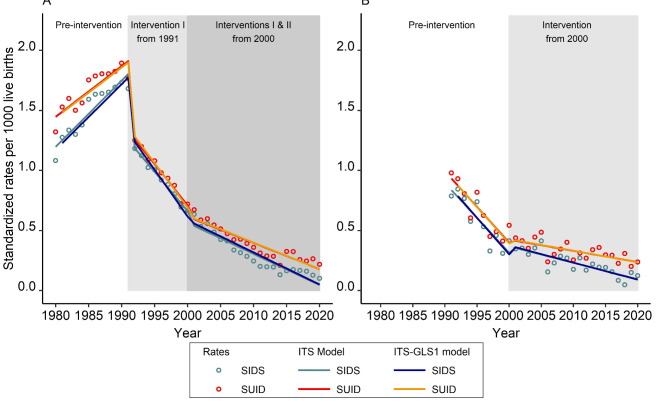
We calculated SIDS rates per 1000 live births per state. Live births and SIDS were available from 1980 onwards for the West German states and from 1991 onwards for the East German states. We applied interrupted time series (ITS) analyses to investigate the role of two public health interventions in 1991 (West Germany) and in 2000 (West and East Germany), respectively. Infant pertussis hospitalizations were available for five West German and three East German states between 1994 and 2019. We used multilayer and multivariate correlation analyses to determine the correlation between SIDS and pertussis hospitalization rates, including Pearson correlation test and vector autoregressive (VAR) analysis.
In West Germany, the average annual SIDS rate (per 1000 live births) increased from 1.08 in 1980 to 1.68 in 1991, before declining to 1.18 in 1992 and subsequently to 0.10 in 2020. In East Germany, the average annual SIDS rate (per 1000 live births) decreased from 0.79 in 1991 to 0.12 in 2020. The results of the ITS model indicated a significant change in both level and slope at the 1991 interventions (West Germany) and in slope at the 2000 interventions (West and East Germany). The correlation coefficients between SIDS and infant pertussis hospitalization rates were 0.69 (95% CI [confidence interval] 0.41, 0.85; p < 0.001) in West Germany, and 0.41 (95% CI 0.03, 0.69; p = 0.037) in East Germany. The correlation decreased during later periods (2000-2019, 2010-2019), particularly in East Germany. The results of the VAR analysis corroborated the findings of the main analyses.
SIDS and infant pertussis hospitalization rates were correlated in both West and East Germany. Further studies - including improved diagnostic assessment of pertussis - seem warranted.
Not applicable.
感染可能在婴儿猝死综合征(SIDS)的病因中起作用,百日咳博德特氏菌是一种潜在病原体。目的是分析SIDS与婴儿百日咳住院率随时间的关联,比较以前未接种疫苗的人群(西德)和主要接种疫苗的人群(东德)。
我们计算了每个州每1000例活产的SIDS发生率。西德各州从1980年起可获得活产数和SIDS数据,东德各州从1991年起可获得这些数据。我们应用中断时间序列(ITS)分析来分别研究1991年(西德)和2000年(西德和东德)两项公共卫生干预措施的作用。1994年至2019年期间,可获得五个西德州和三个东德州的婴儿百日咳住院数据。我们使用多层和多变量相关分析来确定SIDS与百日咳住院率之间的相关性,包括Pearson相关检验和向量自回归(VAR)分析。
在西德,年平均SIDS发生率(每1000例活产)从1980年的1.08上升至1991年的1.68,随后在1992年降至1.18,2020年降至0.10。在东德,年平均SIDS发生率(每1000例活产)从1991年的0.79降至2020年的0.12。ITS模型的结果表明,1991年干预措施(西德)在水平和斜率上均有显著变化,2000年干预措施(西德和东德)在斜率上有显著变化。西德SIDS与婴儿百日咳住院率之间的相关系数为0.69(95%可信区间[CI] 0.41,0.85;p<0.001),东德为0.41(95%CI 0.03,0.69;p=0.037)。在后期(2000 - 2019年、2010 - 2019年)相关性下降,尤其是在东德。VAR分析的结果证实了主要分析的结果。
西德和东德的SIDS与婴儿百日咳住院率均相关。似乎有必要进行进一步研究,包括改进百日咳的诊断评估。
不适用。