Lampert Thomas, Müters Stephan, Kuntz Benjamin, Dahm Stefan, Nowossadeck Enno
Robert Koch Institute, Berlin Department of Epidemiology and Health Monitoring.
J Health Monit. 2019 Nov 1;4(Suppl 2):2-23. doi: 10.25646/6077. eCollection 2019 Nov.
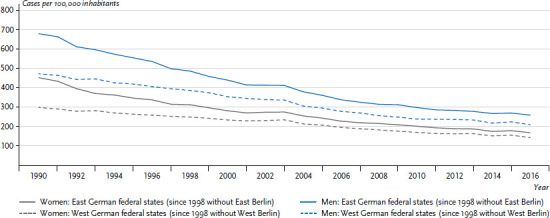
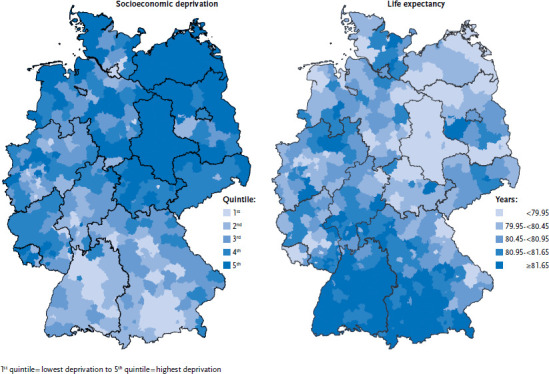
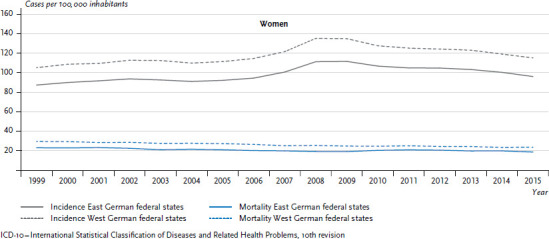
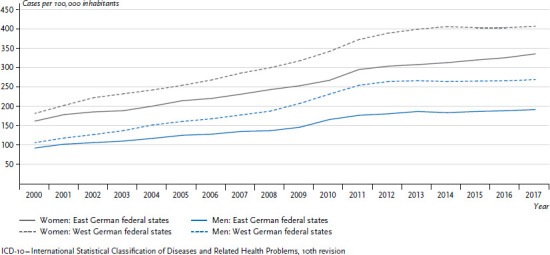
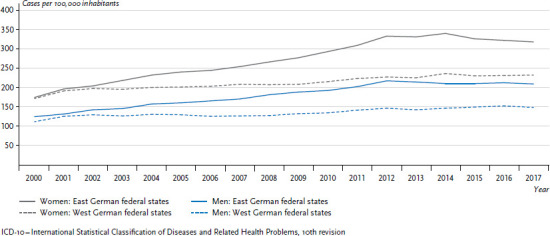
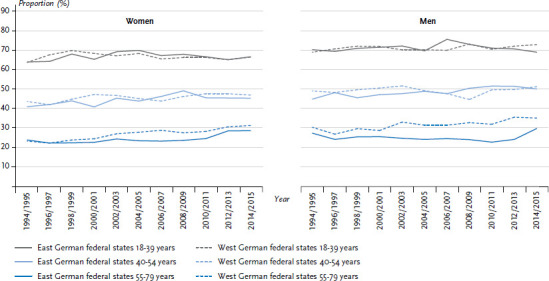
Following the fall of the Berlin Wall in November 1989, considerable effort was made to bring the living conditions and levels of social participation in the former East German federal states into line with the former West German federal states. As a result, differences in health between the East and the West diminished significantly, in many cases as early as the 1990s, examples being life expectancy and cardiovascular mortality. In regard to health behaviour, the overall tendency has also clearly been one of convergence. Thus, only very small differences can be observed today, for example in the use of tobacco or in the prevalence of obesity. Yet the results also highlight the insufficiency of regarding the remaining differences as a simple comparison between East and West. Instead, the focus should shift towards smaller-scale approaches that take regional differences in living conditions into account.
1989年11月柏林墙倒塌后,人们付出了巨大努力,以使前东德联邦州的生活条件和社会参与水平与前西德联邦州保持一致。结果,东西部之间的健康差异显著缩小,在许多情况下,早在20世纪90年代就已如此,预期寿命和心血管疾病死亡率就是例证。在健康行为方面,总体趋势也明显趋于一致。因此,如今只能观察到非常小的差异,例如在烟草使用或肥胖患病率方面。然而,这些结果也凸显了将剩余差异简单视为东西方之间比较的不足之处。相反,应将重点转向考虑生活条件区域差异的小规模方法。